I spent time at the Woodward Dream Cruise this week in my brother Charlie’s 1985 Ford Mustang convertible (his first new car which he bought and has maintained since that year). I think the Cruise is the largest annual assemblage of classic cars on the planet. What a great time for anyone who enjoys historical vehicles and the memories they bring back, especially here in the Motor City.
During the festivities, Chrysler Corporation (I just can’t say Fiat Chrysler) took the opportunity to introduce its newest car color – Plum Crazy. Purple, a color USA Today called “the black sheep of car hues” is destined to be the new performance car shade for the Dodge Challengers and Chargers.
Interestingly, USA Today further reports that the color has been brought back as a “heritage” color. Actually purple performance cars have been around since 1970 (I saw plenty of them at the Cruise), but it had been in disuse for a few years. While I have never been fond of purple as a car color, I realize that one man’s trash is another man’s treasure.
In a similar vein, while I’m not a fan of purple cars, my favorite flower is a reddish purple, and it’s now in bloom. Yet most people consider the Fireweed just what its name implies … a weed, not a flower.
However, once you’ve seen, as I have, the plains and foothills of Alaska covered with a veritable carpet of Fireweed as far as the eye can see, and every nook and cranny of light in the forests filled with them, I think you’ll agree with me.
Still, my lawn service hates them. I live on one of the thousands of lakes in Michigan and the flower/weed loves to grow in the soggy marshland that borders our lake. There, tucked in among the tall cattails, the plant thrives. The service is forever offering to eradicate them. I say don’t you dare – one man’s weed is another man’s flower.
When the Chinese government lowered the Yuan this week, the markets were in turmoil. For some, the move was a boon – those investors in the Chinese market saw reason to celebrate and Chinese stock prices (after having experienced a more-than-25% drop this year) began to rally. The lower Yuan was expected to improve the ability of the Chinese manufacturers to sell their wares.
Just across the Chinese borders, in most of the emerging market countries of Southeast Asia, the Chinese government’s move was viewed with alarm. Their advantage in currency was diminished and they feared that their manufacturers would suffer. Their stock markets tumbled.
Here, in the US, investors seemed to alternatively opt for both reactions. In the first day and a half after the news, US stocks fell dramatically. The Dow tumbled about 500 points in that time span! No doubt US investors felt, as the emerging market countries did, that a falling Yuan would hurt the economy due to the new attractive pricing of Chinese goods.
Then on Wednesday at 10:20 AM EST everyone changed their minds: Three consecutive days of gains ensued.
Suddenly, as Marc Faber, author of Gloom, Doom and Boom, expressed it, investors realized that the Chinese move was “meaningless” to the US markets. Times are not the same as when the artificially low Yuan was stealing manufacturing jobs from the US.
Instead, for years, the Yuan has appreciated against the US Dollar. And the US Dollar, in turn, has appreciated against every other currency. In just the last couple of years, the Yuan has increased by more than 80% against the Japanese Yen. This move amounted to just more than a 3% lowering in value against the dollar.
The US has been the beneficiary of years of artificial stimulation by the Federal Reserve. Its economy is growing. While it is hard to tell what is really happening in China, the government claims 7% growth, while Faber estimates a shocking 0%!
At 10:20 on Wednesday, the US investor started to value this disparity; the progress we have made here with a growing economy and new highs being set by our stock market indexes versus the slump that the Chinese economy and stock market have been experiencing.
Some of the market experts suddenly switched sides on whether the expansionary support of the Federal Reserve was really coming to an end. Some even went so far as to say, as I have been saying for over a year, that it may be 2016 before a Fed rate hike actually materializes.
Realize what the Fed is up against. At the moment, the US economy can at best be characterized as low growth. It certainly is not booming. While we are in a very long economic expansion, it has been a very limited one.
Actual unemployment rates (part timers who want to work and those outside the labor force who want to return) is still estimated to be in double-digit numbers. Inflation measures are still indicating very low rates.
These are not the type of economic conditions in which the Federal Reserve has normally raised rates! Normally, it is just the opposite.
Now add in the Yuan-induced increase in the dollar cost of goods. This comes after one of our greatest dollar rallies of the last ten years. The dollar has already appreciated against everything except the Yuan. Now it too has been devalued against the dollar.
One of the chief reasons for dollar appreciation in past bull cycles has been an increase in interest rates. This is pretty much the way it is around the world. The countries seeing the greatest appreciation in interest rates often see the greatest appreciation of the purchasing power (the value) of their currency.
If the Fed moves our interest rates higher, expect our dollar to become dearer, our goods overseas pricier, and our manufacturing and exports lower. This is not an outcome the Fed should want to see at the present time. They are looking to sustain the expansion not terminate it.
Yet, they find themselves out of bullets to lower rates to combat some future financial crisis. Some feel that the only way they can reload is to move rates higher.
One man’s poison is another man’s cure.
All the best,
Jerry
PS There has been no change in our positive view of the stock market. While interest rates increased a tiny bit in the market last week, positive earnings and revenue surprises outdid last quarter’s numbers, positive economic surprises outnumbered negative ones, bullish sentiment remains low, and seasonality is positive in the short term.
The market remains locked in a trading range, but the intermediate- and long-term trend of most stock indexes remains positive. It still all looks good to me but one man’s fertilizer is another man’s…
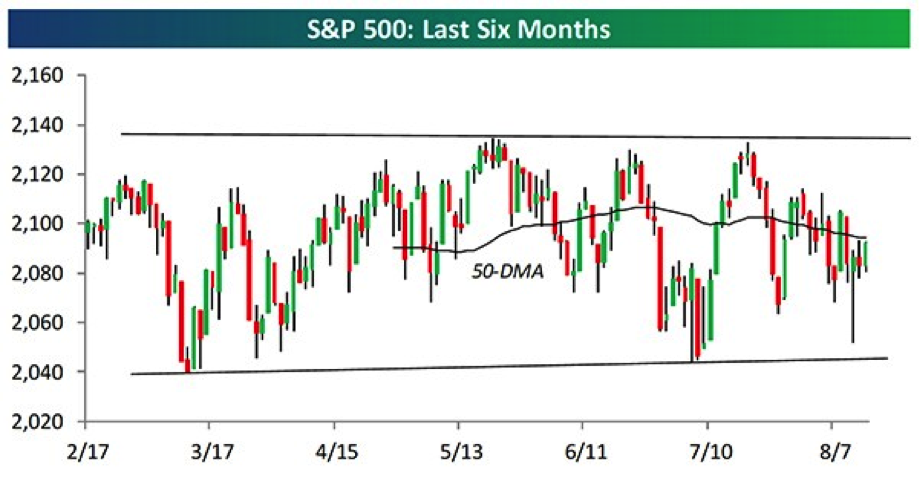
Source: Bespoke Investment Group
http://www.flexibleplan.com/market-hotline/disclosures