Investing Without a Goal is Like Racing Without a Finish Line.
But in investing, what is the finish line?
Monday witnessed the 99th running of the Indy 500 car race. The winner was Juan Pablo Montoya. He finished the race in 3 hours, 5 minutes and 56 seconds at an average speed over the 200 laps of 161.341 miles per hour.
How do we know Montoya won? Simple, we saw him cross the finish line first!
Most races have finish lines, the crossing of which allows us to declare the winner of the race. There are ultra-running marathon events with no “finish line” that simply try to go the farthest in a time period. But even there, isn’t the time period really the “finish line”?
In investing, there is no actual finish line, unless you subscribe to the old line that, “He who dies with the most money wins.” But investing, like most activities in life, is improved by having goals.
It is said (although I cannot find a source for the quote) that “Life without goals is like a race without a finish line – you’re just running to nowhere.”
Goals focus our activities. As Yogi Berra said, “If you don't know where you are going, you'll end up someplace else.”
When we are focused on a goal, we tend to perform better. In a 1986 experiment, psychology researcher Dr. Michel Cabanac asked subjects to sit with their backs against a wall (without a chair) while he timed how long they could endure that position, he offered them an increasingly higher money reward each time they were asked to do the experiment.
As the chart from his paper demonstrates, when the goal was small or non-existent, they did not last very long, but as the goal became more significant, they were able to endure the position much longer.
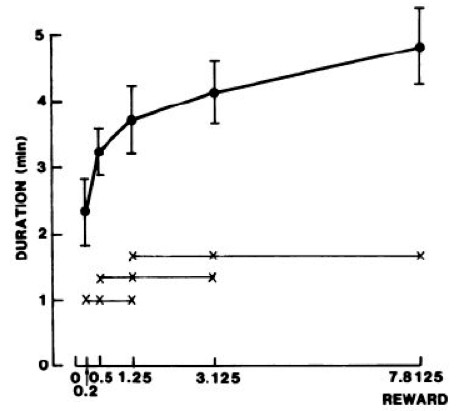
Here's a graph from a classic study by French researcher Michel Cabanac, published in 1986 in the Journal of the Experimental Analysis of Behavior.
So if having a goal improves results, what should an investor’s goal be? For over 30 years I have begun presentations by explaining that investing is not some abstract concept or hobby for most people.
Investors invest for a reason, usually to reach some goal. That goal can be like a race to a finish line – financing a college education, or buying a house, for example. Or it can be like an ultra-running marathon race where it involves trying to survive for the time limit of the race – like funding retirement, where you don’t want your investment dollars to run out before you do.
I would submit that how one measures progress toward a goal can depend on which type of “race” you are in – one with a finish line or one without.
In the former, like the runner who is watching the mile posts go by and feels the necessity to speed up as he approaches the finish line, the need to reach that short-term goal of a college education or home down payment is likely to cause the investor to watch the shorter-term performance of the investment more closely and adjust as one gets closer to their goal. As songster Jimmy Dean once said, “I can’t change the direction of the wind, but I can adjust my sails to always reach my destination.”
In the latter type of “finish line,” it is more important to keep your eye on the prize – the end result that will allow you to support yourself throughout your retirement years. Similarly, if you are already in retirement, your primary concern is preservation of your portfolio dollars and keeping ahead of inflation so that your standard of living is not adversely impacted.
Flexible Plan provides a number of tools with a goal of enabling its clients to monitor their progress and win the race. Our dynamic, risk-management investment approach seeks to smooth out your investment experience so that you reach your own financial goals.
And our OnTarget Monitor lets you know each quarter how you are doing in reaching your goal. We do not do this by referencing some arbitrary benchmark with risk characteristics you could not endure (like the S&P 500), but instead, we report on your progress in reaching the goal set for your portfolio when you initially set up your account or chose the strategy you are now employing.
As master organizer Stephen Covey says, “Begin with the end in mind.”
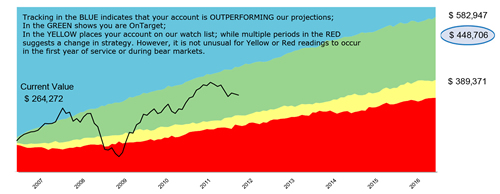
Source: Flexible Plan Investments
In this week’s Indy 500, there were 37 lead changes. The winner led the race for only 9 out of the 200 laps. He took the lead for good in the 197th lap. What mattered was that by the race’s end he had achieved his goal – crossing the finish line first and winning the race.
All the best,
Jerry
PS—With regard to the present state of the markets, there is no change in our view of either the stock or bond market. The primary trend in stocks remains up, as we have been reporting for years now. While the mixed signals being given by earnings (neutral), economic reports (negative), interest rate trends (negative), sentiment (positive), and seasonality (positive) continue to offset each other and leave open the possibility of a mild correction, there has been no break in the short or immediate upward trend for stocks. In fact, an all-time high was registered in the S&P 500 just last week.
With bullish sentiment among stock investors declining for the fifth straight week and below average for the 12th straight week, it is surprising to realize that as of Friday’s close, the S&P 500 is up over 3.5%, which is better than its 2.82% YTD return at this point last year.
Most of the negative investor expectations seem to be based on fears of overvaluation based on many market gurus’ bearish citing of the current levels of price/earnings ratios in the market. Yet, while it is true that stocks are no longer the bargains they were at the market lows in 2009, historically they can go much higher than the current levels before a new bear market is called for on this indicator.
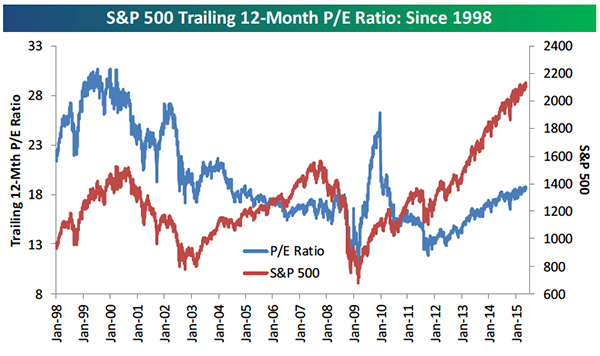
Source: Bespoke Investment Group
Bond prices continue in a sideways to downward trajectory. Our earlier guess that economics might not allow the Fed to move rates higher until next year has found support from the Fed Funds futures crowd, who now price Fed rates for a January, 2016 advance.
I continue to believe that the only reason for an increase in rates earlier (baring a substantial improvement in business conditions and/or an increase in inflation, especially in wages) is the need for the Fed to reload its tools for the next recession. That means getting out of the present zero rate environment as soon as possible. In any event, what the bond market is saying about interest rates is much more important than the Fed actions at this point. It seems to be saying rates will move higher and bonds will continue to tumble in price.