New Year’s Eve is all about partying for a large percentage of the world’s population, but it has a different meaning to me. Don’t get me wrong. I’ve gone to my share of NYE parties, including doing the Times Square thing in 2000 (highly recommended!). But over the years I’ve shifted away from celebrating that way.
No, it’s not the parties that impress me on New Year’s Eve; it’s the hour-by-hour progression of the celebration, starting at the International Dateline somewhere east of New Zealand. As midnight is reached around the world, the crowds roar and the fireworks explode. An hour later it repeats - Auckland, Sydney, Tokyo, Bombay, Moscow, Berlin, Paris, London, New York, LA and finally Honolulu.
As I watch the collage of celebrations on TV, what impresses me isn’t the fireworks or the spectacular shots of the celebrations in so many distant lands. Instead, it’s the knowledge that as midnight draws near, in every language on Earth, folks just like us are counting down the seconds in unison. For those ten seconds and maybe a few seconds more, the people in each time zone are truly living in the moment.
Why’s that important? Since the beginning of recorded history, living in the moment has been valued. In Buddhism it’s said that “being mindful of the present is the key to happiness.” And according to Mathew 6:34, Christ said "So do not worry about tomorrow; for tomorrow will care for itself.
The Romans had their “Carpe Diem,” as they taught their young to “Seize the Day.” Our own David Thoreau counseled “Live in the present, launch yourself on every wave, find eternity in each moment.” His contemporary historian and author, Alice Morse Earle, wrote: “The clock is running. Make the most of today. Time waits for no man. Yesterday is history. Tomorrow is a mystery. Today is a gift. That's why it is called The Present.”
Recent studies have confirmed that we are happiest, not when our mind is wondering, contemplating the past or future, but rather when it is focused on the moment.
(See a short Ted Talk by Dr. Matt Killingsworth on the subject http://on.ted.com/Killingsworth)
I must say that while I agree with all this, I’ve lived my life very differently. I’ve tried to balance my life with a healthy regard for the lessons of the past, have always planned for the future, and tried to make the most of the opportunities of the present. Yet as I watched midnight occur across the globe this year, I realized that one of my life-long passions was indeed governed by the philosophy of living in the moment.
Active management is all about living in the moment. While it also draws upon history for the basis of each active strategy, it is continually focused on what is happening now. Active management strategies cannot see into the future, they can only seek to realize what the present provides. They are based on the probability of favorable outcomes, and seek each day to profit from them.
Buy and hold investing does not have much relationship to the here and now. You buy and wait. You invest and hope. Rather than seeking to profit from what’s happening in the present, buy and hold investing considers the present – the moment – irrelevant.
Yet we know from experience that even if active strategies do not return more to investors over a given period, what happens each day is relevant to even the buy and hold investor. Every financial market goes through peaks and valleys. Investors get euphoric and they also get despondent.
When stock prices fall day after day, when the percentage of the daily decline moves from decimals to single and then to double digits, even the most ardent of buy and hold investors has had second thoughts. Many have abandoned the approach, and their investments, at the very worst time – near the bottom. They begin to live in the moment and it becomes very relevant.
With the market tumbling today, it’s easy to understand the fear. Fear comes from our past, but it can influence our actions in the present and our plans for the future. It clouds our judgment.
But we can use the power of computers to test active strategies in advance. And we can use them to track and carry out high probability trades in the present. Fear does not enter the picture or cloud their view of the present.
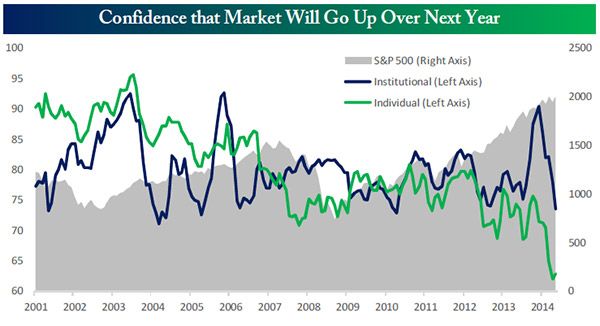
Right now there are reasons to be cautious. Interest rates are up from last summer, the Fed is threatening action to raise rates, housing and manufacturing numbers have slumped from last year, investors have an above-average level of optimism, and valuations are on the high end of the scale. Commodities in general have fallen steeply in price and oil prices have collapsed.
Yet for each of these issues there is a counter argument. Interest rates have been falling lately. Many believe, as I do, that the odds favor a delay in the Fed tightening of rates. Consumption, sales, inflation and employment reports are all positive, and many surveys confirm that most investors still are not on board with this bull market. Gold has been the best of the commodities this last year and today rose in price, while oil’s decline has boosted the bottom line of consumers and most businesses around the world.
Yale School of Management
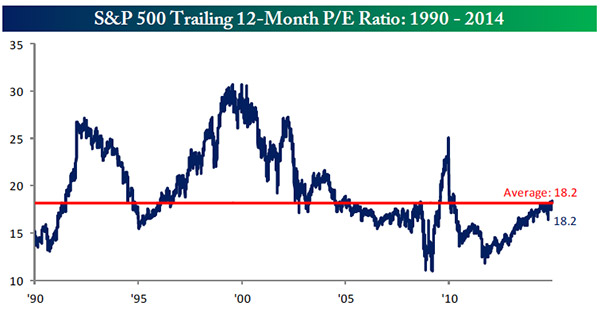
And sure, valuation is not great, but we just touched new all-time highs on most US stock indexes a mere week ago. While stocks are no longer undervalued, it is noteworthy that Price Earnings ratios (the generally accepted measure of valuation) are about the same today as they were a year ago, even though the S&P 500 grew by over 10% in 2014. Why? Because earnings have been growing at similar double-digit rates, keeping P/E multiples in check.
Bespoke Investment Group
Yes, stocks are over bought. They will likely come down in the short run. Just as we saw periodically last year, corrections will come and go, but there is no evidence that the bull market is over as yet. The primary trend remains positive and most indicators are still pointing to higher prices in the intermediate term.
January is usually a month of advancing stock prices. Yet last year the S&P 500 fell by more than 4% in January. Still, that index finished the year up over 10%, and over 15% from where it ended last January.
History shows that when the market is in a strong uptrend, it does not pay to try to time the short-term trends. It is a time when taking some short-term pain can be profitable in the intermediate term.
Living in the present may promote happiness, but it does not guarantee it in the short term. Responsiveness is an advantage that active management has over the buy and hold approach in most markets, but when a bull market is identified, it usually pays to give the primary trend the benefit of the doubt until proven otherwise.
Finally, investors utilizing active strategies for the first time have got to shrug off the buy and hold mindset. I know you have seen your buy and hold investments in the past rise to new heights and then be dashed when a major bear market arrives on the scene. And in the past you have had to simply hold and hope for a recovery.
But as active investors know, each strategy has high probability trading parameters that can move your investments to safety when the historically tested sell parameters are met, rather than when fear is at a maximum. It’s all about living in the present and not fearing the actions of the past or worrying about the future.
All the best and Happy New Year,
Jerry
http://www.flexibleplan.com/market-hotline/disclosures