The Coming Crash in 2015: Why there will be no Happy New Year before we see QE Reloaded
by Franz Lischka,
In September 2013 in my post How QE Alters Bond Yields (Or Rather How It Does Not) I wrote that historically the end of QE was associated with the following 4 events, which I expected to show up again after the end of the latest QE-programs (which in some cases was completely against the market consensus of that time):
1) Falling inflation expectations
2) As a result: falling Treasury yields (what basically no one believed at that time)
3) Rising credit spreads
4) A falling stock market
Now almost 2 months after the end of QE I thought it was time to look back on what has happened so far (the first 3 prediction were quite spot-on) and what it means for the part that has not yet happened (the 4th prediction).
Let’s get through it step by step.
1) Inflation expectations: They completely crashed. While everyone blames it on the oil crash, it is exactly the same pattern as the last 2 times.

2) Treasury Yields: Against an overwhelming consensus (what was suspicious anyway) Treasury yields fell, when the Fed reduced its purchases

This was something that most people got wrong. Here is a short run-down why: Most expected that when the Fed would stop its purchases, demand would therefore fall and yields would have to rise. Now what was wrong with that assumption was that the Fed, though the largest holder of Treasuries, does not yet control the market (as perhaps the BoJ does in the JGB market), nor is it just a marginal buyer that does not influence the behavior of all other participants. Just the opposite: The Fed vastly influences expectations of all other bond buyers. The Fed buying Treasuries increases the money supply which increases inflation expectations, which increases the expected path of future Fed Funds rates. And this is the main point: The long-end of the Treasury yield curve is basically nothing else than the average expected Fed Funds Rate over the lifespan of the bond (plus a small term premium, but this is in comparison a minor issue), no matter what the Fed is buying or not. Otherwise large arbitrage opportunities would be created. So what counts is not how much the Fed is buying in the Treasury market but what it means for expectations of future rate hikes. And that’s why yields rose substantially at the beginning of QE 1 and to a lesser degree after QE 2 and not at all after the beginning of Twist (as bond traders became sober about the less than expected effect of QE on inflation, gave up on betting on an early rate hike and took QE for granted). Yields only rose in spring of 2013 when the Fed did not only talk about tapering, but connected it indirectly to the next rate hike. Both events were then tied to the unemployment rate. QE should have ended at a rate of 7%, the first Fed Funds rate hike should have occurred at unemployment below 6.5%. With tapering ending and the Fed shifting its justification for rate hikes away from unemployment towards inflation, which remains very low, yields began to fall despite the end of QE.
By the way, if you think QE is responsible for low yields, think about the Eurozone, where yields are even much, much lower, despite the ECB backtracking on QE. Why? Because it is the lack of QE that has brought the Eurozone towards the edge of deflation and with as a result no rate hike by the ECB to be seen in a long, long time, even rock-bottom yields get some kind of justification.
So QE did not decrease rates, therefore did not increase bond prices. That means, while the Fed bought Treasuries, everyone else sold. So where did the money actually go? Into risky assets. The Fed did not suppress yields with QE; instead it crowded out the Treasury market and pushed everyone towards the more risky stuff.
And this is the main point now and in coming months, as things are starting to reverse here as well. And leads me to prediction
3) Rising credit spreads. What got rather little attention in the ongoing bull market in equities: Spreads have been constantly on the rise since the end of June when the Fed had cut the QE program to $35 billion.

Things are even much worse in the lowest rated space, the CCC and below rated stuff (while that once used to be more or less a no-go area, it now makes up a substantial part of many high yield funds):

While many blame the high yield sell-off on the low oil price that has caused troubles for HY issuers in the once booming fracking industry, the rise in spreads began much earlier than the crash in oil (see more on oil below). Further the spread widening is not just a thing of the high yield market. It’s the same story in investment grade (and much more stuff, see more on that below).

Now before I want to dig further into this risk-off story in a couple of markets I want to look at prediction
4) Falling stock prices. This is the only prediction that so far has not yet come true.

Why? I “blame” it on the strong seasonality at the end of the year. Different to QE 1 and 2 this time around QE ended not right before or in the mid of the usually dull summer swoon, but right before the historically best time of the year.
But what does that mean for the next year? Nothing good. Once the strong seasonality wanes and liquidity tries up, things are bound to turn ugly. This could already happen in late January or in February, as February is historically one of the weakest months of the year and the big exception in the historically strong winter half-year (November to April).
I have nothing good to say about the US stock market for early 2015, especially as I look at a lot of other stories going on right now.
One interesting aspect to look at post-QE is how the last 2 major downturns had evolved compared to this time. In both cases the main trouble came from the Eurozone. Immediately after the end of QE1 things got completely out of hand in Greece:

And worsened even more after the end of QE2:

Though the end of QE2 in summer of 2011 actually was mostly the story of sharp spread widening in Spain and Italy, 2 countries too big to be saved by the rest. This marked a severe escalation of the Euro crisis (and actually the main story of the summer of 2011, though the rating downgrade of the US is now often regarded as the main event of these days):

But now? Nothing, despite rising political tensions in Greece. Except some spread widening in Greece itself, but only minor. And almost boring the situation in the rest of the periphery. The set-up of the Eurozone seems to be much healthier now. Well, actually personally I think it has more to do with current accounts, which were extremely negative in the periphery then, but are balanced now. But additionally you now have the ECB finally planning to expand its balance sheet after being for an eternity asleep at the wheel (which I blame on the constant interference by the German Bundesbank). As a result spreads in the Eurozone, also in the corporate space, are as low as they have been in years despite the global spread widening and an economy in trouble:

Instead the weakest spot has shifted to emerging markets. The crisis in Russia, Venezuela, Nigeria and others are blamed simply on oil, but the pattern is an all-too familiar one. Once QE ends, troubles emerge:
Russian Ruble in USD:

Emerging Market Credit Spreads (Embi+ is a major Emerging market debt benchmark):


It is always the weakest part of the chain that breaks. And while the place is different now the timing is not by chance. As Warren Buffet once famously said: “It's only when the tide goes out that you learn who's been swimming naked.” And the tide has now shifted.
Now one of the big stories lately has of course been oil. Some blame the crash on conspiracy, mainly coming from Saudi-Arabia. The trigger was OPEC’s decision to do nothing. But is this also the cause? No. Not at all. You can’t “blame” OPEC for the crash in the oil price. You can blame them for doing nothing to prevent it, but not for causing it.
There are rather 5 reasons for the crash in oil:
1) The fracking boom (or bubble as some call it) of the last 3 years (that some say was caused by the Fed’s cheap money) …

2) … met the deflationary environment of the global retirement wave (more below)…
3) … while short-term the end of QE…

4) …combined with a rise in the US-Dollar (itself a by-product of QE ending)…

5) … was emphasized by the historically very negative seasonality at this particular time
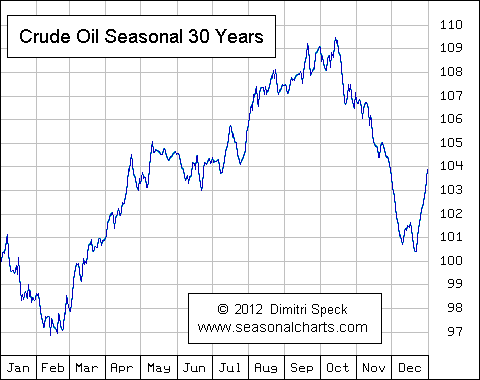
From: Link
Now the last part is an interesting one: While QE ended at the best time of year for stocks (therefore postponing the negative effect of QE’s end) it was the worst time for oil. (Just as the end of QE and worsening seasonality for equities met in spring 2010 and summer 2011).
Now is the fall in the oil price good or bad for the US economy? Historically it was good, but nowadays with all the investments in US oil production the answer is not that clear-cut anymore.
Further, and this is an even bigger trouble, the problem is that the crash in oil is just part of a big deflation story. This summer I wrote a post about how the retirement wave in the US is causing low unemployment, but at the same time low inflation. Please see What the Baby Boomers turned Retirement Boomers mean for Growth, Jobs, Inflation and the Markets .
The oil crash would be great for the US economy and the stock market, if it would be accompanied by a more expansionary monetary policy. But to the contrary, it is caused by a much less accommodative Fed. For the same reason the troubles in (oil-producing) emerging markets means troubles for the US. They are all a sign that deflationary forces are getting stronger and money is getting tighter in the US. Some argue that we may see a replay of the tech-bubble of 1999. The idea is that we will see a full-blown emerging market crisis (which I think we will), which will then lead to a more expansionary US monetary policy. But exactly this is not the case right now. The Fed is now very reluctant to restart QE. This is not 2010 or 2011. The unemployment rate which was still sky-high then has now fallen to near full-employment. Further we have now a change in the leadership of the Fed. This is an often neglected issue. As I wrote in September 2013, briefly before Janet Yellen was appointed, in my post Whoever Becomes Fed Chair(wo)man, Historically Any Change Meant Trouble a shift in Fed leadership is usually associated with a more restrictive monetary policy for some time, leading to a crisis very early in the tenure of the new Fed leader. And this is exactly the situation now. Things will turn worse, but the Fed will be reluctant to act, as it fears to steer up new bubbles.
But how bad can the situation get for the US economy and the US stock market? Worse than you think. Remember the spread widening. There has been historically a clear connection between spreads and the economy (I use below the New Order component of the ISM as it is a good leading indicator for the US economy):

There have been 3 major drops in this indicator since the financial crisis, the last one was due to the severe winter in the 1st quarter of 2014, the other 2 were associated with rising credit spreads at the end of QE 1+2. The market is still cheering the strong economy in the 3rd quarter (5% growth), which still may be a bent-up of demand from the weather-related downturn in the 1st quarter, while the latest data was quite mixed. Especially durable goods orders were very weak so far in the 4th quarter and might be an early proof that rising credit spreads are causing a major slow-down in the US economy (as they did after QE 1 +2).
In the stock market there is a tight connection between spreads and stocks, which doesn’t bode well:

In the high yield space the lowest rated (and most equity like) issues have in the past a led stocks at major turning points, especially when the turn was to the downside (here shown is the index value of these issues):

Here a recalibrated short-term look with the QE timeline:

Another interesting similarity with prior QE programs: The VVIX, the volatility of volatility. Sounds a bit weird, but has some interesting implications (basically a high VVIX means that people – mostly hedgefunds – who want to run a constant risk portfolio, have to adjust their holdings very frequently, causing some wild market swings, as we have seen lately). Anyway, this index has now temporarily risen to the levels right after QE1 and 2 as well as the height of the financial crisis in October 2008 and its early beginning in August 2007. Not a good sign.

Now after a lot of charts and details, here a brief sum-up: There are a lot of similarities between the prior endings of QE and the current one. They might just be blurred by 2 major differences:
1) The center the crisis is not the Eurozone this time, but (some) emerging markets
2) Seasonality, which was very negative for stocks the other 2 times, has now held up the market so far
And there is a 3rd one that is important going forward: The Fed is much less inclined to act immediately this time, as unemployment is low and the fear of a bubble is high (just last summer in her speech before Congress Janet Yellen was talking about “stretched valuations” in high yields, bank loans and social media and biotech stocks).
What should that mean going forward? Markets are calm now, but that is natural in the last days of the year. Seasonality is extremely strong now:
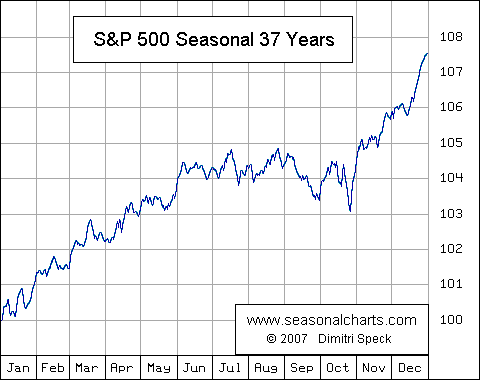
Even the oil market has some seasonal support at the end of December (see before). That easily sweeps under the rug all the troubles lurking in the shadow. Once the year-end liquidity tries up, things are likely to get rough again. It will get worse until the Fed turns around and starts to print money again. Rising spreads are a harbinger for bad times in the US stock market and a downturn in the US economy, which the stock market is currently not prepared for. Trouble again is that the Fed will be reluctant to act. For that reasons, things will most likely turn worse than they did in 2010 and 2011. Not to mention that valuations are far worse now.
Nevertheless I would not predict a 2008 crisis. The epicenter of the crisis is in emerging markets where things will get worse again next year. The rise in the US-Dollar is causing troubles for everyone indebted in USD (and that are many there) and that means a new string of defaults like in the 2 prior USD-revaluation periods after the end of Bretton Woods.

Despite the doom and gloom I nevertheless would not predict that the S&P 500 would have a negative return in 2015. That sounds now really weird after all that I have written, but the point is that it is in the hands of the Fed to stop any slide in the market early on. As long as inflation expectations are rock-bottom, there is nothing that binds them from a macroeconomic perspective. I just don’t think that they will act anytime soon. Only after things get much worse, especially for the US economy. And that might be in the second half of 2015. So, yes, I partly think that the 1998 comparison has some merit. Then like this time (and different to 2008), the US is not the center of the crisis, just as it was not in 2010 and 2011. The S&P was actually up in 1998, as it was in 2010 and down in 2011 only by the smallest possible margin (-0.003%). But don’t forget that there was each time a major downturn in between. And this is what I have in mind. Only probably a bit worse. In any event it should be the largest downturn in US stocks since the financial crisis. Maybe it is like 1998, but then 2015 will be like 98, not yet 99.
So while everyone contemplates about the timing of the first rate hike, I contemplate about the timing of the return of QE, which I would expect before the end of 2015 and which then could turn things around again.
Actually there are markets that I am quite bullish on for next year (though only in local-currency terms),, namely those that are already seeing very accommodative monetary policy or are likely to early next year, i.e. Japan and the Eurozone. But I would expect gains there to occur mostly in late 2015 when I expect the Fed to make a U-turn.
But wouldn’t that in the end mean QE forever? Is this the future? Yes and no. The problem, as I wrote in What the Baby Boomers turned Retirement Boomers mean for Growth, Jobs, Inflation and the Markets are the deflationary forces coming from the retirement wave (in the US, but also from China, where the situation is much worse as the one-child policy is now starting to bite the labor force). Retirements mean less credit growth and less demand, as I result less inflation, even deflation. It’s the mirror image of the 70s, when the baby boomers started to work, which let to high unemployment and high inflation at the same time:

Now it is the opposite. Despite all the talk about rising wages, nothing to be seen here:

This is the problem going on right now. It’s not the aftermath of the financial crisis, as is widely believed. Now this development is bound to go on for another 10 years. Only then will the US labor force stabilize (and around that time the speed at which the Chinese labor force will shrink will at least stabilize, but not get worse). As I wrote in the mentioned post, it is all like Japan, just offset (by around 10-15 years). Sorry, this is the future going forward (at least for another decade): markets live and die from the hand of the Fed. You may hate it, but there is no way around a new QE program. The ECB, pressured by the German Bundesbank, has avoided QE so far. And where has it led? Deflation is hardly avoidable in the Eurozone now.
The Fed will have no option but to act again. In my opinion hopefully more subtle than the last time (and hopefully nothing like the BoJ is doing). Rather hopefully at a low speed that can be maintained without causing too many bubbles on the way. Even though I think there is no way to avoid QE, it was at times (especially in the last round of easing) a bit over the top. I never understood why the Fed started a new round of QE in September 2012 while Twist was still running and stocks were at a high and why they were running the printing press in 2013 at such a speed. I assume they were nervous about the low growth rate. But again it’s all about the retirement wave. 3% growth is a story of the past, last quarter was a short-term anomaly. Once that is recognized maybe we will see a more steady policy at the Fed instead of the ebbs and flows of QE. But for the meantime, get ready for the drought.









