This morning, for the fourth time, I had to interrupt my workout to re-tie my shoe. My trainer, John Zilli, joked that I was simply stalling. But not wanting to trip on my shoe laces as I headed to the treadmill, I dropped to one knee, yet again, and tied my laces.
“You know you’re doing it wrong,” John called over to me. Now, I’ve been tying my shoes for over 60 years, and though I must confess that for the first year I used to con my younger sister, Carol, into tying them for me (a story that she still loves to retell at the slightest provocation), I think I do know how to tie a shoe. So, of course, I shouted back something like, “You can’t be serious.”
“No, really,” John replied. “I just watched a TED video on it.” John grabbed his cell phone, hit a few keys, and the video sprang to life.
Being someone who has enjoyed TED talks for a long time, I watched. Sure enough, Terry Moore, in a three-minute talk, demonstrated that there was a “strong” method and a “weak” method to tie a shoe lace.
You can learn about the difference here
(As they say on the www.ted.com website: TED is a platform for ideas worth spreading. Started in 1984 as a conference where technology, entertainment, and design converged, TED today shares ideas from a broad spectrum — from science to business to global issues — in more than 100 languages.)
As much as I enjoyed the video, reading the blog comments afterwards was almost as much fun. I didn’t realize there were so many people with opinions about shoe laces – from numerous other ways of tying to new brands that promise stronger knots! As Mr. Moore remarked on the video, little things can be important. (I’m sure the entire nation of Germany agrees with its 1 to 0 win in extra time to capture the World Cup after a 24-year hiatus.)
Not so sure about that in the stock market, though. Last week was a good example. We had the worst week in the market since April. That’s right, since April! But here’s the “little” part – the decline totaled less than 1%. Even on the Russell, where the bulls were moaning all week, the lost was less than 2%.
Even though there were many indicators that the market was overbought and was poised for some price weakness, this is all the bears could muster.
Such is the way of the world when you are in a roaring bull market in stocks. Like we saw last year when the S&P 500 rocketed to 30%-plus gains, the few setbacks that occurred were short-lived and could not even manage a 5% decline all year.
Most investors did not heed my advice last week to use my projected short-term market weakness to “buy the dips.” Instead, just as what occurred last year during those less-than-5% sell-offs, small, individual investors fled the stock market at the slightest whiff of a downturn.
This just does not pay as long as the longer-term indicators are bullish, as they are today. Short-term weakness, and our projections of same, are opportunities to increase equity exposure, not decrease it.
Yet as the two charts below demonstrate, bullish opinions from the American Association of Individual Investors (AAII) decreased last week and bearish sentiment soared. And this occurred just one week after the market touched an all-time high – so much for renewed calls of “irrational exuberance.”
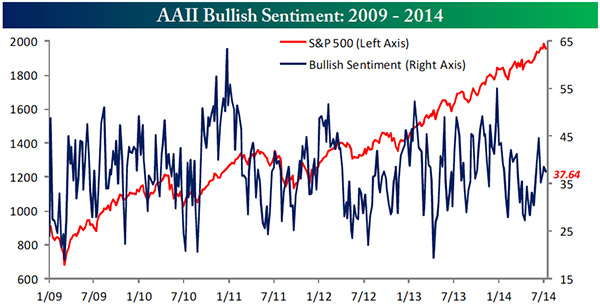
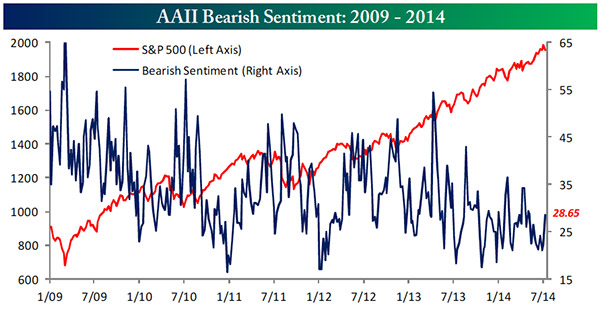
Source: Bespoke Investment Group
Oh, and by the way, after last week’s “sell-off” and bearish reaction, as I write this on Monday, July 14th, the Dow is up 114 points.
Reviewing the indicators; they’ve actually gotten a bit more bullish since last week. Yes, stocks remain overbought and a correction of some sort could happen any time. But interest rates moved from the minus column to the plus column. They had risen steeply on the positive employment news two weeks ago, but then along came rumblings of problems in Portugal’s central bank and rates started declining again. As bond prices rose, so did stocks.
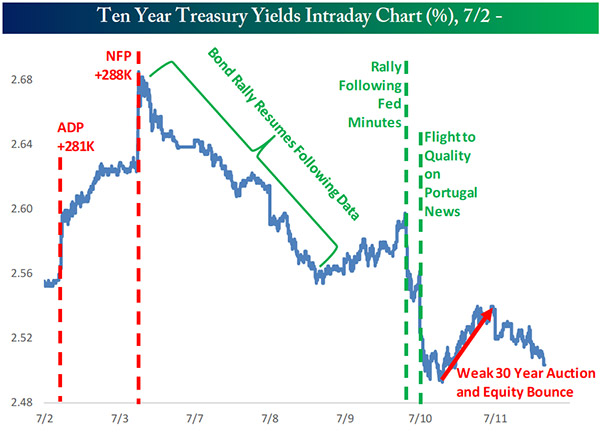
Source: Bespoke Investment Group
Second quarter earnings started coming in last week. While I am worried that for the first time in eons analyst revisions entering this earnings reporting season had a positive bias (seems like these usual pessimists have had it wrong now for years), so far the companies reporting seem to be surprising more to the upside than the down. Case in point: first reporting Alcoa, where earnings had a positive surprise and the stock gained over 5%.
There are negatives. Economic indicators were few and far between last week, but there were only two that beat expectations, while three failed to do so. (There will be many more reports this week than last and Federal Reserve chief, Janet Yellen, plans two days of testimony on Capitol Hill – so plenty of fodder for the financial media.) Furthermore, this week is a weak one on the political/seasonality calendar.
Still, I can’t get those sentiment numbers out of my head – so negative, at a market top? These numbers are usually a contrarian measure – meaning the stock market usually goes in the opposite direction. Interestingly, that’s all that Mr. Moore was suggesting with his advice on shoe tying.
All the best,
Jerry