After multiple weeks of travel, my family threw a trip-postponed birthday party for me Friday night, but it was really just an excuse to have a family get-together. My 92-year-old mom, brother, sister, niece and nephew were there. My wife set up the party of mostly hamburgers, ice cream and cake, with plenty of birthday cards being given.
My son and his girlfriend surprised me, however, with a legacy, heavyweight audiophile vinyl edition of the best-selling jazz album of all time, Miles Davis’ “Kind of Blue.” I rushed it to the turntable and cranked up my Macintosh amp from which the most pure, warm and perfect sound – ambrosia for the ears – was emitted. Thank you Michael!
Here’s “So What,” the first track on the album, complete with video of the extraordinary Miles Davis.
I love the whole concept of jazz. It can sweep you away, improve on or magnify the blues, or it can just be there in the background as if it is woven into the fabric of your day-to-day activities.
Best of all is the improvisation. Each jazz piece seems to set down a beat and refine it until you are a part of it. Then each member of the group has their chance to break away, to soar, and that’s when really special things happen.
The same can happen in the stock market. It, too, sets a beat and refines as it builds a base in a sideways market. Then if it breaks out, special things can happen.
This year we have essentially been in that sideways market. But indexes have put in a mixed performance. If they were lucky, they were flat – like the Dow and the S&P. If they have not been lucky, they have stumbled. Both the NASDAQ and the small-cap Russell 2000 have tumbled into correction territory while avoiding being classified as a bear market as of yet.
Both indexes have really been in a classic bubble. They have each seen outsized returns in 2014, exceeding the return of the S&P 500. Even the shape of their equity curves, when compared to the S&P, resembles a bubble. But as you can see in the graph of the NASDAQ below, the bubble has burst.
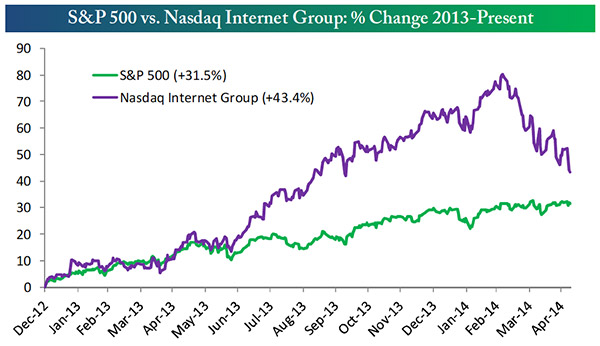
Source: Bespoke Investment Group
Yet the chart also shows that the S&P 500, like the Dow, just keeps chugging along. In fact, last week the Dow Jones industrial Average actually hit a new all-time closing high on Friday! Today, as I write this, the S&P 500 is in its own high ground and should close at a new high point. The New York Stock Exchange Composite Index (in my opinion, the most representative index, as it reflects the percentage change in each stock in the NYSE) had already set its own new high and is doing so again today.
While I believe the lagging indexes merely reflect stocks that went too far, too fast, many investors are worrying that the laggards are really the canary in the coal mine which has gone quiet, signaling impending disaster for the indexes moving higher.
History, however, suggests otherwise. Research by the Bespoke Investment Group shows that since the Russell 2000’s inception in 1979, there has been only one occurrence (a similar divergence in 1981) when the Russell 2000’s decline in the face of a flat or rising S&P has led to a subsequent correction (greater than 10% loss). And when they filter out periods where the S&P had been in a decline that preceded the divergence and focus on the subsequent performance of the S&P over the next one and six months, it has all been positive – 100% of the time!
And then we have today’s break out. It’s not that all is right with the world. We still have the unsettling situation in the Ukraine. And earnings, while mostly positive this earnings reporting period, have seen the lowest percentage of stocks beating expectations of any quarter since the bear market ended in March of 2009 (57.4%).
Yet while earnings beats this quarter were ranked 20th out of the last twenty quarters, top line revenues did register their 12th best quarter of that period, and guidance supplied by the companies for the future flashed slightly higher for the first time in eleven quarters! Adding more bullish fuel on the fire, economic reports also had a positive week. Seven out of last week’s economic reports exceeded economists’ predictions. We get 20 more this week.
Of course, surprising everyone, interest rates continue to tumble. While mortgages are about 0.8% higher than they were a year ago, bond interest rates have moved steadily lower throughout 2014. This means that many top growth stocks are now yielding more than the 5-, 10- and even the 30-year treasury bonds. This is usually positive for stocks going forward, as is the sudden surge in bearish investor sentiment that overtook the level of bullish sentiment this week – and all while the Dow and S&P are hitting new highs.
Still, I recall my first real exposure to good music, 60 years ago. It was in a small school auditorium at Isaac Newton Elementary School in Detroit. Perched on the stage was a portable phonograph (yes, it was 1,000 times bigger than an iPod and it was, dare I say it, plugged in!). The teacher carefully placed the needle on the spinning 78 (send me an email and I’ll explain it) and the music soared throughout the hall.
It was a piece by Joseph Haydn, where dainty, low-volume pastoral melodies are suddenly punctuated with a loud crescendo of music – a surprise to all of us as we listened to his 1791 “Surprise Symphony” – designed to keep audience members from nodding off after the evening’s banquet. Listen to the 2nd movement of the symphony.
Hopefully, today’s stock market action is the good kind of surprise, and the latest “break away” does not turn into a “break down.” Something we always need to be prepared for as investors. Are you?
All the best,
Jerry