With Mickey Rooney’s death over the weekend (at age 93, after accumulating show business credits spanning 10 decades), I got to thinking about the Andy Hardy movie series that propelled Mickey at the ripe old age of 16 into stardom. In the 50’s the TV screen was awash with black and white classics of the 30’s and 40’s. Like the Great Depression generation, many of the baby boomers binged on Andy Hardy movies long before Walking Dead, Breaking Bad or House of Cards.
The Andy Hardy movies were a far cry from these villain-focused series. Instead, they were perfect fare for theFather Knows Best generation – as Judge Hardy worked hard to guide young Andy through the trials and tribulations of growing up.
Beginning with A Family Affair filmed in 1937 and continuing through 1946 with a brief reprise in 1958, the 16 movies of the Andy Hardy series of motion pictures were one of the most popular series in film history. They focused on Andy’s life in the fictional, Midwest town of Carvel. As I recall, every script of these corny, sentimental comedies was pretty much the same.
Something truly terrible would occur in Andy’s life – like being dumped by girlfriend Polly Benedict. Then, suffering the usual teenage angst, Andy would slump into depression and talk to “Pops,” the wonderfully sage Judge Hardy, played perfectly by actor Lewis Stone. The judge would give Andy some great advice, Andy would ignore it, the advice would prove correct, and when finally adopted by Andy, everything would turn out all right – and another Hollywood happy ending would ensue.
The stock market seems to be acting out the same script. That’s why I call it an Andy Hardy kind of market. Since December, I’ve been writing that the stock market in 2014 would be nothing like 2013. It would be more volatile. It would contain a correction of at least 10% and, yet, it would end the year higher.
While we have had our share of peaks this year in the S&P 500, with a new all-time highpoint in the S&P 500 just last Thursday, these excursions into the rarified air of the market stratosphere have been brief and, so far, always followed by a quick retreat into yet another valley, like today and last Friday.
While up to now these declines have been restricted to the 5% variety, this has only been the case if you focus on the blue chip index. When one drills down into more specialized indexes and individual stocks, the damage has been far greater.
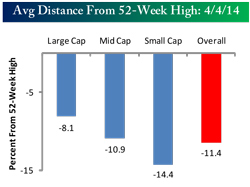
For example, reviewing the stocks in the far broader S&P 1500, we find a very different picture:
The average stock has already tumbled quite a way from its own 52-week high. Smaller company stocks have been especially hard hit. This is in sharp contrast to the larger cap companies that many of the indexes focus on. And even here, when we broaden the examination to large cap stocks beyond the limited number in the Dow or S&P 500, the extent of the damage is much greater than we have seen in the much smaller declines in these often cited indexes.
If instead of looking at company size, we focus on financial sectors, we find much the same story playing out:
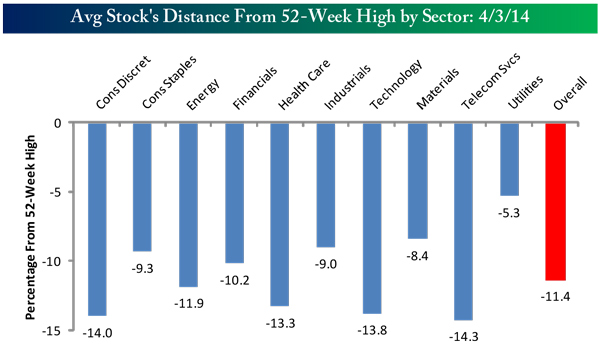
Source: Bespoke Investment Group
Recall that Consumer Discretionary, Health Care (read Biotech) and Technology stocks were the darlings of last year’s market run-up. Now, as Judge Hardy would say, “The chickens are coming home to roost.”
There are plenty of reasons for the short-term internal market weakness. While the focus of the media has been on the Ukrainian situation and Chairman Yellan’s misstep, there have been plenty of other reasons for some short term concern.
Chief among them is, “Golly Polly,” the perfect storm caused by the collision of last year’s rally and higher taxes. Virtually ignored by the media has been the increase in taxes experienced by many investors – Obamacare surcharge, higher rates, increased payroll withholding, and reduced deductions. Combine this with higher capital gain distributions from the mutual funds and year-end profit taking due to the rally and the amount of taxes due are up, leading a lot of investors to sell stocks to raise proceeds to meet tax payments this spring.
The last two times that taxes increased (1991 and 1993), in the year following (1992 and 1994), stocks followed a pattern much like this year. Following a year with tax hikes, from year end until the end of the first week in April, stock prices fell. This year is no different, the government must be paid. Encouragingly, despite the early setback, the stock market ended higher in both of those years.
Of course, there are other items negatively affecting stocks, but these are actually mixed. We’ve had some sideways motion in yields, and the yield curve has flattened (the difference in yields between longer term and shorter term bonds has narrowed). This tends not to be supportive of stocks. Still yields have not skyrocketed as many feared would be the case when tapering began.
Similarly, economic reports were mostly disappointing last week, with only eight of twenty-one exceeding economists’ consensus estimates and thirteen falling short. Most experts are blaming the weather for the downturn, although if one looks at reports from the areas of the country that did not have the winter slowdowns, the down turn remains evident. Still, year over year economic reports are improving now with more up than down.
Finally, tomorrow is the first day of the quarterly earnings reporting season. We may just be going through the lull before the storm. Both company guidance and earnings analyst revisions have been decidedly negative, yet that has been the case in past quarters where earnings have turned out much better than expected. Again, the upcoming reports could confirm the weather-related slowdown, but if they don’t, the reports could prove to be a catalyst for another move through market highs.
Lastly, seasonality turns higher this week, sentiment is moderate, stocks are slightly oversold, and market patterns usually associated historically with new highs in the S&P 500 have overwhelmingly favored higher prices a month from now.
I saw Mickey Rooney once live at the Fisher Theater in the comedy-musical, Sugar Babies, in the early eighties. He was terrific. I can still see him in my mind’s eye singing and dancing across the stage in his seventies with Ann Miller, recreating the days of Vaudeville when he first appeared on stage as an infant. You can see an outtake here.
Still, I remember him best of all as Andy Hardy and grew up loving those corny scripts. Who can help but smile when they feed the great Judy Garland, playing the part of the younger, love struck neighbor, Betsey Booth, a line like: “I sing, you know.”
It’s an Andy Hardy kind of market, but that ain’t all bad, and now with the entire casts reunited – can movie seventeen be far behind? I think I can wait a while to see that one. As Andy once said, “The next ten years of my life are the best.” To which the Judge replied, “The next ten years of anybody’s life are the best.”
All the best,
Jerry