This weekend we were honored to have Steve Finn, the owner of our largest custodian, Trust Company of America, and his lovely wife, Kelly, join us for our annual Holiday Party (see more about the party in the “ What’s Happening ” section). On Sunday, at a post-party brunch, Kelly (who studied art at the International Academy of Art in Nice, France, and at the Brera Art Academy in Milan, Italy and has many years of patient craftsmanship with oil paint and easel) was telling us about how she goes about creating her exquisite paintings.
Painting fine art requires long hours, and while she now paints in a beautiful new studio that we visited a month ago, we wondered whether she’s able to be seated while she paints or does she stand all day. I found her answer interesting.
As she paints, she is constantly moving. Now, I would expect her hands to be constantly engaged, but it turns out her feet are a blur as well. She says that one must keep moving, gaining perspective on the work even as it is in the throes of creation.
I know this is how many of us view fine art. We move closer, admiring the brush strokes and fine detail. Then we move away seeking to absorb the whole – to gain perspective on the artist’s piece. I just never thought about it as part of the process of creation.
Since we send out a weekly hotline and make available model account and research results describing the individual components of our strategies, the details of their performance are pretty minutely dissected. Just check out the weekly results printed in each issue of this hotline.
However, it’s rare that we are able to step back and view the portfolios and gain some perspective about what’s happening in the world of investments. So much is focused on the current events, the latest earnings and each daunting squiggle in the price charts, that sometimes you can’t see the forest for the trees.
Yearend usually does provide the opportunity to take the time to gain a broader view. I don’t know why this is. At any point in time one can look back twelve months and see the one-year rate of return. But with the approaching New Year, suddenly people just seem more focused on what happened during the calendar year.
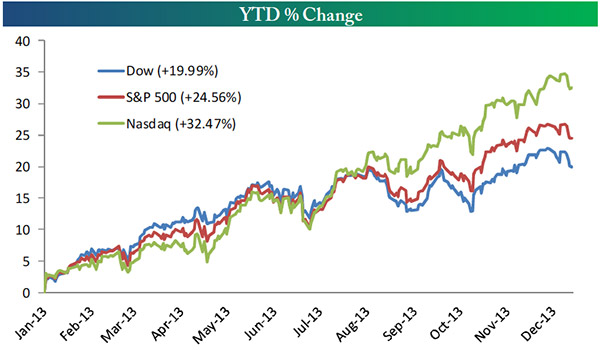
I was reminded of this phenomenon Friday when I saw the year-to-date chart of the major stock market indexes – the Dow, the S&P and the NASDAQ. All of them are up for the year – all by about 20% or more, I might add. Having the best year-to-date performance is the NASDAQ.
Source: Bespoke Investment Group
Yet when one steps back and gauges the NASDAQ’s performance year to date vis-à-vis the other indexes, it is obvious that this was not always the case. In fact, the mostly tech index lagged the others badly as the year commenced. You’ll recall that early in the year it was being burdened by concern over its leading component, Apple. Not only did it rise less when the others were gaining, but it fell harder when the stock market reversed itself and tumbled a bit in March, April and July.
Thereafter, however, the NASDAQ Index turned a corner. It was born anew. It shot higher, overtaking the other indexes and accelerating, hardly pausing when the market had yet another small correction in September and then again in October.
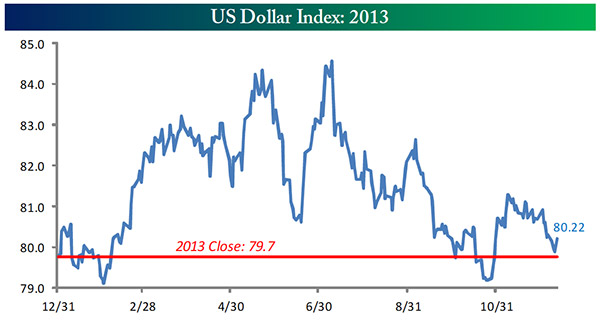
At the same time, the mighty Dow Jones Industrial Average seemed to put on exactly the opposite show. It started strongly at the year’s inception, weathered the tiny spring and summer thunderstorms well, and then seemed to lose energy as the year’s marathon race turned into a yearend sprint for the finish line. Other markets follow this same on again/off again behavior. Here’s a chart of the gyrations the Dollar Index engaged in this year. It had a nice run-up in the first half of 2013, and then gave all its gains back, and then some, as we moved through the latter part of the year.
Source: Bespoke Investment Group
Like index investing, strategies can also put in start and stop performances. Most active strategies are designed to focus more on absolute performance – slow and steady wins the race is their philosophy. However, just as indexes range from fairly resistant to volatility to those that are more aggressive, like the NASDAQ, so too with strategies. Some by design are more volatile, have larger drawdowns, and more aggressively attack the market that they are designed to exploit. With more volatility comes an increased chance of this start and stop behavior.
While most of our over 100 strategies have done wonderfully this year, some of the more volatile strategies have been down or flat. Although most have had great recoveries since the summer lows, their performance does illustrate a problem that portfolios can run into.
The best solution to underperforming strategies is to diversify strategically, just as we were taught to diversify by asset class back in the eighties and nineties. Diversification reduces the probability of volatility. It’s the old saw not to put all your eggs in one basket, and it applies equally to index investing and strategy diversification.
However, just as actively managing diversified portfolios of indexes can improve the performance of asset allocation portfolios; active management of your strategically diversified portfolio can help deal with the greater volatility of some strategies. If you actively manage your strategy selections – these periods can be reduced or avoided.
I know most advisors, and almost all clients, have neither the time nor the expertise to evaluate our over 100 strategies and determine the best ones to hold in the current market environment, as well as the best percentage of each for the desired suitability profile of each client. Nor do they want to engage in that process all over again a month later and learn the newest strategies and make the decision to drop a strategy from the mix.
Yet that is how strategic diversification can be most effectively employed. All of our strategies are actively managed. That active management has defined Flexible Plan since its founding in 1981. So that is what attracts most investors to us.
If you believe in active management, shouldn’t you also believe in active allocation of your investment in those strategies… and others that may become more attractive as time passes and markets change?
Enter our new FUSION process, which actively manages your investments in the active strategies. The methodology for doing that management has been applied to our MAPS/SAS and MSP strategies since February with excellent results.
Now in FUSION, which replaces these three approaches, we will manage not only the allocations to strategies but separately allocate to asset class indexes, like stocks, bonds and even gold, and will professionally utilize, where available, money market, leveraged and inverse funds as well. (See more on FUSION in our What’s Happening article.)
Next year we expect to have a new perspective on the financial markets. Next year, with the help of the FUSION process, when we step back to evaluate the year, we hope to see the realization of our goal to reduce volatility further and capture even more of the upside offered by the market, whatever that may be, than was even possible this year. And the artist that will be painting this picture will be FUSION. You can find out more from your financial advisor.
Wishing you all the best, in this holiday season and all year long,
Jerry
P.S. It’s a difficult week to call the market’s direction. With the Federal Reserve meeting on Wednesday, the short term is likely to be dominated by its pronouncements – will they announce tapering or won’t they? Without this “event” I believe that the market would trend higher.
We have had a little correction and the market appears oversold. Our Political/Seasonality Index since the end of last week has been calling for a yearend rally. Most of our strategies remain fully invested, at their appropriate level of suitability, looking for higher price levels ahead. Strategic Diversification where in place, is there should the Fed’s decision surprise.
© Flexible Plan Investments