I thought that we still had two and a half weeks until Halloween. You’d never know it from the frightening tales from Washington, D.C. Just as the government shutdown was to have been a near world-ending event, the impending debt ceiling should be named Armageddon II.
You’ll recall all of the gloom and doom being broadcast before the shutdown went into effect on October 1. At the time, I wrote that the effect of this 18th shutdown in the last 30 years was not going to be devastating – that most of the government functions would just continue. Now the reports are coming out that 83% of the government is still operating.
What was closed down? All the visible parts of government – even though past shutdowns have not closed our national monuments in D.C., this time they did. Why? “It’s a cheap way to deal with the situation,” an angry Park Service ranger in Washington says of the harassment. “We’ve been told to make life as difficult for people as we can. It’s disgusting.“
I bring this up not to comment on the politics of the shutdown but rather with respect to so many financial columnists’ oft-repeated remark that the markets are being held hostage by the travails in Washington.
As the charts below make clear, when fear increases, as represented by the increase in the VIX (or fear) Index, stocks have slid lower. While that had been playing out during the first part of last week, that reversed itself during the last few trading days, suggesting a recovery is beginning.
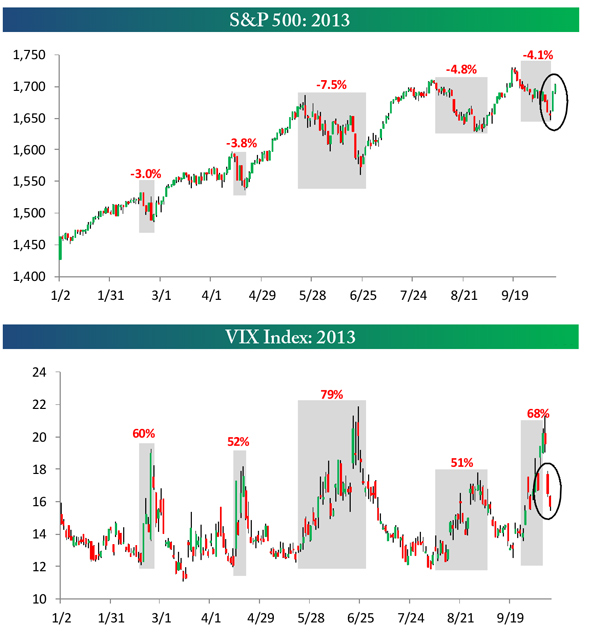
Source: Bespoke Investment Group
Although I do believe that the market would now be at new highs if it weren’t for the budget disputes, the fact is that investors have been pretty calm about the whole matter. The S&P 500 is actually up over 1% since the day before the shutdown began fourteen days ago – annualized that would be close to a 30% rate of return!
With the shutdown under our belts, now we are forced to consider the prospect of a refusal by Congress to raise the debt ceiling. This, too, has happened before, and yet today the market is at much higher levels – within a few percent of all-time highs. Still, the politicians in both branches of government, executive and congressional, and from both parties, are doing their best to scare the populace and the world at large with visions of default simply to advance their own agendas.
They seem not to care about what the effect of talk of default does in the eyes of our foreign trade partners and enemies alike. Nor is there any consideration for the consequences such talk will have on the financial markets or the dollar. It’s just, “Make it sound as bad as possible – and let the facts of the matter be damned.”
Here are the facts: Failing to raise the debt ceiling does not require a default on US obligations. In fact, given the language of Section 4 of the Fourteenth Amendment such a default may be unconstitutional.
Since the Federal government takes in tax revenues of about $250 billion per month and the interest expenses that have to be paid are about $20 billion, there is no economic reason to default. If a business had such revenue to interest coverage (better than 12 to one), it would be rated Triple A!
Well then, where is the problem? The problem is that the Federal Government has a veracious appetite to spend even more money, much more money than it takes in. Each day the Federal government spends $16.7 billion, but takes in “only” $14 billion in tax revenues. To get the money for the additional spending, the government must borrow about $2.7 billion each day. That can’t continue without raising the debt ceiling.
So then don’t we have to raise the debt ceiling? Probably, but if we don’t, the remedy is not to default on our Federal obligations (bonds). The solution is the same as it would be if you were living off borrowed money and you had reached your borrowing limit at the bank. Your first response wouldn’t be to default on your mortgage. That would have dire consequences. No, you’d keep making your payments and try to cut spending elsewhere instead.
With the sequester I note that we have already shown we can cut spending, albeit as the price for higher taxes “on the rich.” And we can decide to cut spending to deal with the debt limit, too. It would be criminal to default.
I don’t like a lot of our politicians, but I don’t believe they are criminals. They simply have differing values and ideologies. Remember the close past elections. The country is evenly split between the red and the blue states. In the end (of this crisis, not the world), though, they will either raise the debt ceiling or cut spending. I hope they do both, and if they do, an incredible re-ignition of this year’s stock market rally is likely to ensue. We do not want to miss this rally when it comes.
As I said, the markets have been pretty calm about all this, while it seems to be the politicians and the media that continue to try to top each other with the worst possible consequence of a default that will never come. Maybe investors are being too complacent, or like me they feel that they have seen it all before and they know how overblown the talk has been in past “crises” with no real economic cost.
It could be the tale of the boy who cried wolf, or maybe it’s the headless horseman riding through the countryside wreaking havoc. However it turns out, it again highlights the advantage of using computer-driven strategies to manage your investments instead of emotionally responding to the latest manufactured crisis out of Washington. Check out the year-to-date returns of some of our strategies, after maximum advisory fees, in the strategy section of today’s hotline (left column index). The computerized approach has handled all the “dips” in the charts above just fine.
All the best,
Jerry
PS:
As I stated above, I remain bullish. Interest rates continue to ease and earnings reports for the just finished 3rd quarter have begun to trickle in. To date, most have outperformed the analysts’ projections – a very good development. At the same time, to the extent that we have had dips in stock prices, buying has quickly stepped in to exploit them and all the indexes have so far remained above their intermediate- and long-term moving averages.
The constant media drum beat on the shutdown/default issues has had its effect on psychology. Bearish investor sentiment is on the upswing (but seemingly illogically, so is bullish sentiment) and small businesses registered a less positive outlook for the economy in the last NFIB Small Business Trends report. Although, with respect to the latter, it appears they are most upset about taxes and increased government regulation. Among small businessmen the fear of increased government regulation is at the highest level in over a decade!
It’s been reported that the issuance of new or expanded government regulations have slowed to a mere trickle during the shutdown. So maybe shutdowns aren’t so bad.
© Flexible Plan Investments