Just before leaving on my recent road trip, I picked up a new pair of glasses. It was the first new pair in about three years. As many of you are probably aware, I wear (strong) prescription glasses, but you may not realize that the glasses are bifocals. Bifocals have always been considered a sign of aging. They made you look older!
And, it used to be easy to tell when someone was visually challenged, both with seeing objects far away and up close. A little line separated the lenses designed for each. The top part was for seeing at a distance, while the lower half moon, or rectangular lens, provided help with reading.
Then, over a decade ago came progressive lenses. They were great. Each lens looked like one piece of glass and no one could tell if you were wearing bifocals because the line was gone! Ahhh, vanity.
There is a problem though even with the progressive lenses. While the new bifocals merge the two lenses for each visual malady into a lens uninterrupted by a giveaway line, the lens remains two lenses in its functionality. A problem emerges when deciding where one function should end and the other begins.
The higher up the up-close part of the lens extends into the lens, the more area in your line of sight that is available for viewing nearby objects. As a result, a choice has to be made: where do you draw the line?
On my previous pair, I saw great at distances but was struggling with my reading and computer work. So when I got my new pair, I said let’s try extending the reading part higher into the mid part of the lens. You guessed it! Now my reading and computer work is a breeze, but the sweet spot for seeing at a distance in tiny.
And, of course, this is always the case when one choses to draw a line between two things – it’s never perfect.
President Obama is certainly discovering this. He chose to draw a line at the use of chemical weapons in Syria. On one side our nation would sit back and watch the slaughter between the two factions in Syria. On the other side, if chemical weapons were used to cause some of the deaths, we would then intervene.
Don’t get me wrong. I’m not against drawing a red line or a line in the sand. As traders, we have to do it every day. If this happens we want to sell, if that happens we will hold on.
Even though these “lines” can be useful, unfortunately, like President Obama, most traders don’t follow through when first the line is crossed. With most investors, this dithering usually leads to losses. And, regrettably, in the case of Syria, each step forward and then backward by the President has also led to investor losses.
As I have been stating in this column for over twenty years, uncertainty about the nation’s course of action always seems to cause declines in the stock market. Today, illustrates this perfectly.
When the President blinked, and laid the decision at Congress’ feet over the weekend, it looked like the decision on Syria was going to be delayed for over a week. The markets could look elsewhere for news, and prices on stock exchanges around the world shot higher.
When the New York markets opened this morning, our stocks followed suit – the gains in the Dow were triple digit. But when the saber rattling commenced at a White House gathering with a united front of Congressional leaders, our rally evaporated.
While I can’t say that I agree with where the President chose to draw the line, I am most appalled by the President holding markets and a whole people hostage while he spent a summer deciding on which side of the line he was standing.
As investors we have learned that it’s good to draw lines, as long as they are based on sound logic. And when those logical lines are crossed, the best thing to do is to follow through. Because human emotions result in behavior that so often fails to do so, many investment professionals, like us, have automated their trading strategies.
To do this involves substantial research into where the best place is to draw the line. Once drawn, the automation insures that the logic of the decision behind the line drawing is followed through. What would happen to your portfolio if each time the lines were crossed we spent a month debating what to do? Oh, wait, that’s the traditional investment committee approach to investing…
Seems like this uncertainty was the story all month long – whether with tapering by the Fed or the President regarding Syria. We had warned that August is often a negative month, and it did not disappoint. It did end down the most for any month since 2012.
But aren’t the negative pundits on Bloomberg and CNBC losing perspective? A new high was hit on August 2. The S&P fell just 3% during the month. The NASDAQ 100 fell a miniscule 0.5%. Even the terrible bond market slipped only 1.0%. Oh… and Gold, which everyone was writing off in May, gained 5.2%.
September, too, is normally negative. But recent historical studies from multiple sources have reported that:
- when the market is up for the year, Septembers actually tend to be positive (Bespoke Investment Group);
- the first year of an election cycle tends to see a positive NASDAQ (Mike Burke); and
- a negative August usually leads to a positive first half, at least, of September (Jay Koeppel).
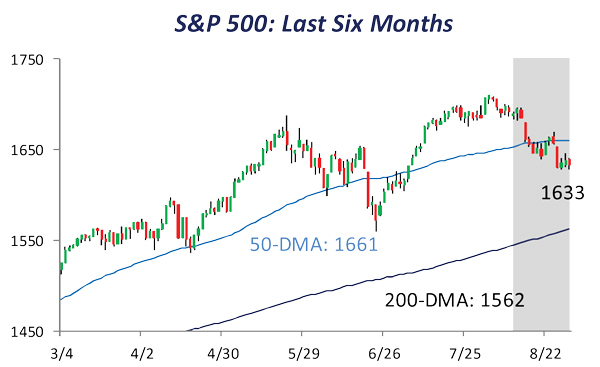
And in terms of lines being crossed, while the S&P chart shows that the short term 50-day moving average line has been crossed (just like it was in June before the market went on to new highs at the start of August), the longer term 200-day moving average has not been breached. We remain in a very minor correction phase.
Source: Bespoke Investment Group
Being outside of earnings reporting season, and with outperforming and underperforming economic reports coming in at a dead even level, interest rates trending higher intermediate term but lower short term and all the political cross currents, I cannot rule out that this correction will turn into something bigger. All summer I have been warning of a short term correction, but that longer term we should be okay. So far the only surprise has been that we have seen so little downside action.
Why do we stay in stocks when we believe that there will be any short term correction? There are so many reasons:
- We might be wrong. The immediate future may yield no more than the 5% downturns that we have been experiencing for the last 12 months.
- When you are in a primary bull market, the worst mistake you can usually make is exiting too quickly. It’s easy to get whipsawed. As we have seen repeatedly this year, when the market is in an intermediate term rally, it turns higher very quickly and it’s tough to buy back in at a price lower than where you sold.
- Our automated systems are for the most part cautioning against it at this time.
- We believe in strategic diversification as the first line of defense. All our strategies are actively managed. They all have defensive tools. Some of the shorter term has already employed defensive measures. But if things turn really negative, each has proven able to adapt.
So, like in the President’s case, each of our strategies has drawn a line in the sand. But, unlike in the Syrian matter, for the most part those lines have not been crossed. Be assured that when each is crossed (and eventually they always are), we will immediately act on your behalf.
In the meantime, my secret is out. I’m wearing bifocals, and while the line is not visible, I’m aware of it. It’s not drawn where it used to be, but so far I’m adjusting to both the short and the long vision just fine. Only problem is that for long distance, I’m developing the habit of wearing my glasses a little bit low on the bridge of my nose to look out through more of the sweet spot. Of course, that makes me look older…
All the best,
Jerry
© Flexible Plan Investments