It’s hard to tell which to be most worried about – the Chinese spying on us through their computer hacking or the government spying on us through all our data providers! To paraphrase Jay Leno’s remark the other night, “Voters said they wanted a government that listened to them– now they’ve got one!”
While I can understand the need to contain terrorism (although I also like probable cause that there is a terrorist to listen to), I am really concerned about the hacking. I’ve spent two weekends out of the last month repairing my home computer from assaults on it by various forms of malware. I think I am now an expert on removal tools, if anyone needs some help.
Earlier this year we had an attack at the office that breeched the walls but not our data. Although we have many defenses, the attacks are relentless. We have hired a computer security expert who audited our systems and assured us that our data had not been viewed, copied or altered, but he also installed some new defenses and is in the midst of designing even more that will go into place this summer.
Source: Bespoke Investment Group
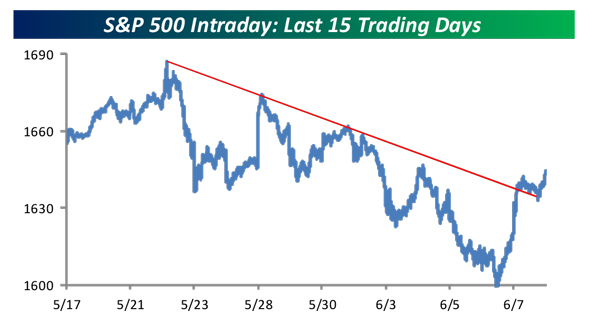
As an investor, you, too, may have felt like the attacks on your portfolio were relentless in the downturn that commenced after May 21st. At the close of the previous week (just after my column “Perfect” – as in nobody’s …) and the first half of last week, most investors were feeling quite battered. Yet the total decline from the May 21 peak to the June 5 bottom was just over 4%. We have yet to see a 5% decline this year!
And what of last week’s Monday through Wednesday tumble? By week’s end, a gain on Thursday and Friday erased them all to net the week out with a gain of just under 1% on the S&P 500.
Of course, as we have been discussing (and recommending ourselves), most market commentators have been saying “buy on the dips.” Well, I watched some of the market shows during the two-week decline – no one actually said they were buying. And I talked to a number of investors and advisors – they sounded more scared than eager to buy. Did you buy stocks during the decline and take advantage of the dip like everyone said to do BEFORE the dip?
Probably not. That’s the problem. Fear takes over when the market is going up – you fear buying at the top – and fear holds you back during the declines because you fear the market is going lower. Or maybe it’s greed that makes you think you can buy even cheaper if you just wait it out, just like it’s often greed that can cause investors to abandon their bearish tendencies and finally buy when the market repeatedly is making new highs.
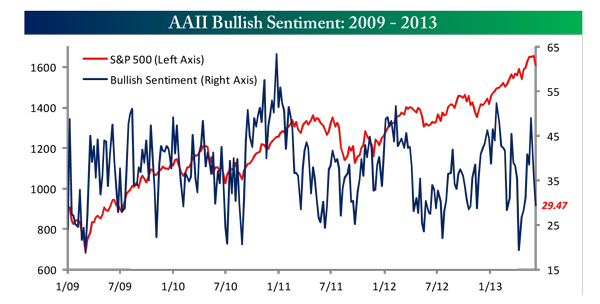
In any event, most investors let emotions guide their actual investment. Look at the chart below of bullish sentiment by individual investors.
Source: Bespoke Investment Group
Talk about a roller coaster ride – their emotions have more ups and downs than, say, the stock market. And that’s why studies show that most investors make so much less than the very funds they invest in – they let their emotions guide them.
Years ago when I was first introduced to investing, I found myself in the same emotional box. Fortunately, I had access to computers before the advent of the personal computer and started testing what factors really seemed to reflect or influence stock prices. When I compared their buy and sell points to what I had done on my own, I realized that the best signals were usually at times when emotions and general views of the market were just the opposite of the signals.
That’s what led me to become a quantitative investor – one who lets the numbers rather than their emotions be their guide. Forty years later I am still a believer. Well researched, back tested methodologies allowed me to take the emotions out of my investing and made me a better investor.
As to the numbers, for the most part, they are still saying we are in a bullish trend but the short-term case is weakening. Economic reports have switched – for every one report that outperforms the expert prediction, there are two that under perform. This is normally a negative. Yet, as was the case in the late nineties, there are periods when bad is good. Weak economic numbers, when they are being watched by a Federal Reserve contemplating a tightening of interest rates, can be a good omen.
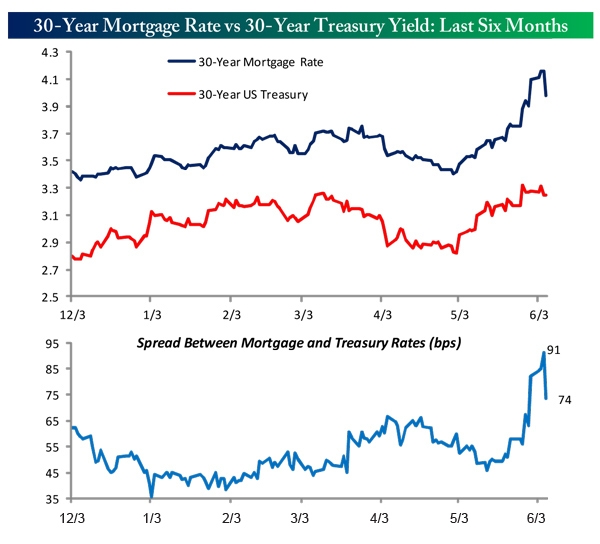
Still, interest rates, change in Fed policy or not, have shot higher (although improving a bit last week). Mortgage rates have moved up from the three- to the four-percent range, and while it’s still early and rates are historically low, any rise in rates is of a concern. (Really, if you haven’t listened to me before about refinancing your mortgage and lightening up on your bond fund exposure, please do so now.)
Source: Bespoke Investment Group
Earnings continue to be a bright spot. McDonald’s global sales figures surprised to the upside today, for example. But the last reporting period, while positive, was weaker than the last few.
Most of our trend-following strategies, and even some of our very short-term pattern recognition strategies, have been on the bullish side. Volatility, however, has increased, and we have seen our TVA indicator reducing exposure. We exited high yield bonds on Monday of last week. Sometimes this is a precursor of weakness in the stock market, as well.
Still, as the strategy sections of today’s Hotline show, May was, on balance, a good month for stock investors, as have been all of the months this year. The weakness now surfacing has so far been confined mostly to the bond, emerging markets and commodities asset classes.
At the moment, the indicators I spy remain mostly bullish on equities (tech and the NASDAQ look very strong), especially for the longer term market, say by year end.
All the best,
Jerry
© Flexible Plan Investments