Normally, May is a perfect time to visit New York City. The snow is gone, spring is in the air, Broadway readies for its Tony celebration, and people just seem friendlier. While there were plenty of friendly vibes from the populace when I visited on company business last week, and it is a super season on Broadway (“Motown” and “Kinky Boots” look to lead the list of new musicals – they were terrific), the weather was abysmal – cold and very rainy. They even had snow in parts of New York as the weekend began.
I don’t think New York is alone in this less-than-perfect spring across the nation. I hear the same story from nearly everyone I talk to around the country.
Well if this isn’t perfect, what is perfect? While we could focus on what makes a perfect day, or perfect spring, I don’t ask the question just in weather terms. What is perfect? In golf, maybe it’s a hole in one; in baseball, it’s nine innings without a hit, a walk or an error. For you, perfect is … what?
In the financial markets, I think investors try to focus too much on the perfect trade. They know the old Wall Street saw about “buying low and selling high” – so they insist they’re going to do both, but I believe 99.9% of the time they do neither.
In over 40 years of observing Wall Street, I haven’t seen many perfect trades. When I ran a hedge fund in the early seventies, I used to see them occasionally when we would put on arbitrage trades that, because of the deal’s structure and the math involved, could not lose. But those days and foolproof arbitrage opportunities are long gone.
When we were just doing market timing back in the eighties, my company did have a near-perfect sell when it moved 100% out of stocks on August 30, 1987 – just 2.2% from the then all-time high. Following which, the market proceeded to sell off 31.5% over the next month and a half.
Such prescience is rare. Most timing signals are designed to catch the majority of the uptrend – few, if any, gain every penny.
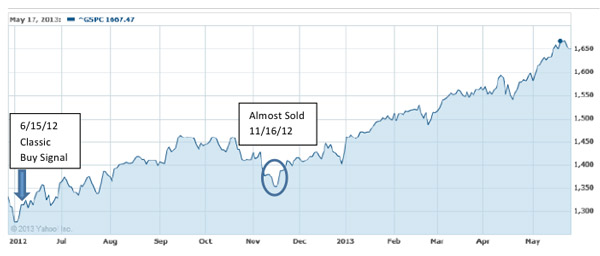
While I am quite pleased with our last market timing Buy signal (buying on June 15, 2012), I know that we were within a whisker of a Sell signal in mid-November. Fortunately, we held on and have enjoyed all the gains of the second leg of the current run up. The difference between perfect and not so perfect can be so small.
Source: Yahoo! Finance
For that reason, most professional investors don’t aim for perfection; they simply try to put the odds on their side. For them, buying at the absolute bottom and selling at the very top are always a goal, but they are more than satisfied to simply be on the right side of the trade most of the time.
As long-time readers of this column know, since that near miss in November, we have been urging investors to participate in the stock market’s rally. We even made fun of our fellow analysts when in the early spring they started to finally tell investors to “buy the dips.” Why? Because they were late to the game and we expected the dips to be brief.
It is not surprising to us that we have not had a decline in the Dow of over three days in a row this year, or a correction of 5%. That’s what happens when the trend turns higher and momentum is in command. So we have been saying, yes – “buy on the dips” (you might have noticed the one last week that we had suggested the market was due for), but more importantly, we have just been saying – “buy.”
Right now, the odds continue to favor higher stock prices. The right side of the trade has been to be in stocks, at least since mid-November 2012. The Federal Reserve, the institution holding the greatest sway over the markets, is as accommodative for investors as it has ever been in its history.
All of the broad indexes and market internals have confirmed the markets’ recent new highs. While nothing is guaranteed, such confirmation usually means higher highs or at least a return to the heights to seek reconfirmation.
While the Fed, rising earnings, and low interest rates have been the prime mover of the stock market’s ascent, reports on the economic health of the nation since March have not been supportive. As it turns out, this has not been all bad, as weak economic reports do provide support for the current accommodative Fed policy.
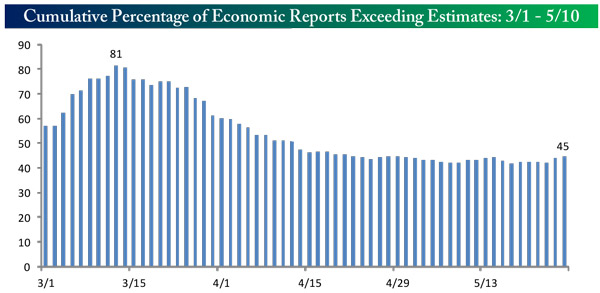
Lately, that has begun to change. As the chart below demonstrates, the cumulative percentage of economic reports beating expectations since the beginning of March has begun to turn higher after falling since the midpoint of that month. In fact, last week eight of nine reports beat the expectations of opining economists, after most weeks have seen the majority of reports failing to match expectations.
Source: Bespoke Investment Group
This week will see eighteen new reports, and if that trend continues, all of our major categories of indicators that we review each week to divine the direction of stocks will be supportive.
I should note that bullish sentiment among individual investors has climbed back above 50% and that can be a negative, but this is just the first week. Of more concern (and certainly the topic of most analysts for the last month or more) has been the overbought nature of the market. In other words, analysts have been concerned that prices have moved too far, too high, and too fast. They caution that such times can be costly to investors.
While it is true that every bear market begins from overbought levels, it is also true that the market can often stay overbought longer than one thinks. It’s kind of like the economic indicator that has a history of calling every one of the last five recessions, but has done so twenty times!
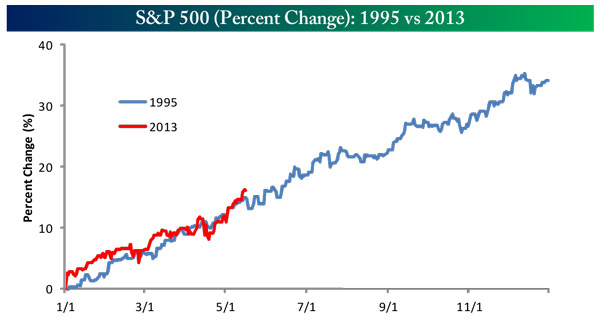
The Bespoke Investing Group had an interesting report this week showing that until Thursday, the S&P 500 Index had been more than two standard deviations above its 50-day moving average for longer (thirteen days) than at any time since 2004 (the longest time was seventeen days in 1995). In other words, stocks had been more exuberant than they had been in over 95% of the instances in market history. That is the very definition of overbought!
Yet, from the time stocks exceeded the two standard deviation mark to their tumble below that level on Wednesday, the S&P 500 gained 2.5% (better than 49% annualized). And Bespoke reports that the thirteen times that this has occurred, the market went on to gain 2% over the next three months over 76% of the time. And in the 1995 example – here’s what the year looked like versus this year’s market:
Source: Bespoke Investment Group
At this point in time in 1995, where would you have liked your portfolio to have been invested?
Similarly, when the stock market tumbles more than 1% the same day it sets a new all-time high like it did last Wednesday (5/22) with a 2% fall intraday, the outlook has usually been good for stocks. The S&P 500, for example, has gained over 8% during the next six months when the event happens for the first time within the last twelve months, like this time.
Still, few indicators are perfect – the last two times this occurred were at the 2000 and 2007 market tops! And I know it is these exceptions to the rule that makes investing so scary, especially if you have to go it alone.
However, investing with an active investment manager who employs techniques of Dynamic Risk-Managed Investing should make the decision to invest in a stock market strategy much easier than for the typical go-it-alone investor. Firms like Flexible Plan employ multiple tools and strategies to try to keep their clients’ portfolios on the right side of the market while seeking to guard against the full effects of the next major market correction.
The go-it-alone investor must take in all of the conflicting market noise (the exceptions and the rules) and, first, find the courage to buy into a market that can be falling like a stone or blasting higher like a rocket and, then, find it again and reverse course when necessary. Few investors have a compass to guide them, let alone a perfect map.
In investing, as in the rest of life, it’s not necessary that everything be perfect, but it’s great when it is…
All the best,
Jerry
© Flexible Plan Investments