
The humanoid robotics industry has officially moved from curated demos to real-world deployment. From Figure AI’s 200-hour autonomous sorting livestream to Hyundai’s bold plan to deploy 25,000 Atlas robots, physical AI is scaling exponentially. Discover how this rapid technological leap signals a massive shift in the future of commercial automation.
Earlier this month, the world witnessed a rather interesting event: Figure AI, the American robotics company behind the Figure 03 humanoid, livestreamed its robot sorting packages for 200 continuous hours. This marathon was a massive departure from the highly curated, one-to-five-minute demos that have historically defined the industry.
Only time will tell if the revolution was, in fact, televised.
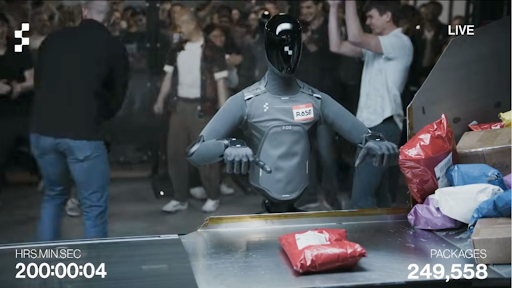
What started as an 8-hour challenge against a company intern (who narrowly won, sorting 12,924 packages to the robot’s 12,732) evolved into the clearest glimpse yet at the monumental advances that physical AI has brought to robotics. By the end of the run, the three units working in shifts processed tens of thousands of packages with zero human teleoperation, manual intervention, or hardware failures.
There are, of course, caveats to this feat. The packages being sorted were fed in a loop, removing the significant variability of a real logistics floor. Furthermore, while the Figure 03 can match an intern’s sorting pace, it is no match for a dedicated, high-speed mail-sorting machine. Despite these constraints, this livestream remains as the best peek behind the curtain that we’ve been given at the true, current state of physical AI.
The Rising Wave
Another major development this month was the announcement by Hyundai Motor Group, the parent company of Boston Dynamics, announcing its intention to deploy more than 25,000 Atlas humanoid robots across its Hyundai and Kia manufacturing plants by 2028. That figure represents roughly 83% of the targeted annual production capacity for the robot. This marks the first time that Hyundai has disclosed a specific fleet size target for internal deployment, another clear example of the industry moving away from vague ambitions toward clear, measurable objectives.
This arrangement between Boston Dynamics and its parent company presents a unique strategic advantage, as it directly addresses the training data bottleneck currently experienced by companies like Figure AI. Deploying such a large percentage of your robotic workforce onto a factory floor — that is also owned and operated by you — virtually guarantees the generation of abundant, highly actionable, real-world training data.
By keeping the vast majority of its initial fleet in-house, Hyundai can stress-test the Atlas in a closed-loop environment, iterating on hardware durability and AI models at an unprecedented scale. They are effectively building an industrial proving ground that will accelerate Boston Dynamics’ path to commercial reliability long before the robots ever face the unpredictability of the truly open market.
Navigating the Humanoid Wave
Boston Dynamics, Figure AI, Tesla, and others still have some ground to cover in order to catch up with the current volume leader, Unitree, which shipped roughly 5,500 humanoid units in 2025. However, the humanoid landscape is evolving so rapidly that an early lead in hardware shipments does not guarantee long-term dominance. The market’s growth curve is compounding exponentially In just a 24-month span, the industry has leaped from novelty, pre-programmed entertainment to robust, autonomous hardware that is finally ready for the real world.
Yet, there is a disconnect between this technological readiness and current market adoption. Despite most public demonstrations showcasing humanoids working in factories or homes, the reality is that most of the units shipped to date have gone to research and education labs. This underscores a market in its absolute infancy; the technology has arrived, but the commercial end-users are only just beginning to place their orders.
Strategies like the ROBO Global Robotics and Automation Index (ROBO) are key to participating in the rise of the humanoid market. The strategy’s reliance on a board of industry-expert strategic advisors ensures that investors are not only exposed to the cutting edge of today’s leading robotics, but that incoming shifts, like the humanoid wave, are navigated with insider-level knowledge. It requires a team that truly understands both the possibilities and the physical challenges that humanoids will bring to the broader automation ecosystem.
ROBO is the underlying index for the ROBO Global Robotics & Automation ETF (ROBO), the L&G ROBO Global Robotics and Automation UCITS ETF (ROBO.LN), and the Global X ROBO Global Robotics & Automation ETF (ROBO.AU).
Related Research
2026 Robotics Update: The Physical AI Ecosystem
Purpose-Built Humanoids for Specific Jobs
Robots: AI’s Real-World Champions
Looking for regular updates? Subscribe here for weekly insights on robotics, AI, and healthcare technology, delivered straight to your inbox.
For more news, information, and analysis, visit the Artificial Intelligence Content Hub.
vettafi.com is owned by VettaFi LLC (“VettaFi”). VettaFi is the index provider for the ROBO ETFs, for which it receives an index licensing fee. However, the ROBO ETFs are not issued, sponsored, endorsed, or sold by VettaFi. VettaFi and its affiliates have no obligation or liability in connection with the issuance, administration, marketing, or trading of the ROBO ETFs.

