Either Sadness or Euphoria: What the Midterms Mean for Investors
Membership required
Membership is now required to use this feature. To learn more:
View Membership Benefits Advisor Perspectives welcomes guest contributions. The views presented here do not necessarily represent those of Advisor Perspectives.
Well, that was a drubbing. Voters delivered an unambiguous message to their government almost two weeks ago. Democrats easily captured the House and will hold at least 54 Senate seats, flipping reliably red turf in Texas, Iowa, Kansas and South Carolina along the way.
The cause was no mystery. In addition to a rejection of perceived Trump administration mismanagement, inflation and gas prices drove the result. With gasoline up roughly 30%, tariffs pinching farm states, and an unpopular war in Iran as the backdrop, voters made the White House pay at the ballot box. Republicans outspent their opponents and redrew district lines in their favor, and yet still were decimated.
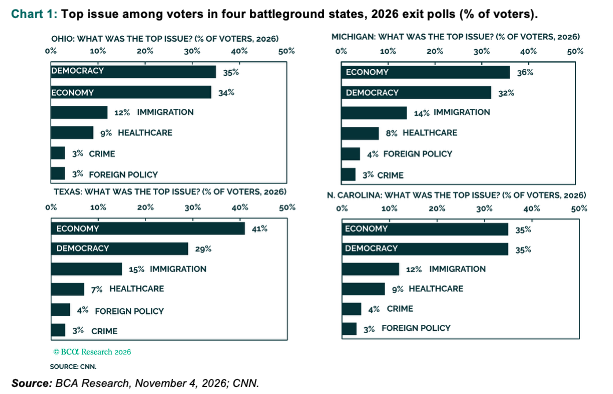
For investors, the real question is what comes next. Our answer: Expect noise in the near term, stay constructive over the medium term, and use the next two years to prepare for potential outcomes in November 2028.
The Politics
Gridlock. Democrats have gained subpoena power and a firmer grip on the budget, but the presidential veto will inhibit partisan legislation. Expect the new majority to aim its investigations at the Iran war, immigration enforcement, corporate influence and the administration itself. Those hearings will generate plenty of headlines, but will likely have a negligible financial market impact.
Fighting over money. Government funding expires on December 11, and the lame-duck session must deal with it, while the Republicans push to increase defense dollars before the new Congress is seated in January. That sets up the risk of another shutdown. The debt ceiling will resurface, probably by late winter, though Treasury accounting maneuvers can buy time. Expect brinkmanship, but not default, which may cause some market jitters along the way.
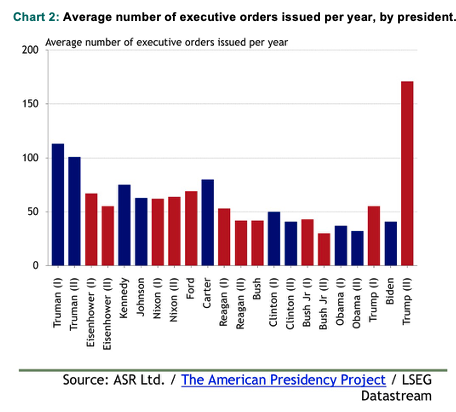
Entrenched MAGA. On November 6, the president named Stephen Miller, a well-known MAGA hardliner, as his new chief of staff. Despite Trump’s early chatter of working across the aisle, the White House apparently intends to double down on executive power. This administration has issued more executive orders than any president in history, and we can expect more of the same.
Tariffs subside. Over the next two years, tariffs should carry less weight than they did over the previous two. Some will remain, because they now raise real revenue and are hard to unwind. Others are likely to be traded away at the bargaining table; Canada, Mexico, and China are the places to watch.
Let’s make a deal. The most interesting possibility is a fiscal bargain. The president has signaled a willingness to work with Democrats, and history says fiscal policy tends to loosen heading into a presidential election. A deal could pair more defense spending with restored health-care subsidies and a permanent extension of the expiring tax cuts.
The Economy: The Fed Is Nearly Done
Perhaps fewer hikes. The Federal Reserve has already pushed the Federal funds rate to 3.75%–4.00%, and the 10-year Treasury yield has settled a bit since its recent 5.3% high. Markets are pricing in two to three more interest rate hikes, but we think only one or two to be more likely. Look for a hike in December and possibly another in March. The Fed’s aim is to anchor inflation expectations while energy prices are high, not to crush an economy that is still growing solidly.
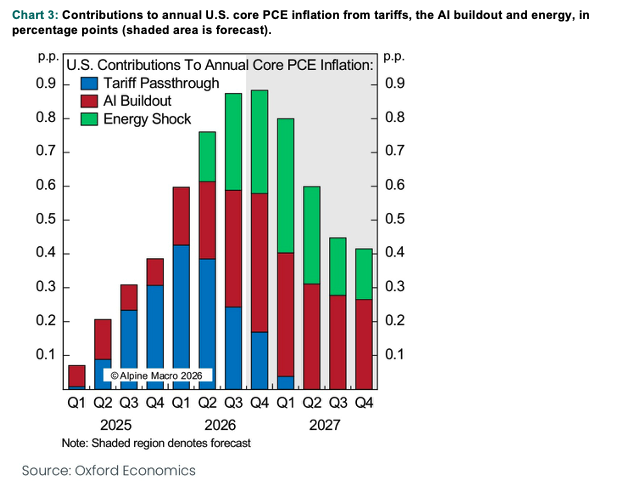
Inflation should ultimately fade. Energy, tariffs, and the AI buildout have all added to inflation this year. We expect that pressure to peak around year-end, and then subside gradually through 2027. Oil is the swing factor. Crude flows through the Strait of Hormuz have largely recovered, and the squeeze now sits in refined products such as diesel, which should ease as refining capacity catches up. Over the next couple of years, we expect oil to drift toward $60 per barrel.
A steeper curve. If we are right, the yield curve steepens from the front end. Short-term rates fall as the Fed hikes less than the market fears, while long-term rates stay elevated, propped up by record government debt and the cost of financing the AI buildout. Heavy deficit financing is the reason, and it is why we are keeping bond duration short for now.
The Markets: Cautious Now, Constructive Later
Near-term caution. Markets tend to wobble around midterms, and this year’s setup is edgier than usual. The trading day immediately after the election was very strong, with stocks rising across the board. The following day, investors ran for the exits; the S&P index dropped 4.4% and some AI stocks ended far worse. The following Friday and Monday, tech stocks rebounded.
As an asset manager, the past few days have been like watching a herd of bison changing direction on a whim. Like Billy Joel’s 1976 song “Summer, Highland Falls,” market participants seem to be vacillating between “sadness or euphoria.” In these environments, I typically treat any weakness as an opportunity to add, not necessarily a reason to run.
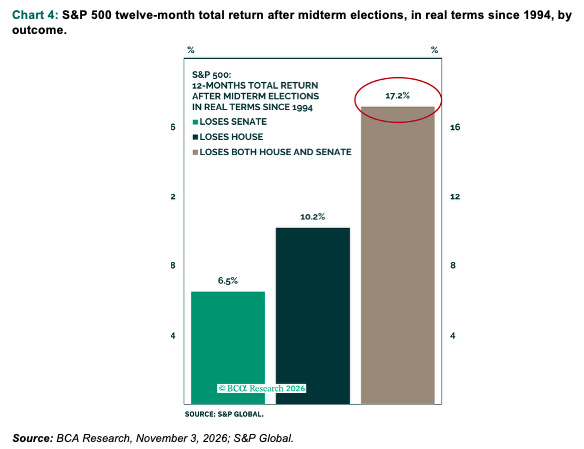
Medium-term optimism. Stocks have typically posted solid gains in the year after a midterm, and the best returns have come when the opposition party wins both chambers, with real gains of roughly 17% on average. Gridlock tends to shrink policy uncertainty. Meanwhile, corporate earnings estimates are rising at the fastest pace in 35 years, and AI investment is largely committed.
The politics of AI. Federal legislation is unlikely to derail the buildout in the next two years, since a veto stands in the way and AI is increasingly seen as a national security imperative. However, voters are noticing rising power bills near new data centers, and governors, utility regulators and zoning boards who control permits, rates and grid access report to those voters. There could be some resistance at the state or local level, but the hyperscalers have the means to shift their plans to other locations.
Themes remain intact. Many of the themes we favor still hold: memory chips and semiconductors; critical and industrial metals; the power grid and infrastructure; and a preference for Asia over Europe.
Planning: The Real Question Is 2028
Gridlock should carry us through the next two years without major tax changes; however, 2029 is another matter. If Democrats retain Congress and win the White House, a more left-leaning majority would likely pursue higher taxes on wealth and income. While this would certainly help the budget, it could have significant repercussions on economic growth.
With that in mind, midterm results are historically a poor guide for predicting the outcome of the next presidential race. On paper, the economy should favor the party in the White House, with low unemployment, growing incomes and a much smaller cumulative rise in prices than in the previous administration.
But voters are sour, and only about one in five Americans say they are satisfied with the direction of the country. By early 2028, markets will assess the likelihood of a Democrat-controlled government, which is why we see the next two years as a favorable window for tax-aware planning. A few conversations are worth having now:
- Taxes on gains. For some, realizing gains at current rates over the next two years may make sense. It will not suit everyone, since deferral and the step-up in basis at death can be valuable.
- Gifting. If the step-up in basis or the lifetime exclusion were reduced, gifting strategies could look very different.
- Roth conversions. Paying tax now at known rates may reduce exposure to higher rates later.
- Tax-efficient income. If income tax rates ultimately rise, investors should carefully consider the tax treatment of their investment income.
Every one of these depends on your income, tax bracket, and goals. Please speak with your advisor before establishing a tax strategy on your own.
What’s Next?
Between a tougher White House, a combative Congress, a December funding deadline, and an unfinished conflict in the Gulf, there will be no shortage of mind-blurring headlines. The question is whether those pieces add up to calm or chaos. We think it is noisy now and constructive later. Corporate earnings remain strong; the Fed is being cautious; and oil prices should eventually ease. The economy is growing steadily, and we will continue to study the markets and search for opportunities.
SOURCES:
Alpine Macro, “A U.S. Midterms Update: A Democratic Congress, A Freer Trump”, written by Dan Alamariu, October 26, 2026
BCA Research, “Democratic Victory Not A Market Risk”, written by Matt Gertken, November 3, 2026
BCA Research, “The Real Meaning Of The Midterms”, written by Matt Gertken and Marko Papic, November 4, 2026
Oxford Economics, “Midterms Q&A – Implications for Trump’s final two years and beyond”, written by Bernard Yaros and Sara Godfrey, November 4, 2026
CNN exit poll data (Chart 1), as presented by BCA Research, November 4, 2026
ASR Ltd., The American Presidency Project and LSEG Datastream data (Chart 2)
Oxford Economics data (Chart 3)
S&P Global data (Chart 4), as presented by BCA Research, November 3, 2026
David Tepp is the founder and chief wealth strategist of Tepp Wealth Management, an SEC-registered investment advisor based in Westfield, New Jersey. With over 20 years of experience in wealth management, David provides strategic financial planning and investment advisory services to high-net-worth individuals and families. He frequently writes on macroeconomic policy, fiscal risk, and market strategy to help investors navigate an increasingly complex global economy.
DISCLOSURES:
Tepp RIA, LLC dba (Tepp Wealth Management), is a SEC registered investment adviser. For information pertaining to the registration status of Tepp Wealth Management, a copy of Tepp Wealth Management’s current written disclosure statement discussing Tepp Wealth Management’s business operations, services, and fees is available at the SEC’s investment adviser public information website – www.adviserinfo.sec.gov (CRD# 283899) or from the Adviser upon written request: Tepp Wealth Management, 210 Elmer Street, Westfield, NJ 07090.
This article is an expression of corroborated facts along with the opinions of the author. This is for informational purposes only and is intended to inform the reader about market related activities which could affect individual portfolios and provide insight on specific relevant topics. It is not intended to recommend or suggest any specific course of action or investment strategy. The reader should not infer the likelihood of any future events. Past performance is not indicative of future results. Investors should always consult an investment professional and/or tax professionals to discuss their unique needs and objectives.
Please remember that different types of investments involve varying degrees of risk, and there can be no assurance that the future performance of any specific investment or investment strategy (including those undertaken or recommended by the Adviser), will be profitable or equal any historical performance level(s).
Tepp Wealth Management may discuss and display charts, graphs, and formulas that are not intended to be used by themselves to determine which securities to buy or sell, or when to buy or sell them. Such charts and graphs offer limited information and should not be used on their own to make investment decisions. This information is provided for guidance and information purposes only and is not a solicitation. Be sure to first consult with a qualified financial adviser and/or tax professional before implementing any strategy.
A message from Advisor Perspectives and VettaFi: Discover something new! Click here to register for our upcoming webcasts.
Membership required
Membership is now required to use this feature. To learn more:
View Membership Benefits