
Advisor Perspectives welcomes guest contributions. The views presented here do not necessarily represent those of Advisor Perspectives.
A veteran advisor I coach, whom I’ll call David, recently lost a referral he expected to close. The prospect went with a competitor who, in the prospect’s words, “was offering more.”
The prospect had been clear about what he wanted: “I’m tired of getting S&P 500 returns. I’m looking for someone to help me pick stocks that can really make this thing grow.”
David isn’t alone. Advisors across the country are hearing versions of the same request. Another client told David that 12% a year was his “conservative” target. The index that has served investors well for decades is suddenly considered passé.
This puts prudent advisors in a bind. Agree to chase the number, and you take on risk the client doesn’t understand. Refuse, and you risk losing the client to someone who will promise it.
Where the Expectations Come From
The main driver is recency bias. We give the most weight to whatever happened most recently. After several strong years in the market, many investors, especially those who have never lived through a serious bear market, assume that strong returns are forever.
Artificial intelligence has added fuel. Many clients now believe AI has made stock picking safer and more predictable. When a client hears that software can identify the next winner, concentrated bets start to feel prudent rather than speculative.
The math tells a different story. At 12% a year, money doubles roughly every six years. Sustaining that for a long period requires taking substantially more risk than a diversified portfolio. And losses hurt more than gains help. A portfolio that falls 50% needs to gain 100% just to get back to even.
3 Landmarks of a Speculative Market
David has watched several market cycles, including the dot-com collapse and the 2008 housing crisis. He describes three landmarks that tend to appear when sentiment turns speculative:
- Easy money at the bus stop. Get-rich opportunities are advertised directly to the public. Before 2008, mortgage offers were on billboards and bus benches.
- Prudent advice gets dismissed. Investors wave off sound strategies in favor of perceived shortcuts. In 2006, the refrain was, “Why invest when I can just flip a house?”
- Leverage takes over. People borrow heavily to participate, which turns a correction into a crisis.
In David’s view, the first two landmarks are clearly visible today. Higher interest rates have so far held back the third. None of this predicts when a correction will come. But it is a reason to handle return-chasing requests with care rather than enthusiasm.
Don’t Argue the Number. Ask What It’s For.
The instinct is to push back with data: long-term averages, standard deviations, and drawdown charts. That rarely works. When you argue with a client’s number, you’re arguing with their hopes. They hear “no,” and they go looking for someone who will say “yes.”
A better approach is to reframe the return target as a life goal. A number like 12% is abstract. A goal is concrete, and it can be funded with a plan instead of a gamble. The process has three steps.
- Acknowledge the target and probe it. Treat the number with curiosity, not judgment. “Why 12%? Why not 14%?” This signals respect and makes the client explain their thinking.
- Uncover the underlying need. Almost every return target is a stand-in for something else: more travel, early retirement, helping grandchildren, or security.
- Quantify the goal. Put a price and a date on it. Once the goal has a number, you can show how to fund it, often at a much more reasonable return.
Here is how that conversation can sound:
Client: I want 12% a year. That’s conservative these days.
Advisor: I hear you. Help me understand why 12%. Why not 14%?
Client: Because I want to travel a lot more while I’m still healthy.
Advisor: That’s a great goal. Where do you want to go, how often, and what do you think it will cost each year?
Now you’re no longer debating a return. You’re building a retirement plan. If $40,000 a year of travel is fully funded by the existing plan, the client doesn’t need 12%. And if it isn’t, you can discuss saving more, adjusting the timeline, or taking measured additional risk, with the client fully aware of the trade-off.
Make Big Numbers Feel Real
Speculative markets thrive on numbers that are too large to grasp. Valuations reach the billions and trillions, and the difference between them starts to blur. David uses a simple time analogy to restore perspective: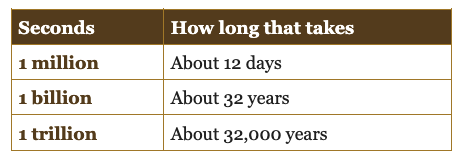
When a client realizes a trillion is not a bit more than a billion but a thousand times more, they look at lofty company valuations and promised growth rates with fresh eyes. The analogy doesn’t lecture. It lets the client reach the conclusion on their own.
The Bottom Line
You can’t talk clients out of recency bias with statistics. You can redirect it by asking what their return target is really for. When the conversation shifts from a number to a goal, you stop competing with advisors who promise more and start offering something they can’t: a plan the client believes in and can live with when markets turn.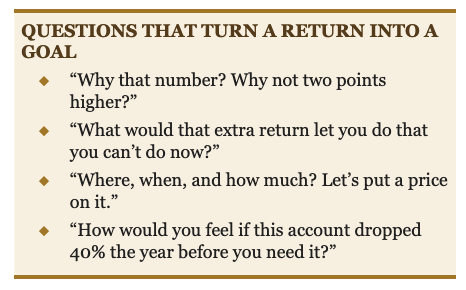
Kerry Johnson, MBA, Ph.D., is a best selling author of 18 books including the upcoming "Resilience: How faith and science can help you bounce forward". He speaks at industry conferences around the world and is a financial advisor business coach promising to increase sales by 80% in 8 weeks.
A message from Advisor Perspectives and VettaFi: Discover something new! Click here to register for our upcoming webcasts.
