The Fed Risks a Policy Error Fighting Oil Prices
Membership required
Membership is now required to use this feature. To learn more:
View Membership Benefits Advisor Perspectives welcomes guest contributions. The views presented here do not necessarily represent those of Advisor Perspectives.
I received both criticism and praise for asking if bonds are pricing in a Fed policy mistake. Given the strong feelings surrounding the topic, I think it is worth digging deeper into that question. United Airlines' recent earnings report offers a timely illustration of inflation mechanics and one that supports my growing concern that the Fed, by raising rates, risks making a policy error.
United reported that its fuel expenses jumped 62% from a year ago as the average price it paid for jet fuel rose to $3.90 a gallon. Importantly, United CEO Scott Kirby said the company "will not recapture 100% of fuel costs in Q4."
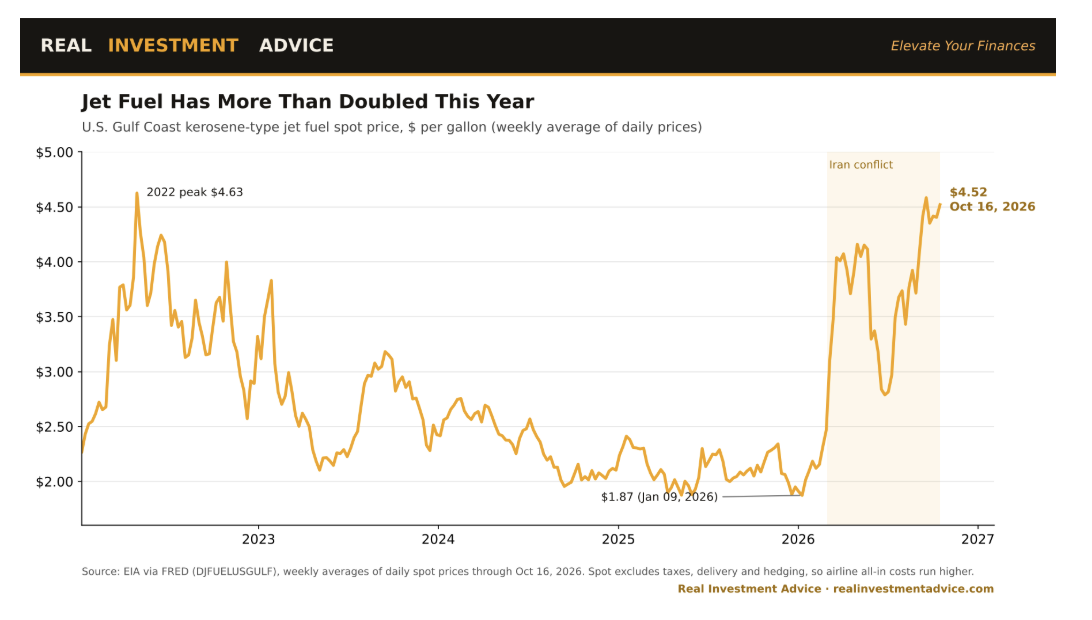
Not recapturing 100% of fuel costs means United raised fares to offset jet fuel costs. Whether the airline raised fares enough to cover higher energy costs is irrelevant to this analysis. What matters is that airlines are passing higher energy costs through to consumers via fare inflation.
Jet Fuel Is Fueling Inflation
The CPI data confirm that higher fuel costs are fueling airfare prices. Airline fares rose 22.4% over the last year. While they rose mainly because of higher energy costs, those increases still factor into core CPI, even though core CPI excludes energy prices. The BLS classifies airfares as a transportation service, not energy.
With a weight of roughly 1.1% of the BLS core CPI figure, airfares alone added about a quarter point to the 2.56% core CPI annual reading for September. In other words, the Iran-driven oil shock and recent events in the Ukraine-Russia war are leaking into the inflation measure that’s supposed to exclude energy prices.
From an investment perspective, this wonky CPI discussion could matter for financial markets if the takeaway is that the Fed is misgauging core inflation. A false reading of oil's impact on CPI, given its transitory nature, makes the Fed more prone to making a policy error with negative implications for the economy and, ultimately, the stock market.
Oil Exposure in the CPI Figure
Airfares are not the only CPI items sensitive to oil prices and contributing to core CPI. Accordingly, my team looked for other CPI items whose prices strongly correlate with oil. We didn’t just look for a strong correlation; we also considered the time lag between energy price changes and when those changes affected selected goods. With this logic, we built our own version of core CPI that strips out energy and energy-related items with high correlations and short lag times.
The model tests the correlation of CPI components against WTI crude prices since 2008. The table below shows the results. We grouped candidates for exclusion into three tiers:
- Tier 1 (Direct Petroleum Fuels): Gasoline, diesel and other motor fuels, fuel oil, propane, and kerosene. These products have the tightest link to crude oil, and the BLS excludes them from the core CPI, as do we.
- Tier 2 (Fuel-Intensive Transportation): Airline fares, other intercity transportation (bus, rail, and ship fares), and delivery services. Jet fuel is a large share of airline operating costs, and parcel carriers add fuel surcharges. Delivery services are the closest the CPI comes to measuring trucking costs affected by diesel prices. We exclude these from our core CPI while the BLS includes them.
- Tier 3 (Weak or Lagged): Car rental, moving and freight, local transit, tires, and vehicle accessories. These prices are linked to oil, but the data show a delayed relationship. We keep them in our core CPI measure.
Interestingly, moving, storage, and freight (the item that sounds most like trucking) have a correlation of only 0.14. Pricing for those services is much more dominated by labor costs.
We placed electricity and natural gas in Tier 1, as the BLS already removes both from core CPI. Combined, Tiers 1 and 2 account for 7.51% of the CPI.
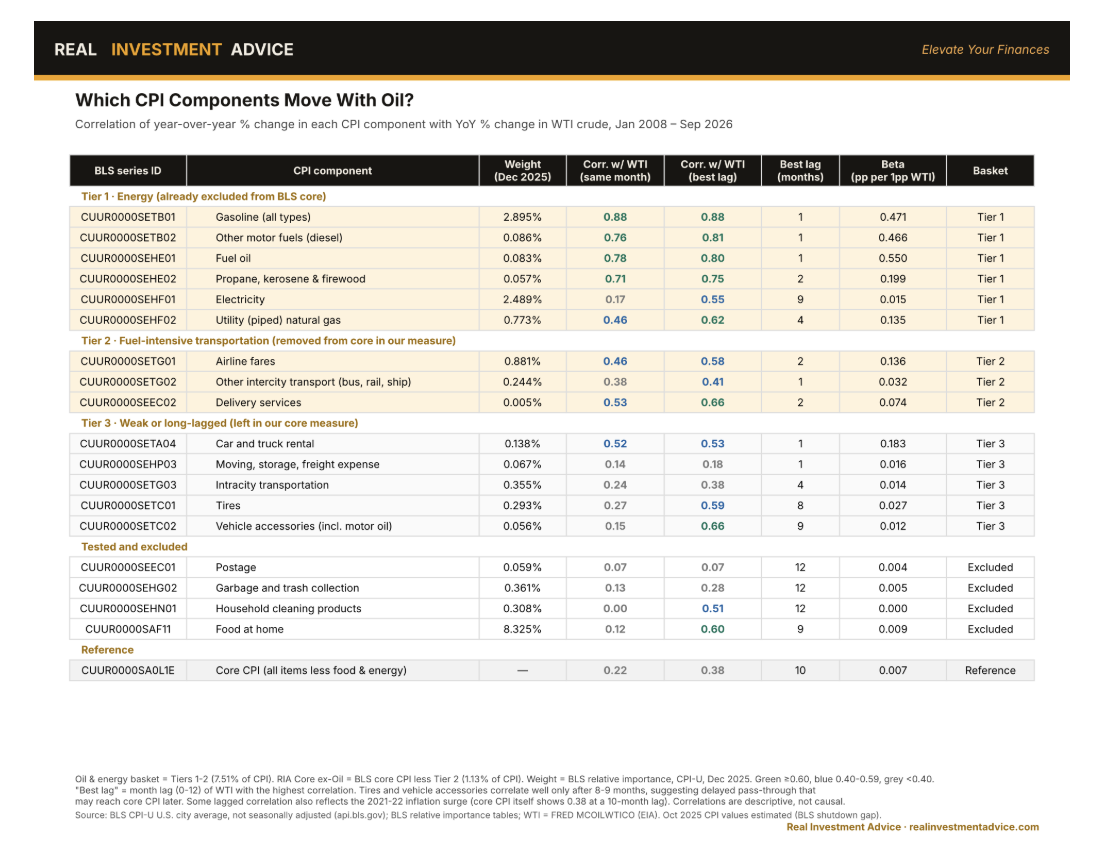
Tier 3 is interesting. It includes tires and vehicle accessories, including motor oil, which show little relationship to oil prices in the same month, with correlations of 0.27 and 0.15. However, their correlations jump to 0.59 and 0.66 when compared to oil prices nine months earlier. Synthetic rubber, carbon black, and lubricants are petroleum-based, but manufacturers and retailers pass those costs through slowly. Car rental has a modest 0.52 correlation, but renters buy their own fuel.
Tier 3 prices are affected by oil, but with a long enough lag that we thought it best to exclude them to provide a more current assessment of inflation. However, because oil prices started rising in March, the impact on Tier 3 prices is starting to reach core CPI. Thus, our core CPI is slightly higher than reality.
Oil Explains the Inflation Rebound
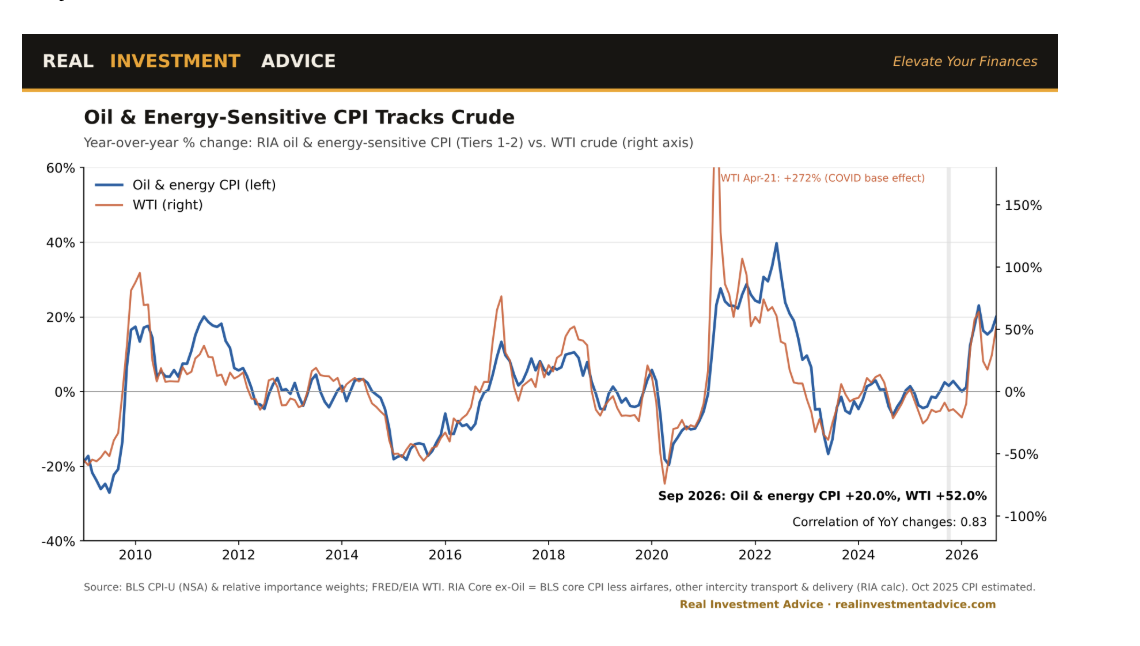
Our Tier 1 and 2 basket tracks crude closely, with a 0.83 correlation over the last 25 years.
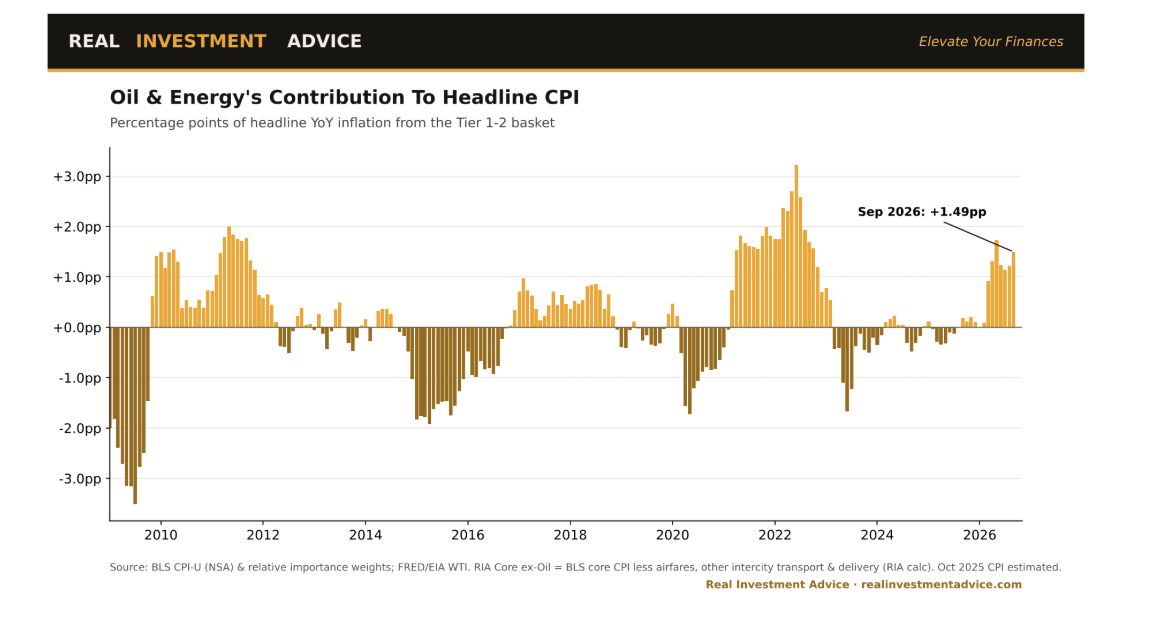
Oil and energy-related items added 1.49 percentage points to headline CPI. That is large but not unprecedented. They added 3.23 points in June 2022 and subtracted 3.51 points in July 2009.
High oil prices significantly affect the BLS headline CPI, BLS core CPI, and our core CPI model. In January, BLS core CPI and our core ex-oil were nearly identical, at about 2.5%. As oil rose, the BLS core climbed to 2.85% in May, while our measure peaked at 2.59%. In September, the BLS core was 2.56%, versus 2.35% for our core measure. The difference (the gold shading on the graph) represents the impact of fuel-sensitive services inside core CPI.
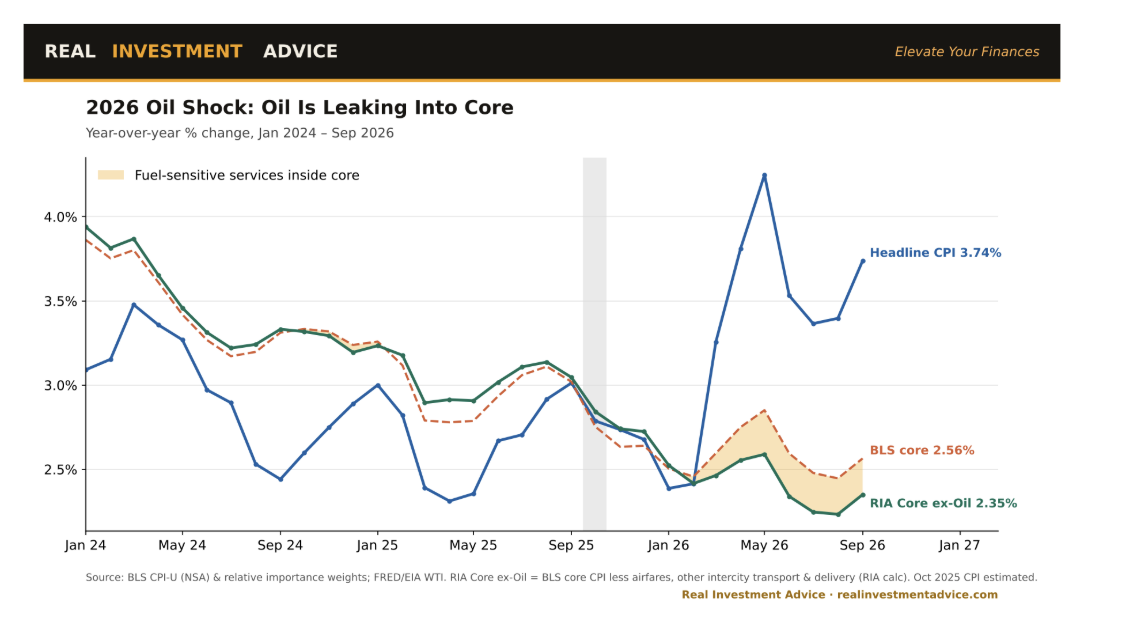
Over the longer term, our core reading and BLS core CPI are very similar. That makes sense, as Tier 2 is a small share of core prices. The two diverge primarily during severe oil shocks.
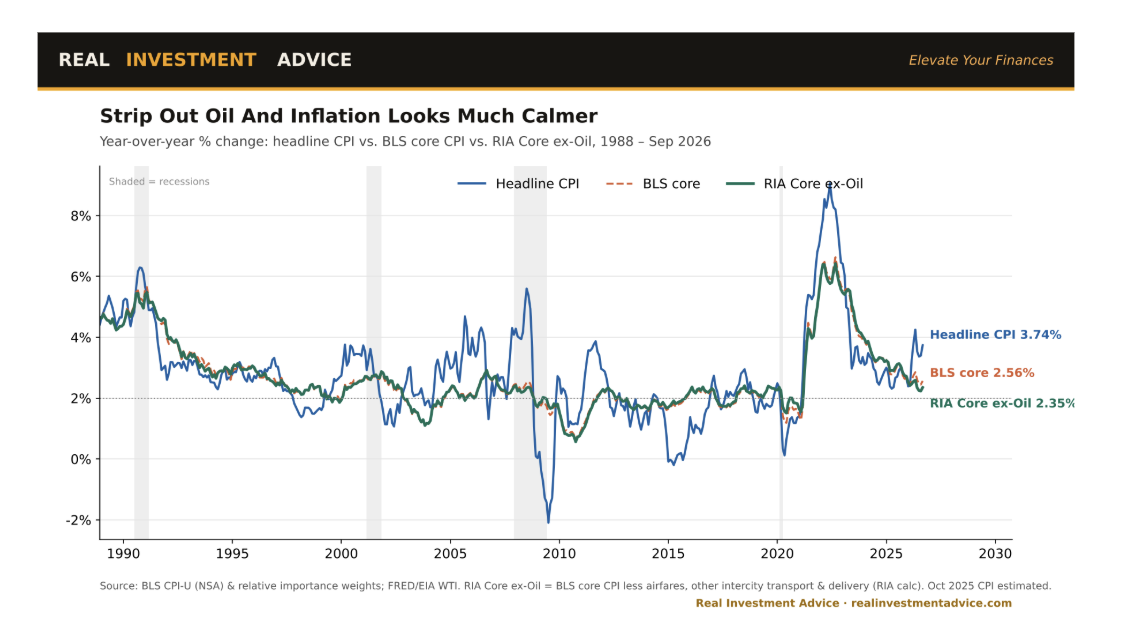
While the 20–30 basis point differential between our model and the BLS gauge is relatively small, our model overestimates core inflation, meaning the true differential is likely larger. We didn’t exclude Tier 3 items whose prices are rising with oil prices, nor did we exclude other items whose prices are partially affected by higher oil prices. An exhaustive analysis using our model would likely render a core CPI reading much closer to the Fed's 2% inflation target.
Policy Is Already Restrictive
The Fed raised rates by 25 basis points in September to a range of 3.75% to 4.00%. According to the minutes: “Most judged that another rate increase would likely be appropriate by year-end.”
The median Fed projection now puts the fed funds rate at 4.1% at year-end. Dallas Fed President Lorie Logan suggested another 50 basis points may be needed, and other members have echoed that sentiment.
The Fed gauges how restrictive policy is by comparing fed funds to inflation. Using BLS headline CPI, the real fed funds rate is roughly zero, which supports the hawks' argument that policy is not restrictive. Using our Core CPI, the real rate is 1.40%.
The Fed's quarterly Summary of Economic Projections (SEP) provides some context for gauging whether policy is restrictive or accommodative. Its longer-run fed funds estimate is 3.2%, alongside a 2% inflation target. That implies the Fed views a real rate of about 1.2% as neutral. Using our core figure, Fed policy is already 0.20% above the Fed's neutral rate. If the Fed hikes further in the fourth quarter, that spread will widen.
Long-Term Rates Make Policy Tighter
Consumers and businesses do not borrow at the fed funds rate. Mortgages, corporate bonds, and many bank loans are priced off longer-term Treasury yields. The 10-year Treasury sits around 5%. Subtracting our core CPI, the real 10-year yield is 2.64%, the highest level since 2010. The average since 2008 is just 0.26%.
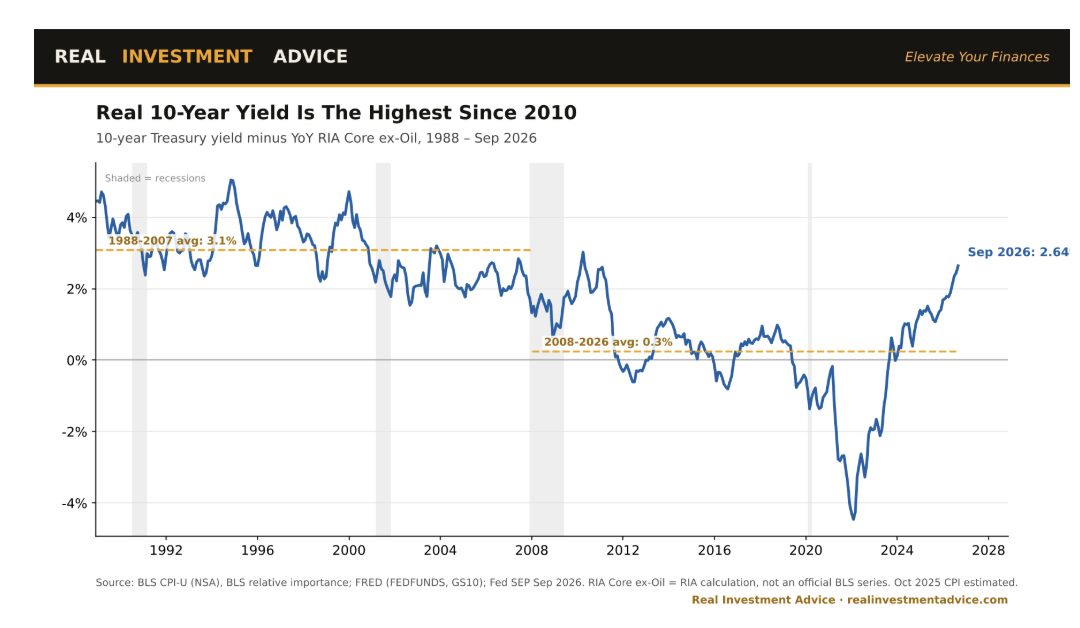
Borrowing costs this far above inflation weigh heavily on housing, capital spending, and credit-sensitive sectors. In other words, the Fed should consider that the bond market is doing much of the Fed's tightening for it.
Is the Fed Overreacting to Oil?
Oil prices did not rise because the domestic economy overheated. WTI averaged $58 in December 2025 and has oscillated between $80 and $105 as geopolitical conflict disrupted supply.
Higher interest rates will not reopen shipping lanes or extract another barrel of oil. Rate hikes work by slowing demand, and their full effects can take a year or more to show up. If the Fed tightens further in response to oil-driven inflation, it risks slowing the economy. The prolonged impact of raising the Fed Funds rate, coupled with the recent surge in long-term bond yields, is exactly the kind of over-restrictive policy mistake the bond market may be worried about, helping explain the recent decline in long-term yields.
Summary
Our core CPI is about 20 to 30 basis points below the official BLS version, with both trending lower. Unlike headline CPI, core inflation is not accelerating uncontrollably, even if it sits above the Fed’s 2% target.
This suggests that the Fed may be fighting higher oil prices with a policy designed to slow economic growth and tighten financial conditions. If the BLS core CPI and our core CPI continue to drift toward 2% or fall below it, the risk of policy increases with each Fed funds hike and each tick higher in longer-term yields.
Read more by Michael Lebowitz:
- Are Bonds Pricing In a Fed Policy Mistake?
- Think Rates Are Peaking? Consider Mortgage-Backed Securities
- Worried Consumers Keep Spending: Here's Why
Michael Lebowitz is a portfolio manager with RIA Advisors and author for Real Investment Advice. For more information, contact him at [email protected] or 301.466.1204.
Join RIA Advisors and elevate your career within a deeply experienced team focused on innovation. Our collaborative environment is built on a foundation of advanced technology and effective investment models, designed to enhance your ability to serve clients and grow your practice. Benefit from a supportive culture that encourages professional development and fosters a forward-thinking approach. By joining our team, you’ll be part of a group dedicated to excellence and continuous improvement, empowering you to focus on building meaningful client relationships and pursuing your business ambitions. Discover the advantages of working with our accomplished advisory team by starting your conversation today.
A message from Advisor Perspectives and VettaFi: Discover something new! Click here to register for our upcoming webcasts.
Membership required
Membership is now required to use this feature. To learn more:
View Membership Benefits