The views presented here do not necessarily represent those of Advisor Perspectives.
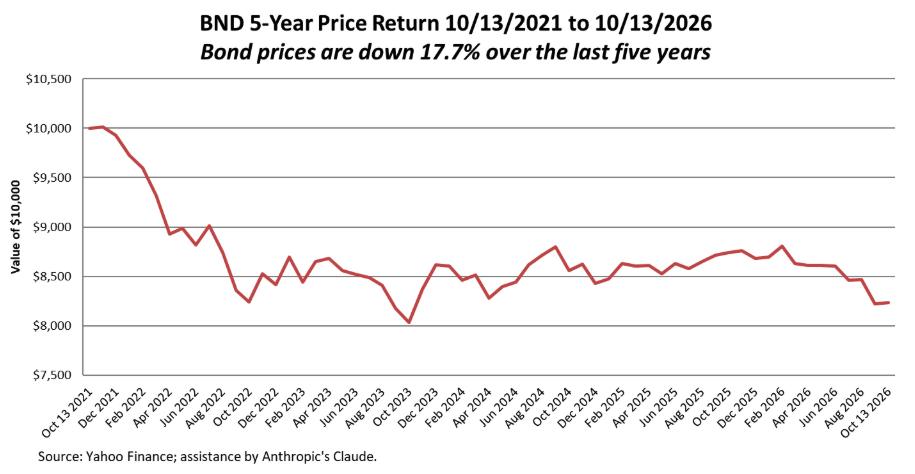
Investors who own bonds are seeing losses in their accounts. Many are not happy, and many just want out. The losses over the past five years are significant. In the example below, the Vanguard Total Bond Market ETF (BND) has lost 17.7% over the past five years. After the biggest decline in the history of the bond market in 2022, bonds stabilized until this year, when the decline resumed. Here’s why I tell clients that they should be thrilled.
Bond Basics for Clients
I spend a lot of time explaining bonds to clients, and I always begin by saying that bonds are the simplest investment to understand. A bond is a loan. When you buy a bond, you are lending money to a government or corporation. They are legally obligated to pay it back with interest. The interest is typically paid out during the period of the loan. Your expected return is that principal plus the interest, assuming the borrower doesn’t default.
To further the example, I have the client imagine they lent me $100 for 10 years at a 5% annual interest rate. I would be legally obligated to pay the client $5 in interest per year plus the $100 principal back at the end of the 10 years. To explain interest-rate risk, I tell them that right after they lent me this $100, rates went up to 7%. This means they are still getting the $5 a year in interest, but the market says $7 is the going rate. So this bond is now worth less than $100. If rates had instead gone down to 3%, the above-market payment means the bond is worth more than $100. I then illustrate default risk by noting that it doesn’t matter what happens to interest rates if I file for bankruptcy.
Explaining the Bond Losses
Note that the expected return on the tenth year in the example above is the return of principal and not a dime more, other than the interest payments. So why do we expect the price of a bond or bond fund to increase? Because we got used to the 40-year great bond bull market between 1981 and 2020.
Rates declined sharply during this period, causing the price of the bonds to increase as yields plummeted toward zero (and were actually negative in Germany). BND was yielding about 1.6% at its low. It would have been virtually impossible for that bull market to have continued past 2020 unless we would accept large negative nominal returns.
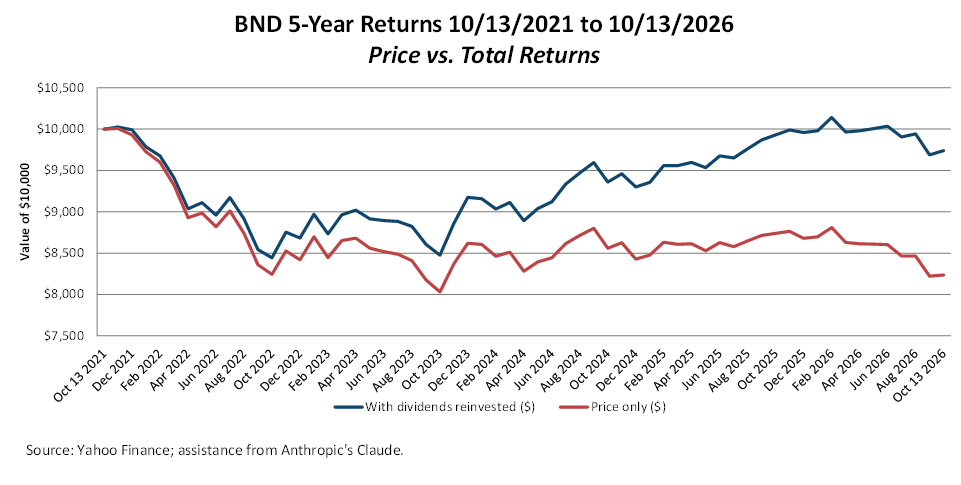
Yet I also tell clients that they didn’t lose the 17.7% in the chart above. They should consider their total return, which includes interest payments typically shown as dividends for funds. Still not great, but the total return with dividends reinvested was a loss of 2.6%, which is at least a far cry from the price-only return.
Why We Should Be Happy
First the good news, and then I’ll follow with the great news. The bond decline didn’t come from defaults; it came from surging interest rates. BND is yielding 5.13% as of October 13, 2026. In short, I tell the client to expect an average of zero gain to a slight loss in the principal value of their bond fund. Why a slight loss? There will likely be some defaults in corporate bonds. At one time the Bloomberg Aggregate Bond Index, which BND follows, was called the Lehman Brothers Aggregate Bond Index, and I’m sure you know why that change occurred. General Motors is another example. Even iconic investment-grade companies go bankrupt.
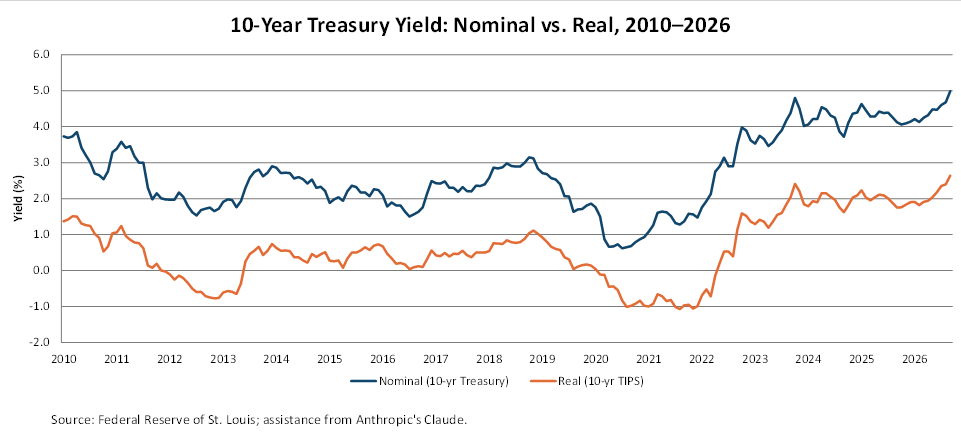
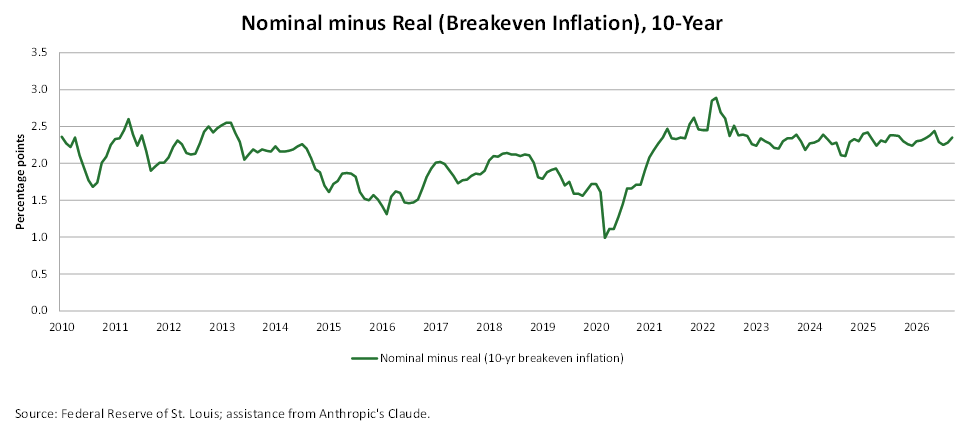
Common wisdom is that interest rates increased because inflation expectations increased, pushing those yields up. With higher inflation, real returns are no higher. The argument is half true in that inflation increased, but future inflation expectations did not. Comparing the 10-year nominal versus real yields of the Treasury bonds, the differences — known as the breakeven rates — are the market’s expectations of future inflation. Those differences are relatively steady.
The chart below shows the differences between the nominal and real yields over time. Note that the market’s expectations for future inflation over the next decade aren’t significantly higher than in the past, other than a brief period in 2020 during the COVID-19 pandemic.
I tell clients to “get real,” as in think in real inflation-adjusted terms. So the good news is that we can now get much higher nominal yields, and the great news is that it’s real. In 2021, we could lock in a -1% percent real return on TIPS and today the real return is nearly 3%. So, if the market is right, we should expect our spending power to grow faster than inflation. If we want to insure against the market being wrong, we can include TIPS in the portfolio to guarantee a real return.
The Wall Street Trickery of Buying Individual Bonds
I wish I had a dime for every time I’ve heard that buying individual bonds eliminates interest-rate risk. That’s typically the excuse for why a brokerage or SMA can charge so much more to build a laddered bond portfolio rather than buying a simple low-cost bond fund. The argument goes that if you buy a bond yielding 5%, you know you will get that 5% along with your principal back. That’s both true and completely misleading.
In the example in the beginning of this piece, with the client lending me $100 at 5%, the fact that the rates went up to 7% in no way protects them from that two-percentage-point increase. The lender earns a below-market interest rate and suffers an economic loss. In other words, the net present value of that annual $2 shortfall versus the market is exactly how much the price of that loan would have fallen, if it were a publicly traded bond. It’s easy to trick yourself into believing you haven’t lost anything, but “trick” is the key word.
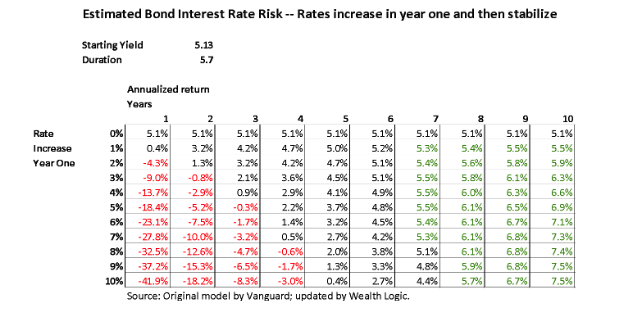
Most bond funds are laddered bond portfolios. BND is a laddered portfolio of over 16,000 bonds. That diversification drastically reduces default risk versus a ladder of a few dozen bonds. BND has a current yield of 5.13% and a duration of 5.7 years. In the chart below, I estimate the interest-rate risk for this laddered bond portfolio.
As an example, if interest rates rose by four percentage points in the first year, this bond fund would lose an estimated 13.7% of total return. But, if rates then stabilized and the investor did nothing, the client would earn a positive return by year three and even more than the current yield before the rate increase by year seven. That’s because as the old bonds run off, they are buying new bonds that are yielding four percentage points more.
Conclusion
My bonds are showing a loss, just like my clients’ are. I’m thrilled that real yields have surged. If stocks decline, there is no assurance they will recover in the next few years. It’s different for bonds that don’t default. Rates have surged, and it’s because real rates have surged rather than higher inflation expectations. Higher real rates mean we can earn far more than inflation.
Bond funds are generally not riskier than individual bonds. The one exception is buying individual TIPS since one will know with virtual certainty how much buying power they will produce if held to maturity. Let’s hope bond prices don’t surge again. It will mean lower real rates, which is bad for our portfolios and financial independence.
Allan Roth is the founder of Wealth Logic, LLC, a Colorado-based fee-only registered investment advisory firm. He has been working in the investment world of corporate finance for over 25 years. Allan has served as corporate finance officer of two multibillion-dollar companies and has consulted with many others while at McKinsey & Company.
A message from Advisor Perspectives and VettaFi: Discover something new! Click here to register for our upcoming webcasts.
More Smart Beta Topics >
 The views presented here do not necessarily represent those of Advisor Perspectives.