A Crowded Exit? A Discussion on the Yen Carry Trade
Membership required
Membership is now required to use this feature. To learn more:
View Membership Benefits Advisor Perspectives welcomes guest contributions. The views presented here do not necessarily represent those of Advisor Perspectives.
Filling Up the Room
Many investors and news followers have heard about the prevalence of the Japanese yen and U.S. dollar carry trade. At its core, a carry trade is simply borrowing where money is relatively cheap (Japan) and investing where the expected return is higher (U.S.). This strategy captures the difference in interest rates, but it also exposes investors to changes in interest rates and foreign currency exchange rates.
The steps of the yen carry trade are as follows:
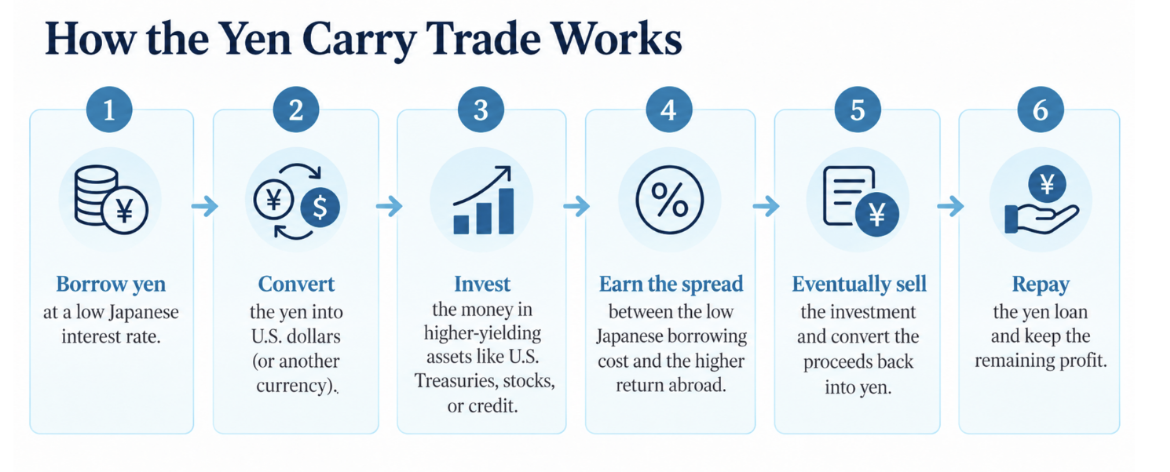
Japan maintained historically low interest rates for years, making the yen a common funding currency for global carry trades, some of which have been invested in U.S. Treasuries and other U.S. assets. As the Bank of Japan (BOJ) has recently raised rates, headlines have focused on a simple question: What happens if investors decide it is time to head for the exit?
What Could Send Investors Toward the Exit
On September 18, the BOJ voted seven-to-two to raise its overnight policy rate to around 1.25%.1 With the BOJ increasing rates, parts of the market have highlighted the worry of a rapid unwind of the carry trade, which could draw capital out of U.S. Treasuries and investment markets, weaken the U.S. dollar, and increase U.S. interest rates.
If a rapid unwind occurred, the potential effects could include:
- Higher U.S. yields that could make government, corporate, mortgage, and consumer debt burdens more significant, reducing incentives to borrow and slowing economic growth
- A weaker U.S. dollar that could add additional inflationary pressures for an importing nation like the U.S., where inflation remains a concern
- Unwinding carry trades that could make other carry trades less profitable and incentivize more quick exits, potentially leading to a snowball effect
While this sequence of events is possible, it represents one of many potential outcomes rather than a predetermined result. Focusing on the most relevant factors, we can gain a better understanding of the yen carry trade as a whole.
Why Investors May Stick Around
While real risks exist, essential market context helps separate the plausible scenario from the headlines.
Putting the Size Into Context
Japan holds around $1.1 trillion in U.S. Treasuries, making it the largest foreign holder, but that total represents only around 3–4%1 of the overall marketable U.S. Treasury market. Importantly, not all of those holdings are tied to the carry trade. Japanese banks, insurers, pension funds, and government entities hold Treasuries for many reasons beyond simply earning the interest-rate spread.
A Change in Destination Does Not Require a Stampede
Rising Japanese yields and yen strength make Japanese sovereign bonds more attractive and encourage some capital to move back to Japan, but that does not necessarily mean forced selling.
Portfolio adjustments could occur through maturing bonds, reduced future purchases, portfolio rebalancing, or more rapid selling activity. The speed and magnitude of any changes are uncertain, but there are many ways to lower exposure without placing extreme pressure on the market.
The Rate Gap Remains
The governor of the BOJ, Kazuo Ueda, indicated that larger or consecutive rate increases would likely require substantially greater inflation pressures. Additionally, two board members dissented in favor of not raising rates.
Meanwhile, the Federal Reserve unanimously passed a rate hike the previous week, and three rate hikes are currently priced in through 2027, as noted by CME Group’s FedWatch.2 Currently, the Fed’s target range is 3.75–4.00%, versus BOJ’s 1.25%.1 Although future policy decisions will alter this relationship, a substantial interest-rate differential remains between the U.S. and Japan.
Speed Matters as Much as Direction
The speed of currency change also matters. A sudden spike in yen strength diminishes carry-trade margins quickly. But what if the yen weakens? Or slowly grows in strength? These other possibilities lead to a much less volatile event, giving investors time to reposition portfolios or even returns reinforcing the carry trade.
As shown below, the yen-to-dollar exchange rate has changed many times in the last three years without causing large sell-offs.
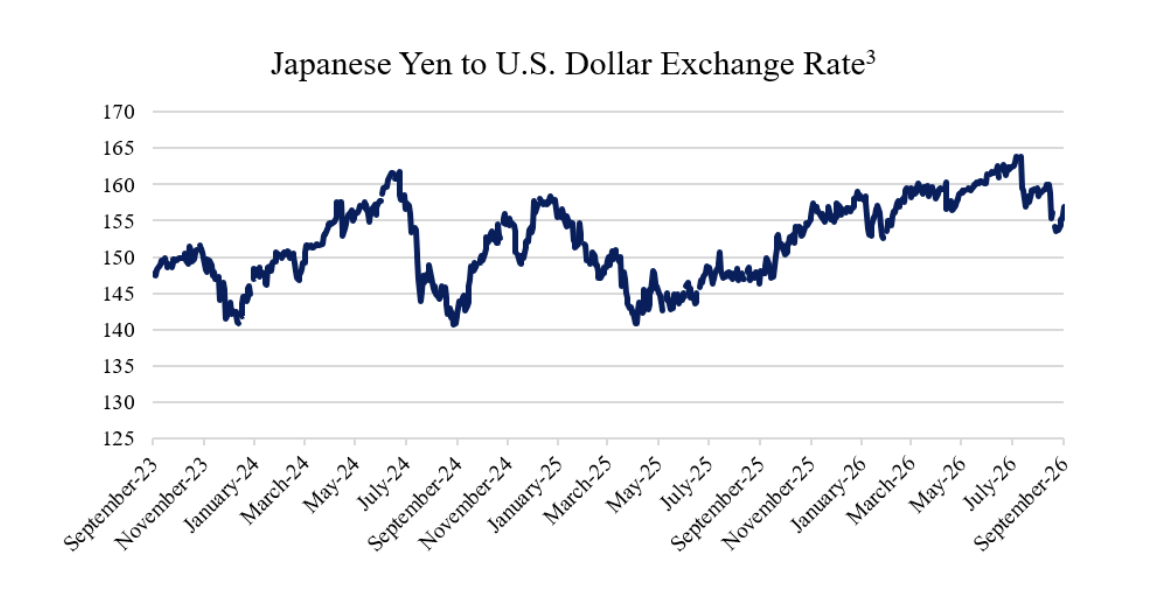
Source is Federal Reserve Bank of St Louis
Policymakers Have Tools to Address Disorderly Moves
Policymakers have tools and incentives to limit disorderly currency movements. Japan and the U.S. have demonstrated a willingness to coordinate when they believe yen movements are becoming excessive.
In July 2026, Japan's Ministry of Finance purchased yen in coordination with the U.S. Treasury specifically to counter what the countries described as excessive volatility and disorderly currency movements. That does not eliminate market risk, and there is no assurance an intervention would occur, but past instances show that policymakers have, at times, acted in response to market conditions.
Prior to Japan, China was the largest holder of U.S. Treasuries. Over the years, China has reduced its holdings, while the Treasury market has continued to function through a wide variety of market environments. This offers an interesting parallel, keeping in mind that events do not repeat, but often rhyme.
An Interesting Parallel
China’s gradual reduction of its U.S. Treasury holdings offers an interesting parallel to the present. In the past, some news articles and media posts highlighted the “danger” of China rolling out of U.S. Treasuries with headlines such as:
- “China Slashes U.S. Debt Stake by $180 Billion, Bonds Shrug” — Bloomberg (2015)
- “Dumping U.S. debt, a possible weapon in global trade war” — Reuters (2018)
- “China’s US Treasury Holdings Becoming ‘Hostages’…” — Bloomberg (2024)
Fast forward to today: China’s Treasury holdings have declined by more than 50% from their peak, from roughly $1.3 trillion to about $600 billion.4 Over that period, the Treasury market continued to absorb the changing mix of buyers.
The comparison does not tell us how Japan’s situation will unfold, but it does show that declining ownership by one major foreign holder does not mechanically result in a disorderly market.
As we know, historical events do not predict future results and different market conditions can produce different outcomes, but understanding how events have unfolded in the past gives us context for today’s financial markets.
Looking Beyond the Headlines
Just because something can happen does not mean it will. The yen carry trade is worth watching, but Japan reduced its U.S. Treasury holdings from about $1.21 trillion in April 2026 to $1.10 trillion in July4 without destabilizing the Treasury market.
The key question is not simply whether investors could head for the exit, but how quickly conditions change and whether the adjustment becomes disorderly. Monitoring what emotions arise when reading headlines will always be part of the investment journey; a journey best traveled when we better understand both what we are feeling and the world around us.
Lucas Ciabattoni, CFA, is the Investment Director at Prosper Hill Wealth Management, a Minnesota-based firm with a national presence. Prosper Hill’s wealth management practice focuses on financial planning, investment management, and retirement planning. Guided by its mission to elevate lives through clarity, trust, and meaningful financial partnership, Prosper Hill emphasizes personalized guidance, financial education, and long-term thinking to help individuals, families, and business owners pursue their financial goals.
References
1. FactSet, accessed September 28, 2026.
2. CME Group, FedWatch, https://www.cmegroup.com/markets/interest-rates/cme-fedwatch-tool.html accessed September 28, 2026
3. Federal Reserve Bank of St Louis, Japanese Yen to U.S. Dollar Spot Exchange Rate https://fred.stlouisfed.org/series/DEXJPUS accessed September 28, 2026
4. U.S. Department of Treasury, TIC Data Table 5, https://ticdata.treasury.gov/Publish/slt_table5.html?utm_source=chatgpt.com accessed September 28, 2026
Disclosures
The views and opinions expressed are those of Prosper Hill Wealth Management as of the date of publication and are subject to change without notice. This material is provided for educational and informational purposes only and should not be construed as investment, legal, tax, accounting, or other professional advice, nor as a recommendation or solicitation to buy, sell, or hold any security or adopt any investment strategy. This material has not been tailored to any individual's circumstances. Individuals should consult their own financial, tax, and legal advisors before making financial decisions. Investing involves risk, including the possible loss of principal. Past performance and historical market events are not indicative of future results. Economic and market forecasts are based on current information, assumptions, and market conditions, are inherently uncertain, and may not develop as anticipated. Any examples are hypothetical and provided solely for illustrative purposes.
Securities, investment advisory, and financial planning services offered through qualified registered representatives of MML Investors Services, LLC, Member SIPC (www.sipc.org). Supervisory Office: 100 South Fifth Street, Suite 2300, Minneapolis, MN 55402. 612-333-1413. Prosper Hill Wealth Management is not a subsidiary or affiliate of MML Investors Services, LLC or its affiliated companies.
CRN202910-12300063
A message from Advisor Perspectives and VettaFi: Discover something new! Click here to register for our upcoming webcasts.
Membership required
Membership is now required to use this feature. To learn more:
View Membership Benefits