Advisor Perspectives welcomes guest contributions. The views presented here do not necessarily represent those of Advisor Perspectives.
One of the advisory teams I coach has a client with $60,000 under management. By traditional metrics, she is a textbook C-tier client. She receives an annual review, a birthday card, and little else.
She has also referred more than $4 million in assets to the firm.
When we calculated the total value of that relationship, the team realized their segmentation model was completely backward. They were rationing time by account size, but account size said virtually nothing about actual value to the practice. If your A and B tiers are built on AUM alone, I suspect you have a few of these high-value clients hiding in your C tier too.
The Problem With AUM-Only Tiers
Most practices segment the same way this team did: $500,000-plus is an A, a middle band is a B, and everyone else is a C. It is simple, easy to pull from a CRM, and measures only one thing: what the client has with you today.
It ignores what the client could bring you tomorrow, who they know, and a factor that advisors rarely admit matters, which is whether you actually enjoy working with them.
The result is predictable. Advisors pour hours into large accounts that never refer business and constantly second-guess advice, while small accounts with wide networks or pending inheritances receive a form letter once a year.
A Better Model: Upward Mobility & Enjoyment
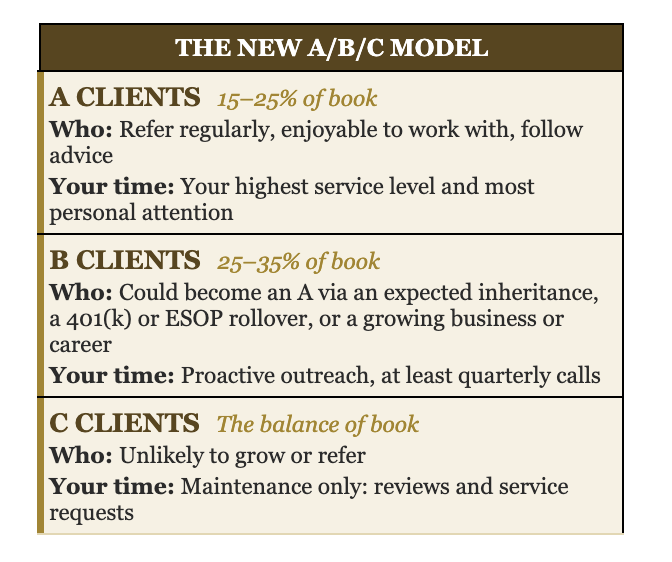
The model I now recommend sorts clients using two criteria. First, what is this client’s upward mobility, meaning their potential to grow assets with you or send you people who will? Second, do you enjoy working with them, and do they follow your advice?
Notice that account size appears nowhere in this model below. A $2-million client who never refers and fights every recommendation can land in the C tier. The $60,000 client with a $4-million referral track record is an obvious A.
The B Tier Is Where the Growth Lives
A-tier clients are already producing. C-tier clients will not change much no matter what you do. The B tier offers your highest return on time because these clients are often one life event away from becoming A-tiers.
The same team saw this play out in a single week. One advisor closed a $1.5-million ESOP rollover, generating $17,915 in gross dealer concession. It was the first of four quarterly distributions from a $5-million ESOP. He did not win it in one meeting. He won it by following up consistently every three months with someone an AUM screen would have ignored.
That is what B-tier engagement looks like in practice:
- Schedule a call at least once a quarter, even when nothing is happening. The call could be for a market update.
- Know the trigger event you are waiting for: the inheritance, the rollover, the business sale, or the promotion.
- Use each contact to uncover new needs. That same week, the advisor’s open questions surfaced retirement, college funding, and special-needs planning, and he walked out with a meeting.
Finding Out Who Will Refer: the Comfort Response
You cannot sort clients by referral potential if you never find out whether they are willing to refer. I teach advisors a simple test I call the comfort response:
“I really enjoy working with people like you. Our best clients come from introductions from our other clients.
The wording matters. You are not asking for names on the spot, which could put people on the defensive. You are asking what it would take, which invites the client to tell you exactly how to earn the introduction.
The answer itself is diagnostic. A client who says, “You have already earned introductions. Whom do you want to meet?” belongs in the A tier. One who names something specific you could do is a strong B. A client who tells you they would rather not introduce you or changes the subject is telling you something too.
Never Fight a Fee Objection by Email
Segmentation only pays off if you keep the A and B clients you are cultivating. The fastest way to lose one is handling a sensitive conversation in writing.
Another advisor on the same team learned this the hard way. He disclosed his 1.6% fee at the end of a closing meeting; the prospect ran out of time to sign, and a few days later an email arrived saying the prospect had understood the fee to be 1%. The advisor’s instinct was to reply with a clear written explanation.
That instinct was wrong. Clients lose up to 90% of what they hear in a meeting within three days, so the value you built is already fading. Email cannot rebuild value or convey empathy, and it invites a back-and-forth where tone can be misread. Any issue that is not purely transactional, fees especially, belongs in person or on the phone.
Here is the protocol I give advisors:
-
Acknowledge. Reply briefly to the email, only to schedule a meeting.
-
Reestablish value. Open by reviewing the client’s needs and the solutions you proposed.
-
Invite the objection. “I know you had some questions about fees. What are those questions?”
-
Explain. Clarify the structure, for example, a 1% advisory fee plus platform and fund expenses for a 1.6% total.
-
Empathize. “I understand where you’re coming from. We did cover this quickly, and I can see how that might have been confusing.”
Re-Segment Your Book This Quarter
You do not need new software to start. You need an afternoon and an honest team conversation.
-
Hide the AUM column. Judge each relationship on other factors first.
-
Mark every referrer. Anyone who has referred in the past three years is an A-tier candidate, whatever their balance.
-
Flag the trigger events. Inheritances, rollovers, ESOP distributions, and business sales — those clients are your B tier.
-
Ask the enjoyment question. Do they follow your advice? Would you want 10 more like them?
-
Check the shape. Aim for roughly 15–25% A tier clients and 25–35% B tier clients. If half your book is A tiers, your standards are too loose.
-
Assign the service model. Top-tier attention for A’s, quarterly calls for B’s, and maintenance for C’s.
-
Use the cover response in your next 10 reviews and move clients between tiers based on what you hear.
Assets under management tell you what a client is worth today. Upward mobility and enjoyment tell you what the relationship is worth. Build your practice around the second number, and the first one tends to follow.
Kerry Johnson, MBA, Ph.D., is a professional speaker, author, and business coach to financial advisors. He integrates performance psychology into practice-management coaching.
Read more by Kerry Johnson:
- What To Say When a Client Loses a Spouse
- Delegate Outcomes, Not Tasks
- Inoculate Before They Leave: How a Proactive Strategy Stops Client Attrition
A message from Advisor Perspectives and VettaFi: Discover something new! Click here to register for our upcoming webcasts.
Read more articles by Kerry Johnson