The views presented here do not necessarily represent those of Advisor Perspectives.
Of the many fee models to choose from, which is the best choice for the client? Is it assets under management (AUM), hourly, flat fee, or a hybrid such as subscription? Rarely is it commission. But the answer to which fee model is the best for the client is clearly “it depends.”
Below, I discuss some pros and cons of these fee models from the client perspective. While all three models discussed here and hybrids of these three are “fee only,” it doesn’t mean that any of them avoid conflicts. In my view, any time money changes hands, there are conflicts of interest.
As part of my research, I spoke with Sydney Squires, senior financial planning nerd and managing editor at Kitces.com, who wrote an outstanding research piece last year on trends in financial advice fees examining fee models.
Let me make some important disclosures. First, I am human, and all humans have biases. While I was asked to write about advisor fee models and try to be as objective as possible, I’ve been an hourly advisor for over two decades, along with the occasional flat fee for a couple of charitable foundations. I’ve never charged AUM, though I often recommend low-cost AUM advisors to others. Still, like every other human, I have biases.
Second, when I started my financial practice 22 years ago, I was already financially independent. There is little doubt in my mind that I would have chosen AUM had I needed to do so to feed my family and send my son to college. That’s likely why 86% of advisory firms still rely on AUM fees as their primary method of charging for advice, according to Squires’ article.
As I go through the strengths and weaknesses of each model, my goals are to point out where the models are strong and to point out potential weaknesses such as conflicts of interest, which are important to be aware of in working with clients. Although we are all fiduciaries, financial incentives matter because we are all human. I know great advisors across all fee models.
Assets Under Management (AUM)
This is a relatively simple and transparent model, as Squires pointed out. If the client has a $1 million portfolio and they pay 1% annually, they can do simple math and know they are going to pay $10,000 for the year (plus or minus changes in the portfolio’s value). The advisor manages the portfolio, so this works especially well for those who don’t want to manage their own money.
This model might be the lowest cost for small clients, Squires told me. One RIA will manage as little as $50,000 for 0.30% annually with access to a live advisor to give support for tax strategies, withdrawals, debt management, and other planning topics. Thus, it’s more than a robo advisor. Squires noted that most AUM advisors won’t want small accounts.
For larger accounts, most advisors have break points, so the percentage charged declines as more assets are added to the portfolio or as it grows. Incentives are relatively aligned, and as Fisher Investments advertises, “we do better when you do better.”
Weaknesses of the model start with conflicts of interest. The advisor has an incentive to capture assets. Squires agreed that the AUM advisor is disincentivized to advise the client to pay off their mortgage, even though the client’s bonds are yielding less after taxes than their mortgage after taxes. There is also the incentive for complexity, which creates barriers for the client to exit from the advisor. For example, a client whose portfolio used only three or four broad low-cost index funds (often superior) and who paid 1% every year might question why they are paying so much for such simplicity.
While AUM fees are relatively transparent, as they can typically be seen in the brokerage statement, they are painless because they are automatically taken from the account. Squires told me that, while easy to find in a statement, they are not very salient, and many people have come to me unaware of how much they were actually paying. Finally, AUM advisors can typically only recommend investments that can be purchased within their custodians.
Flat Fee
The flat-fee model can be advice only or can include investment management. It can be a one-time fee for a financial plan or an ongoing fee for continued services. If it’s ongoing and involves investment management, it has pros and cons similar to the AUM model, and the flat fee can actually be based on the size of the investments. I spoke to well-known planner, Mike Piper, whose website notes he provides a comprehensive financial plan on an “advice-only” basis for a simple flat fee of $7,000.
Piper pointed out that flat fee has fewer conflicts than AUM, using the mortgage payoff example, and agreed that all models have conflicts. The model encourages simplicity if it’s a one-time plan, but just the opposite if it’s an ongoing fee structure with investment management, often called a subscription model. The fee model is similar to other professions, such as physicians who generally charge a fixed fee for each procedure.
Piper and Squires noted the advantages this fee model has for the client are that they know exactly how much the engagement will cost and have a salient experience, because they must act to pay the invoice. Finally, like the AUM model, the client is free to ask the advisor questions without running up the bill, as they would in the hourly model.
Piper agreed that one of the biggest downsides of flat fee for the client is cross-subsidization. Some plans can be very complex (such as tax issues), while others can be simple, including those with large portfolios. Thus, the clients with simple issues are subsidizing those with complex, time-consuming issues. Finally, if the model is advice only, Squires pointed out that there is no assurance the client will implement the plan, and thus get no benefit.
Hourly
The hourly model can be a one-time plan or ongoing. It does not include investment management (at least not from what I’ve seen). Squires noted that it’s highly customizable, depending on what the client needs and what works well for HENRY (High Earners Not Rich Yet) clients. Like the flat-fee model, it doesn’t incentivize capturing assets (mortgage example) and can encourage simplicity. It’s also similar to other professional-fee models, such as lawyers and accountants.
The downsides of hourly are many, however. It can encourage slower work, and Squires pointed out that it can result in an advisor charging while they are in the early part of a learning curve. For example, an advisor who does their first recommendation on a complex executive compensation plan would bill more than another advisor who has dealt with such plans dozens of times.
Hourly can also discourage questions from the client, as they know the advisor is on the clock. It’s only for DIY investors and may not work for small investors because the fee as a percentage of assets could be quite large.
As an hourly advisor, I can’t eliminate conflicts, but I mitigate them by giving the client an estimate of the fee, not billing them until after the plan is delivered, and allowing the client to mark “cancel” on any invoice for any reason if they don’t think they received value.
Summary and Conclusion
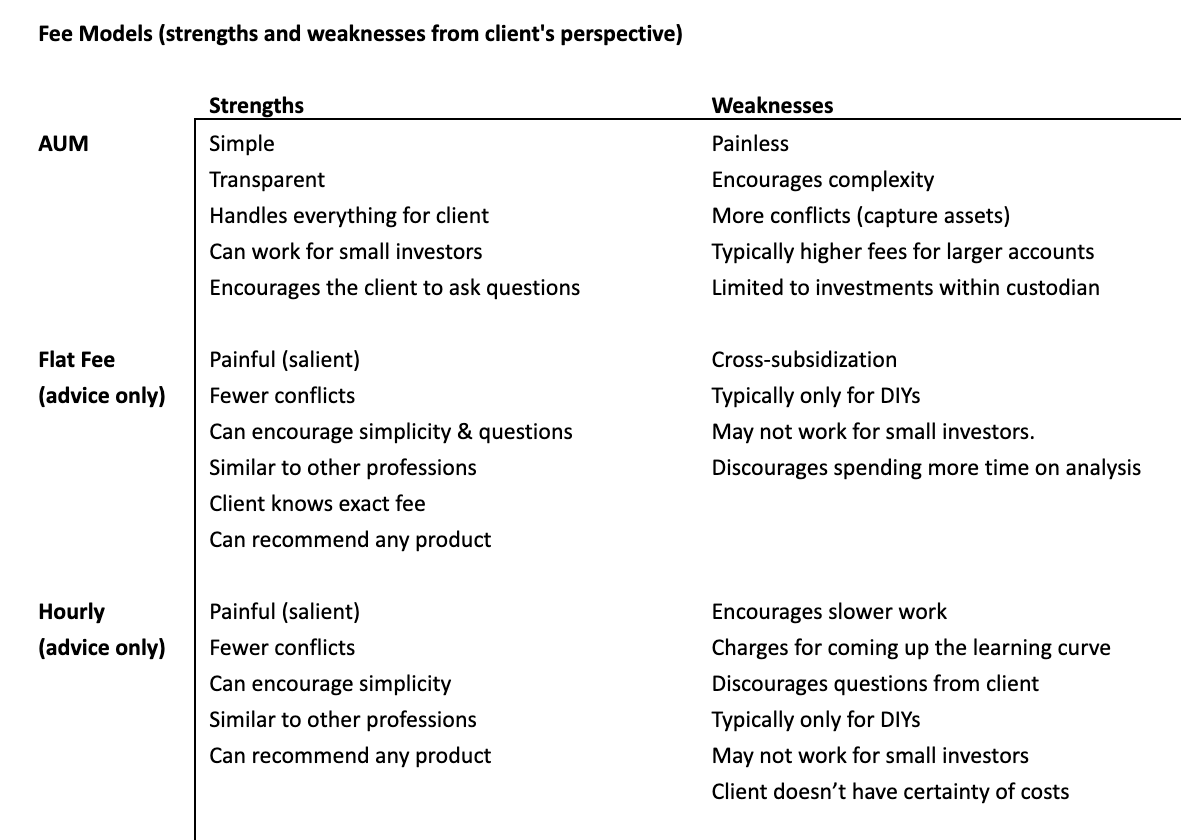
Below is a summary of the strengths and weaknesses of the three fee-only models.
The fee model is irrelevant if the quality of the work is poor, such as an advisor using canned software that makes unbelievable assumptions — which is worse than useless. The purpose of this piece is twofold. First, no matter what fee model(s) you use, be aware of both the strengths and weaknesses. Then, use the strengths of your fee model to maximize the benefit to your client. Second, and even more important, acknowledge and understand the conflicts of your model with your clients and manage these conflicts.
To be blind to these conflicts does the client a disservice. One advisor touting the flat-fee model got very upset during an interview and failed to see weaknesses in his model when I pointed out an AUM model that had far lower fees than his. Again, life is full of conflicts and certainly every fee model has some conflicts.
The word “fiduciary” is easy to say but far harder to practice. Personally, I’ve found the advisors who tout the word “fiduciary” the most are unaware of these conflicts and provide the worst products and advice. Life is full of conflicts, and being aware of them makes one far more ethical.
Allan Roth is the founder of Wealth Logic, LLC, a Colorado-based fee-only registered investment advisory firm. He has been working in the investment world of corporate finance for over 25 years. Allan has served as corporate finance officer of two multibillion-dollar companies and has consulted with many others while at McKinsey & Company.
A message from Advisor Perspectives and VettaFi: Discover something new! Click here to register for our upcoming webcasts.
More Tax Planning Topics >
 The views presented here do not necessarily represent those of Advisor Perspectives.