The successive financial bailouts of the past few decades, necessary as they were, have created a growing expectation: Whenever there’s distress in markets, central banks must step in. Once focused narrowly on traditional banks, they’ve provided emergency lending to prop up markets ranging from Treasuries to high-yield corporate debt.
Now, some are suggesting that they backstop commodities markets, too. It’s something that officials should do everything possible to avoid.
The business of trading and financing commodities plays a crucial role in the global economy. Traders buy oil, metals and the like from producers and deliver them to consumers in the place, time and form needed — a process that at any given moment entails holding hundreds of billions of dollars’ worth of bulky and sometimes toxic assets, much of it paid for with borrowed money. To hedge against price declines, and often to speculate, such companies also employ financial derivatives, which require posting a certain percentage of their exposure as cash collateral or margin — again, mostly borrowed.
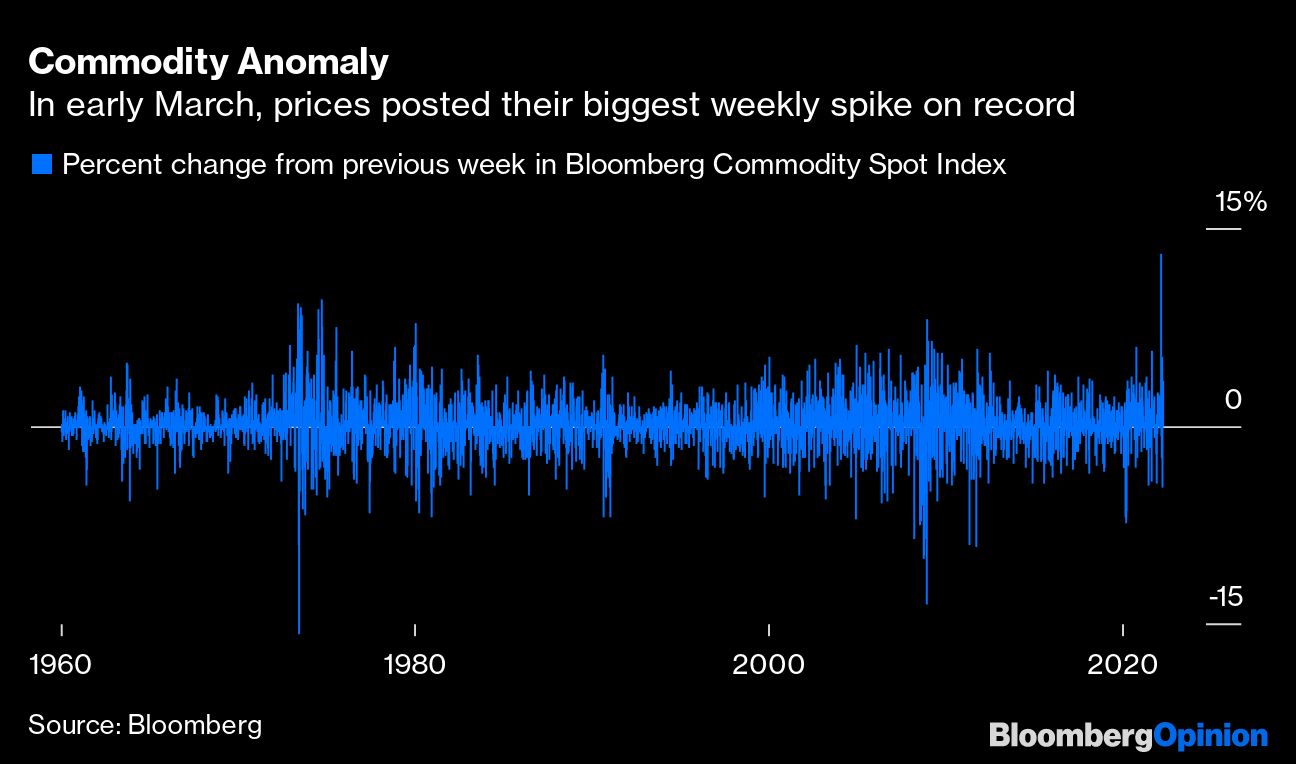
This dependence on loans creates a vulnerability: If prices rise sharply, the amount of financing needed to move more-expensive commodities and meet increasing margin requirements can become daunting. That’s exactly what’s been happening in recent weeks, thanks to a convergence of events including Russia’s invasion of Ukraine and the resulting international sanctions. Prices of some items have spiked more than 100%, while margin demands have shot up as much as 10 times amid extreme volatility. Together with ongoing supply-chain snarls, which add to the volume of commodities in transit, this has placed intense strains on traders’ finances. To rescue one large trader and avert a cascade of defaults, the London Metal Exchange had to shut down for a week and cancel some $3.9 billion in transactions.
Fears are growing that a shortage of financing could disrupt the flow of materials to end users such as power plants and auto manufacturers, further stunting economic growth and worsening inflation. This has emboldened experts and traders — including a group representing companies such as BP, Shell, Vitol and Trafigura — to call for taxpayer backing, in the form of emergency credit lines from the world’s largest central banks.








