It’s hard to imagine a social program more dysfunctional than America’s morass of retirement-saving accounts. It costs hundreds of billions of dollars a year, excludes tens of millions of workers, and fails to ensure a comfortable old age for many who do participate.
The U.S. can do much better, at no extra cost. This won’t be easy, but there are examples to follow — including within the federal government itself.
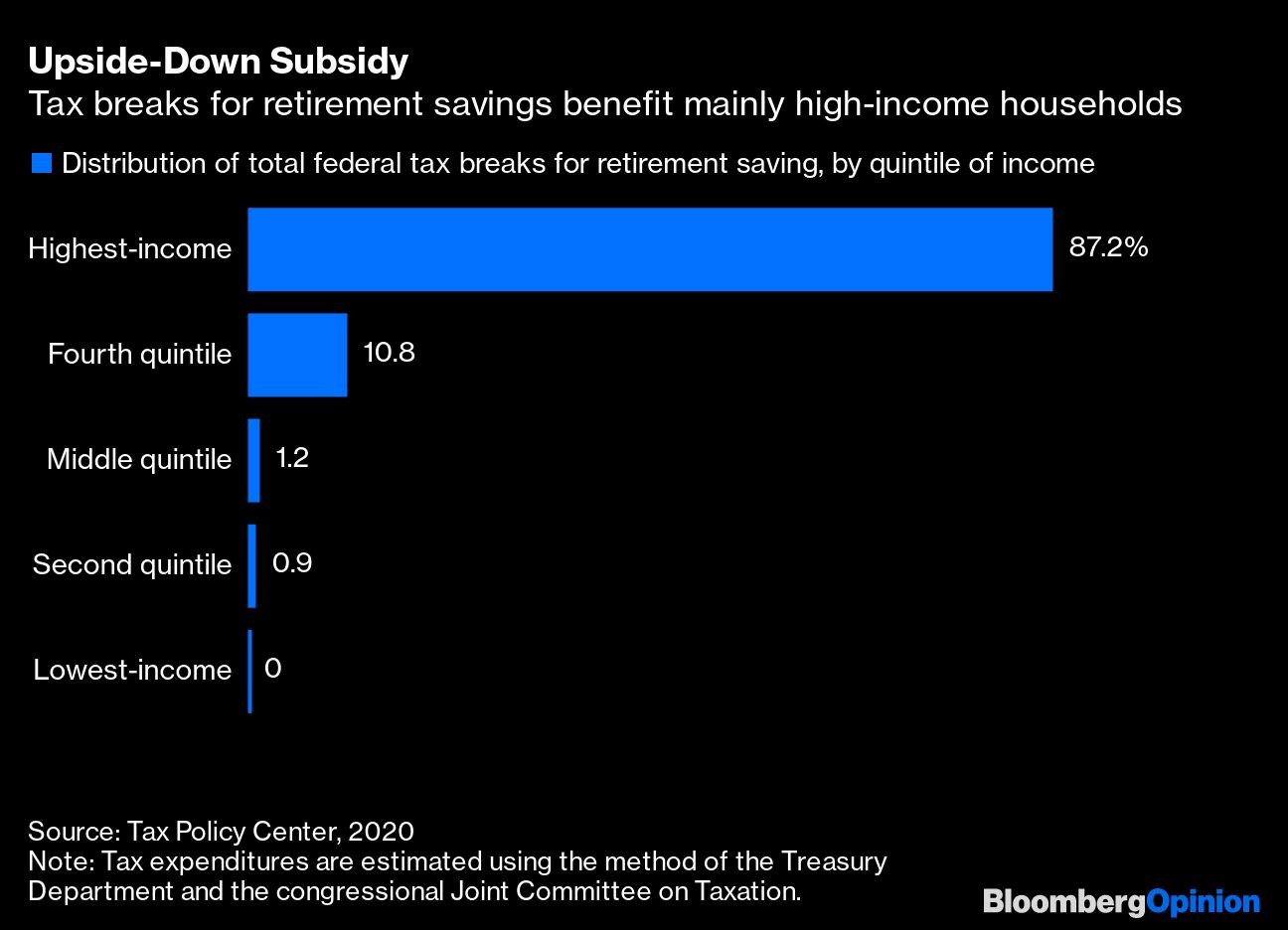
One telling measure of the current system’s worth is how little real harm its disappearance would do. Employers would be relieved of the costs and regulatory headaches of the 401(k) plans that they administer for employees. Investment managers would lose some of the excessive fees that 401(k) accounts tend to generate — but this would be a benefit for savers. Many workers would hardly notice: By one estimate, almost 90% of tax breaks for retirement savings go to the highest-income 20% of U.S. households, a group that would save anyway.

Still, people are demonstrably bad at handling the complex task of saving enough for retirement on their own. They need help, lest they end up overwhelming the nation’s safety-net programs. So what would a better system look like?
First, it should be universal. Everyone with a Social Security number should be enrolled in a retirement-savings account overseen by the government. A small percentage of their earnings, say 3%, would automatically be deposited unless they opted out. (The U.K.’s similarly designed National Employment Savings Trust has reported an opt-out rate of only 8%, less than a third of initial forecasts.)
Second, it should be simple. Conveniently, the U.S. already has a working model: the Thrift Savings Plan for federal employees. Under the plan, contributions are automatically invested in lifecycle funds, which shift from riskier to safer assets as people age. Participants who want more control can choose from a curated menu of prudent, privately managed funds. Limited options, large pools of money, and government oversight keep fees extremely low and maximize returns. At retirement age, account holders are offered a small selection of simple annuities, which provide regular payments for as long as they live — a conversion that could be made automatic, with payments adjusted for inflation.
Third, it should ensure portability. In the current setup, workers depend on employers to manage 401(k) plans that must be “rolled over” whenever they change jobs — a vestige of bygone days when employers used the (often false) promise of generous pensions to bind people to their positions. Instead, accounts should belong fully to holders, staying with them wherever they go. And people should be able to easily consolidate their existing 401(k) accounts into the new plan. This would benefit the economy in more ways than one, allowing companies to focus on their actual businesses and workers to switch employers more freely.
Fourth, it should be progressive. Instead of providing the largest benefits to the highest earners, the government should encourage low-wage workers to set aside money for retirement by matching their contributions. If the more-than-$200-billion cost of the current system were redirected, the lowest earners could easily receive an annual match of $1,000 or more, without increasing federal deficits or debt. If people were further allowed to tap their accounts for the occasional emergency expense, they could save billions more that would otherwise go toward interest on often-predatory payday loans.
The choice is clear. Legislators can keep on tinkering ineffectually with a broken system. Or they can start over and solve the problem.
Bloomberg News provided this article. For more articles like this please visit
bloomberg.com.
Read more articles by The Bloomberg Editors