Advisor Perspectives welcomes guest contributions. The views presented here do not necessarily represent those of Advisor Perspectives.
You’ve heard the phrase, “work smarter, not harder.” It challenges you to find more efficient ways to achieve better results. But how does this phrase apply to client experience, now that we have moved from lockdown to the post-pandemic environment?
What can we take from the pandemic and adopt strategically to create the optimal client experience?
The answer to these questions lies in what some advisors have been doing for years: using a hybrid client experience strategy to increase effectiveness and improve efficiency.
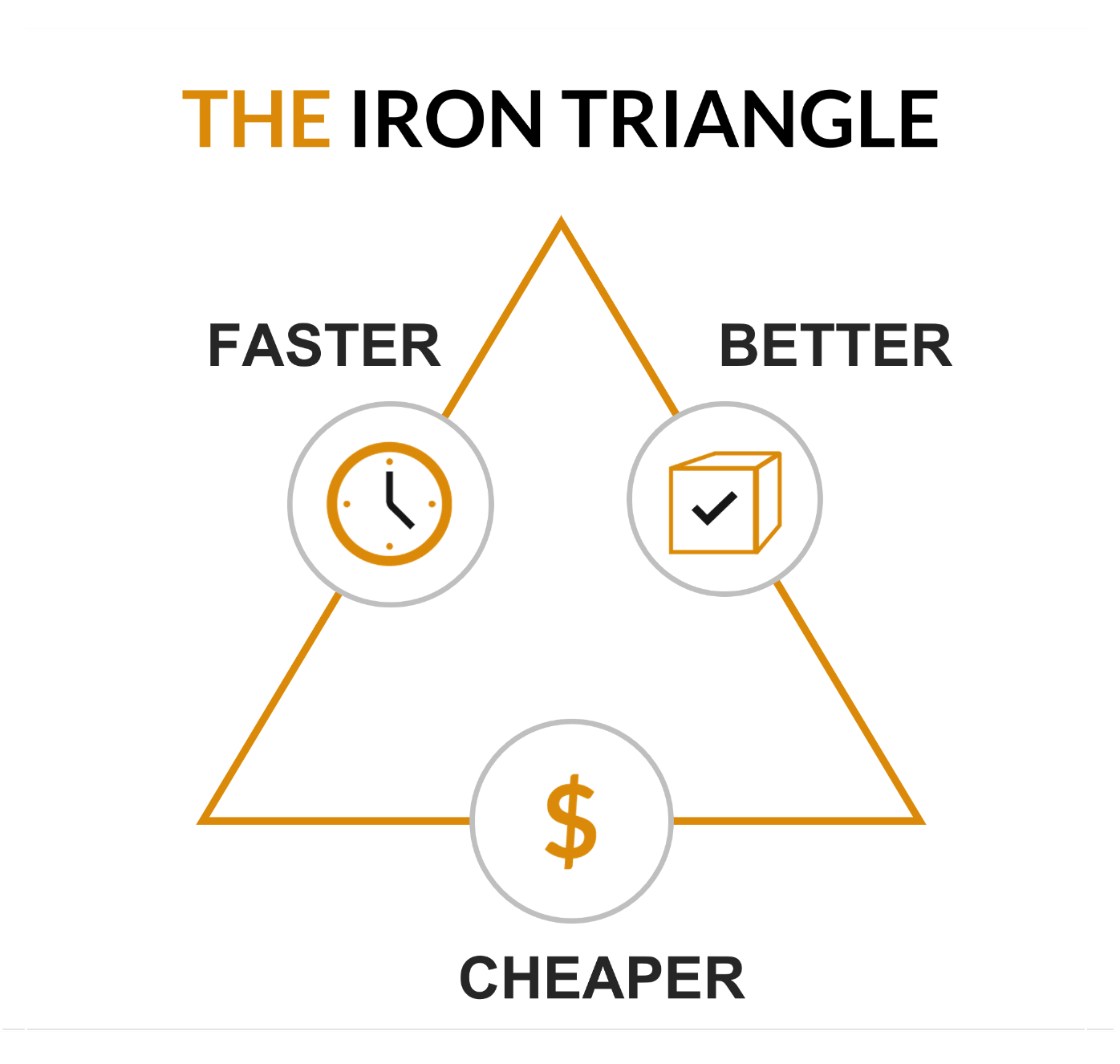
There are three factors to consider as you develop your strategy. These three factors are the “iron triangle.”
The “iron triangle” constrains every client relationship
Imagine you want to go out to eat a hamburger tonight – but where? Fast food or supper club? Or go to the store and buy groceries?
It depends on your priorities. Want it fast? Head for the fast-food chain. Want it cheap? Buy and cook your own meat. Want it gourmet? Head for the supper club.
In each case, though, you are trading something to get what you want. Going to the fast-food joint means you're accepting lower-quality results. At home, you’re giving up time or quality, depending on your ingredients/skill. And at the supper club, you’re going to pay more and wait longer to get the quality you expect.
Time, cost, quality: These three variables are the iron triangle (below). Because of the iron triangle you have to give up one or more factors to get another factor. These three variables affect any decision, from the choice of restaurant to how you communicate with clients. Breakthroughs happen when innovation creates new solutions that increase one or more variables without a corresponding decrease in others. (For example: Spotify premium versus your CD collection.)
Using the iron triangle to create a hybrid client experience
For advisors, meeting in person, or using analog process, is the equivalent of the supper club; meeting online or using digital process is like fast food. How you engage with clients comes down to a simple question about the iron triangle:
Is it worth the time and money to use in-person or analog processes?
The most productive advisors I work with segment their business and pursue different strategies for different segments. In certain cases, using new ways of working creates productivity breakthroughs, because you’re moving faster and more efficiently, without sacrificing results or quality.
Segment your client experience strategy
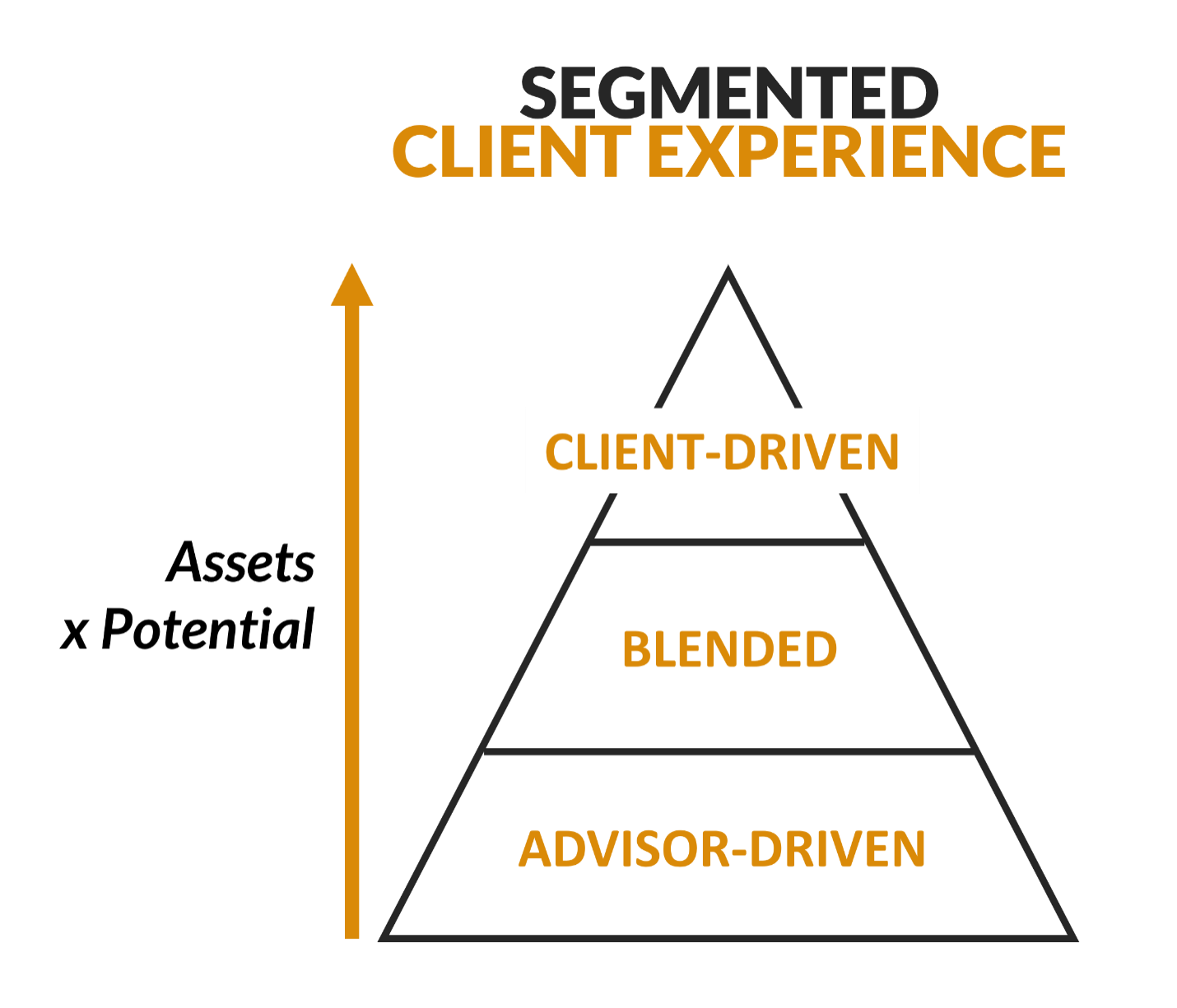
Client experience falls into three segments: Client-driven, negotiated, and advisor-driven. Certain clients will (and should) get the experience they want, no questions asked. Other clients will require a negotiation to arrive at the right mix, and some clients will need to be directed.
You’re asking, “Is this client worth my most expensive time?” Although you may look at these segments and see them as asset-driven I suggest you look at it more as a math equation: Assets plus potential equals priority level:
Being intentional about who gets what experience makes sure your most expensive in-person time is spent in the smartest way.
Segment your communication
If you looked back at your pre-pandemic in-person meetings, you would probably find those meetings covered a wide range of topics and almost never ended early. Why? Because when you spend all that time and effort getting together, you tend to use the time whether it’s productive or not. A lot of in-person time is spent on lower-value communication.
Instead, segment your communication using the, “Is it worth my most expensive time?” test to separate what you need to do in person from what you could do remotely. Then set and manage expectations for communication with a service level agreement that spells out what you’ll be talking about, when, and how. Finally, execute by setting and following tight, focused meeting agendas and deferring some communication to online meetings.
Again, some clients will get whatever they want. But with others, segmenting communication means you’re working smarter with your most valuable resource.
Segment your work week
There is nothing worse for advisor productivity than trying to do the wrong work at the wrong time. If you’ve ever been stuck in rush hour traffic on the way to a client meeting or experienced the phenomenon of Friday cancellations in the summer, you know what I mean.
The solution is to segment your workweek to maximize efficiency. For example, why would you schedule in-person meetings during rush hour when you could meet online instead? And why not schedule your Friday meetings online to minimize the impact of cancellations?
If you’re segmenting your work week with the iron triangle in mind, you’re answering the question, “How can I reduce cost and time while maintaining quality?” to use your time in the smartest way.
Conclusion: Working smarter means working hybrid
Online and in-person meetings are like Spotify and your CD collection. The gains you make in cost and time far outweigh the quality you sacrifice. Both are breakthroughs that help advisors work smarter.
Dan Smaida has spent 23 years coaching and training financial professionals to grow their consulting skills and businesses. Dan has personally trained over 6,000 advisors since March 2020 on hybrid client engagement strategies. See Dan’s work at www.AdvisoryEDGE.com
 Advisor Perspectives welcomes guest contributions. The views presented here do not necessarily represent those of Advisor Perspectives.