Advisor Perspectives welcomes guest contributions. The views presented here do not necessarily represent those of Advisor Perspectives.
For those advisors seeking to outsource their portfolio construction, the proliferation of model portfolios leaves them with an overwhelming challenge to properly analyze the thousands of choices. Indeed, the fate of those who fail to overcome that challenge will be reminiscent of that of Blockbuster Videos.
Remember your neighborhood Blockbuster Video store? In its glory days, it was an enjoyable marketplace where you could go to find your desired movies/videos (unless someone else had rented it first!).
But like many brick-and-mortars, video stores were phased out by forward-thinking technology alternatives (Netflix, Amazon Prime, Hulu, etc.) that made access to your favorite movies and TV shows easier than ever. However, this wasn’t an entirely smooth transition. Eventually streaming services completely disrupted the space, but it wasn’t the most seamless transition for consumers, especially those who weren’t the most technology-enabled. Standards needed to emerge, TV firmware and internet enablement needed to evolve, broadband speeds needed to increase and the content catalogs and user experience needed to adapt.
Disruption led to rapid adaptation, which drove massive adoption.
In the investment management industry, model marketplaces are following a similar path: disruption, adaptation and massive adoption. The technology is there, and advisors see the potential, but there are still roadblocks.
The biggest challenge is the overwhelming volume of available investment alternatives.
You don’t go a week without hearing news about an asset manager’s models being listed in a custodian’s marketplace or an investment management firm coming out with new model strategies. Faced with fee compression, technology alternatives and the continued challenge to sustain and grow their business, advisors must recommend and implement expertly tailored, cost-effective investment portfolios that achieve their clients’ financial goals.
While it’s certainly beneficial for advisors to have more options for client portfolios, there’s also a growing problem: How do advisors make smart investment decisions to meet the unique needs of each client?
Addressing a new problem
Models aren’t a new concept. For many years, advisors have employed model strategies rather than constructing their own portfolios with funds and ETFs. Many advisors have relied on asset managers to provide model strategies, making it increasingly difficult for advisors to make unbiased, data-supported decisions.
Although marketplaces and models were intended to make advisors more efficient, so far they’ve only made things more complicated. There are more than 10,000 model strategies available across various marketplaces. That’s a lot of choices to filter and analyze. Add in more than 20,000 equities, 3,000 ETFs and nearly 10,000 mutual funds in North America alone, and the advisor’s job of choosing the most suitable strategy for a client has become even more daunting.
Investment management is evolving
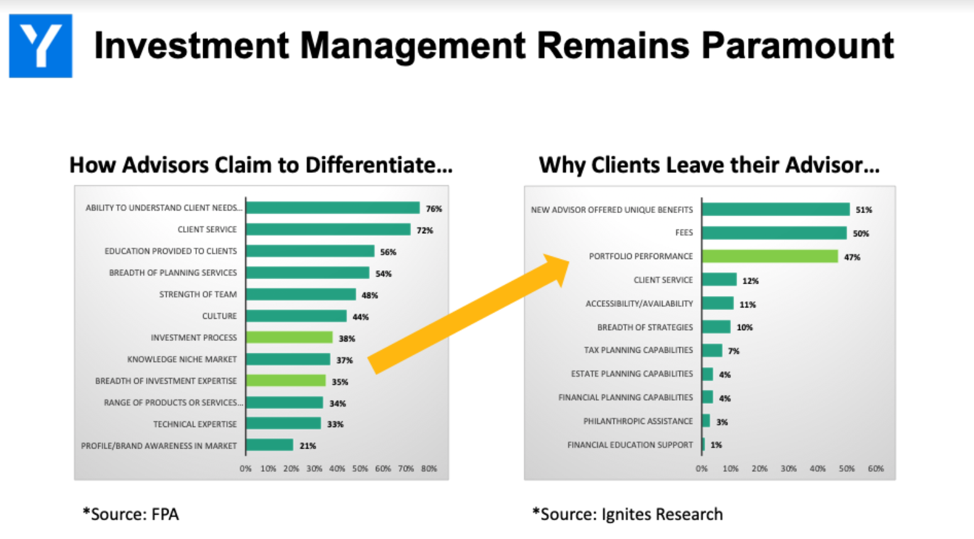
Advisors are spending about 5.5 hours per week on investment management, just a sliver of their total weekly efforts, according to recent research from Kitces.com. However, Ignites Research found that 47% of investors leave their advisors because of poor portfolio performance.
Why is there such a disconnect?
Like the rise of mutual funds and the introduction of ETFs, model investment strategies are another evolution in the best-practices around investment management. By clearly explaining the process of model construction or selection and demonstrating how that model strategy fits with a client’s goals and risk tolerance, advisors can effectively justify their fees. Using models can save advisors time and provide great solutions to meet client needs; however, it presents a new set of challenges around differentiation and due-diligence.
Let the data do the talking
Advisors may find that a moderately aggressive model on one marketplace could either be drastically different from or eerily similar to one on another marketplace. Having a single source, language and data set to compare and contrast models is the only way advisors can be sure they're selecting the most appropriate strategy for their clients. Different models from different asset managers are going to have different components and allocations, making comparisons very difficult.
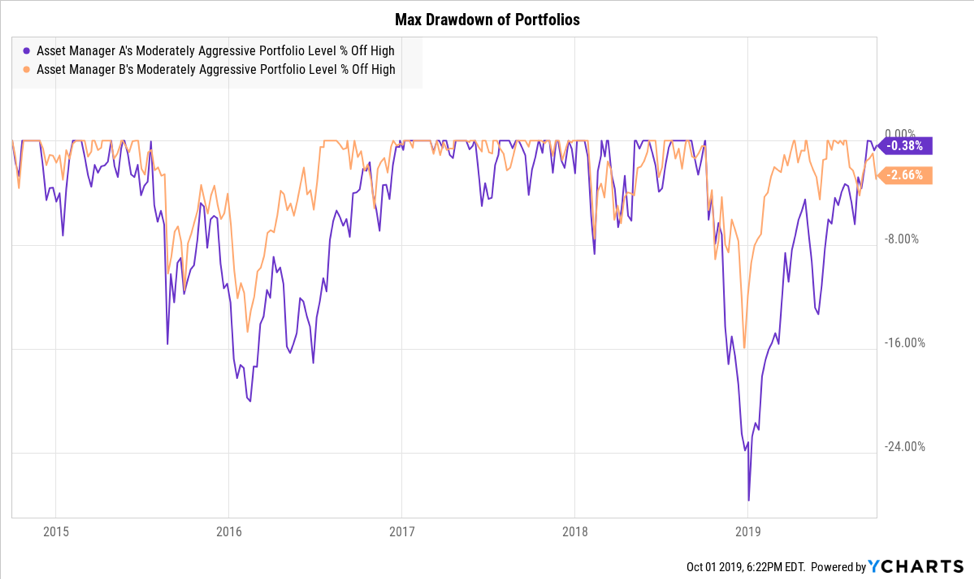
In YCharts’ Model Portfolios tools, advisors are able to compare the max drawdowns of portfolios over any timeframe.
Advisors require an efficient and accurate way to compare models, apples-to-apples, from an objective standpoint. They should be able to apply the same quantitative methods and approaches that they use to select individual securities at the model level.
A greater understanding of the underlying characteristics of model portfolios will enable advisors able to draw comparisons between two seemingly similar portfolios, and make educated decisions on the right models to select.
By bringing together underlying information about the model, advisors can analyze holdings, performance, and sector exposures, and understand the risk characteristics to truly make an accurate comparison. Ultimately they can then make smarter decisions around models. This due diligence is a competitive advantage in a new era of financial advice.
If Blockbuster had the foresight to adapt to a rapidly changing market, it would still be a household name, rather than a cautionary tale in business school cases. Similarly, model-based practices are the wave of the future. Model makers, model marketplaces and advisors who adapt their tools and processes to embrace apple-to-apple comparisons of models will position themselves for rapid growth (Netflix). Those who don’t will miss a golden opportunity to prosper (Blockbuster).
Sean Brown is the president and CEO at YCharts, an investment research and client communications platform for investment professionals. Sean has a 25-year track record of leadership at several technology firms. He earned his bachelor’s degree from the University of Notre Dame and an MBA from Stanford University.
More ETF Topics >
 Advisor Perspectives welcomes guest contributions. The views presented here do not necessarily represent those of Advisor Perspectives.