Advisor Perspectives welcomes guest contributions. The views presented here do not necessarily represent those of Advisor Perspectives.
The fourth quarter of 2018 featured a bruising October followed by a muted November recovery that only served as a fleeting pause before a deep market selloff capped off the year. Indeed, equity returns in the final month of 2018 were dreadful, with the S&P 500 posting its worst December result since 1931.
Fortunately, a slumping Canadian dollar kept 2018 US stock returns in the black for currency unhedged Canadian investors – and significantly mitigated other foreign equity losses. Allocations to quality fixed income, real assets and hedge funds also blunted much of the damage to our clients’ portfolios. But suffice to say that December was still very ugly and spoiled equity returns for the year.
An array of causes, many long-familiar, lay behind the December rout. Escalated US corporate debt levels amidst the fading glow of a historic corporate tax cut; the persistently demoralizing prospect of a disorderly Brexit; currency devaluations among emerging markets; a realization that the FAANG companies were exuberantly priced for global domination; acutely constricted energy pipeline capacity here at home; and political turmoil in Italy and France – the list goes on. But for simplicity’s sake three overarching causes – three “big rocks” that were in the average investor’s way, if you will – can be singled out:
- Tariffs
As the tariff brinksmanship between the US and China dragged on into the fourth quarter it began to adversely impact certain US business sectors such as agriculture and auto manufacturing. Concurrent negotiations between the two countries didn’t achieve much more than partial, short-lived concessions and, overall, merely reinforced the likelihood of continued impasse. Consequently, many investors’ hopes for a near-term settlement of the tariff issue began to wane - and so too did their appetite for risk assets. Never mind that the total quantum of US-China trade is but a drop in the global bucket; the vision of the world’s two largest economies locked in a protracted commercial grapple became a frightening specter that spooked many market participants.
- China
China is responsible for approximately one-third of all global growth; hence concerns surrounding its growth rate were only exacerbated by a bruising year-long equity bear market there and an unexpected downturn in the manufacturing PMI metric in December. This latest bout of worry surrounding China underlies a much larger, longstanding question: whether the transformation of China’s low-wage, export-driven economy to a robust consumer-based one can continue unabated. Muddying the waters further were lingering suspicions regarding the true levels of corporate and local government debt and actual efficacy of its touted structural reforms of state-owned enterprises.
- Fed
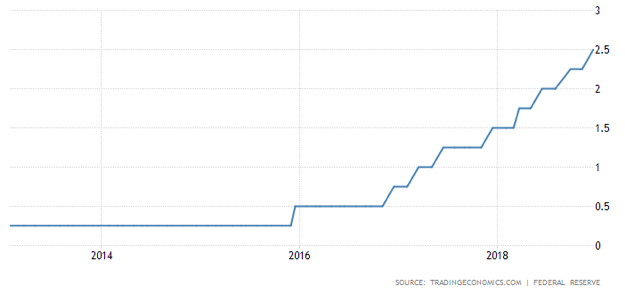
Keenly aware of the fact every recession since WWII was immediately preceded by a rate-raising Fed (and in this instance, compounded by quantitative tightening), investors began to get nervous with the Fed’s interest rate path as 2018 drew to a close:

2018’s disappointing market performance was particularly jarring to investors after 2017’s deceptive calmness featured nothing but positive numbers, negligible volatility and talk of “reawakened animal spirits” and “global synchronized growth”. As we counseled during the market selloff in February 2018, corrections are a normal part of market cycles and are particularly manifest during late-cycle regimes such as the one we now find ourselves in.
Looking forward to the balance of 2019 there are positive signs. Admittedly January has still just begun, but equity returns have rallied off the December lows and the NY Fed posits only a 21% chance of an economic recession occurring twelve months out. Returning to our three big rocks, one sees that a removal of some or all of these obstacles in 2019 is a real possibility.
- Tariffs
Negotiations between China’s trade team and the delegation led by US Trade Representative Robert Lighthizer are currently ongoing with a 90-day détente of sorts at work and a deadline for resolution by March 1st in effect. Speculation as to a positive result or painful intractability abound, but there are three factors that point to a possible successful outcome:
- Trump’s “deal-making” playbook hinges first and foremost upon a stratagem of unpredictability, so uncertainty is to be expected. For example, NAFTA was rather suddenly renewed (in its “USMCA” incarnation) this September despite consecutive preceding months of bad news from the negotiators that repeatedly suggested its demise.
- Trump boasts continually about stock market performance under his presidency – and would be extremely discomfited were a recession and deep bear market to rear its ugly head right just as his 2020 reelection campaign begins.
- China’s recent growth rate has dipped slightly, undermining the confidence of its political leadership and creating a tailwind for conciliation.
Abstruse issues such as intellectual property rights and technological access among others remain as possible sticking points, but at its core the tariff feud is being driven by one side of the negotiating table only (the US) and is entirely unwanted by the other (China). Hence, should the bellicose side of the negotiating table lose its vigor for the fight, things may be settled quite suddenly.
2. China
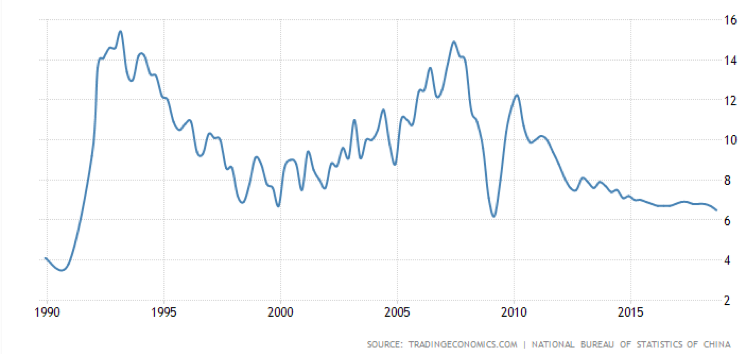
While tapering to the low end of the range recently, China’s GDP growth rate has remained between 6-7% for the past few years - and 2019 looks to be no different:
Approximately 40% of China’s 1.4 billion population are rural poor, many of whom will join the ranks of the burgeoning consumer middle class as urbanization continues apace. Assisted by looser monetary policy, an array of peaceable trading partners beyond the US, continued buoyancy in the service sector and a resilient real estate market, China’s economy has proven more diversified and therefore more recession proof than one might have guessed.
3. Fed
While the US interest rate exhibit on page two is alarming to some, the market has dramatically scaled back its estimate of Fed rate hikes in 2019 with a 70% probability at the time of writing that none will occur at all. A continuing picture of tame inflation and healthy employment gains supported by increasing labour force participation may forestall further increases for a longer period than currently envisioned.
Add to this attractive stock market valuations around the globe and one realizes that should our “three big rocks” cease to loom so large in the eyes of market participants 2019 may turn into a surprisingly positive year.
Tacita Capital Inc. is based in Toronto, Canada and is a private, independent family office and investment counseling firm that specializes in providing integrated wealth advisory and portfolio management services to families of affluence. We understand the challenges of affluence and apply the leading research and best practices of top financial academics and industry practitioners in assisting our clients to reach their goals.
Read more articles by James Nairne