Advisor Perspectives welcomes guest contributions. The views presented here do not necessarily represent those of Advisor Perspectives.
In the financial services industry, it is difficult to attract highly affluent clients – those with over $25 million in assets. I will refer to them as high-net-worth (HNW) clients. The competition for these large accounts is fierce, not only because of the profitability that these accounts provide, but also because a general scarcity mentality exists in the industry where advisors tend to believe that there is a limited pool of HNW clients in existence. This is a gross misrepresentation of the HNW market. As will be illustrated in this article, the real problem is not there being a limited pool of affluent clients, but rather that most advisors aren’t set up properly to attract wealthy individuals and families.
Let’s investigate the HNW market, discover their wants and needs, and look at ways that a firm can prepare to meet those needs.
Basic demographics and characteristics of the HNW population
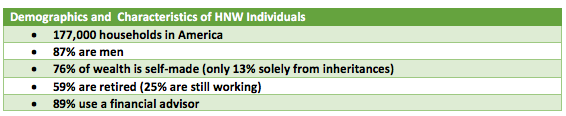
To better understand the HNW market, consider some interesting demographics and characteristics about individuals who have a net worth over $25 million:

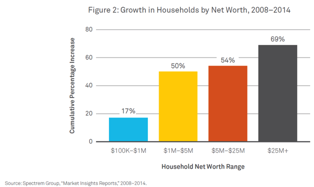
The first takeaway is that there are 177,000 households in America with a net worth greater than $25 million. In 2014, there were approximately 14.6 million individuals who had investable assets of at least $1 million accounting for $56.4 trillion in wealth! Not only is the high-net-worth tier significant, but it is also growing according to Pershing. The following graph illustrates the growth of the high-net-worth market:
Moreover, 76% of wealth is self-made. Some advisors like to use this and play the “lottery” where they try to help less affluent clients in the early years of their career and hope a few of their clients will “make it big.” A study on this idea was performed by PriceMetrix. It concluded that “the number of times small households become HNW clients is simply too few to merit an advisor’s attention. Advisors should concentrate on finding, not manufacturing big clients. Seventy five percent of high-net-worth clients were high-net-worth from the very beginning of the relationship with their advisor.” Thus, advisors should learn how to attract the high-net-worth market to their firm instead of playing the “lottery.”The first takeaway is that there are 177,000 households in America with a net worth greater than 25 million. In 2014, there were approximately 14.6 million individuals who had investable assets of at least $1 million accounting for $56.4 trillion in wealth! Not only is the high-net-worth tier significant, but it is also growing according to Pershing. The following graph illustrates the growth of the high-net-worth market:
Surprisingly, 11% of families whose net worth’s exceed $25 million don’t even use a financial advisor. For advisors wanting to enter the high-net-worth space, there are assets that can be captured without even having to steal them from another financial advisor.
Among HNW individuals, 87% are male and a significant portion of them are already in their retirement years.
What the HNW market wants from their financial advisor
Wealthy clients know that they are more profitable than other accounts an advisor may land, giving them bargaining power with their advisors, especially when it comes to fees. Advisory firms wanting to attract HNW individuals often believe that because of the negotiating position that their affluent clients are in they need to heavily discount their fees to capture these accounts. A recent article published in Financial Planning entitled, “Stop discounting – your clients don’t care,” examined this and concluded that other factors are much more important to affluent clients than price. Surprisingly, 90% of clients weren’t even aware of what they were currenting paying in advisory fees.
So, what does the HNW market need from their financial advisor? Here are the top four expectations.
1. Higher level of service
The HNW population expects a higher level of service. These clients believe they are entitled to more of the advisor’s time than the average client account. Advisors should make it clear to the affluent client that they have the necessary time required to not only handle the client’s account, but also that they have the time to provide that extra-level of service that the affluent client expects.
Older-aged HNW clients tend to want advisors who will also be their friend. Client appreciation events, time spent on the golf course and talking at length with these clients can go a long way. Younger HNW clients tend to want more touch points, but shorter durations. Overall, 90% of HNW individuals are on social media. Being connected to HNW clients through various social media sites is a great way to enhance your relationship with these clients.
2. Feeling of exclusivity
The HNW market enjoys exclusivity due to the unique nature of their financial position. They want to ensure that the advisor working with them helps other high-end clients and can understand the unique intricacies that are associated with this market.
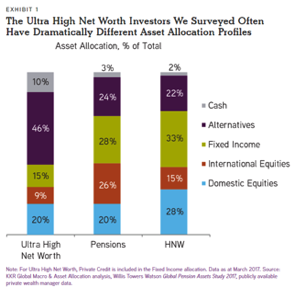
HNW clients are more sophisticated in their investment decisions than the average investor and expect advisors to be able to offer investment solutions tailored to meet their unique needs. The higher the net-worth of the client, the greater the weighting towards alternative investments in the client’s portfolio. See the chart below illustrating the asset allocation of these clients:
This higher allocation to non-traditional investments for affluent clients shows the HNW markets desire for access to products that can meet their level of sophistication and investment needs. For advisors who want to play in the HNW arena, having both the understanding and the access to a wide array of investment solutions is of vital importance.
The HNW market also has higher allocations to cash in their portfolios. Financial advisors who take the time to create a great cash management strategy will put themselves in position to capture these larger accounts.
Some firms go one step further and put in place an account minimum, not so much as to deter clients with smaller account sizes, but rather to create a feeling of exclusivity that the HNW market is attracted to and demonstrates to the client that their firm is in position to focus solely on the needs of this unique market.
3. Feeling of control
HNW individuals expect their advisor to retain a feeling of control over their assets. They have been successful in life and many believe they are capable to manage their own money but simply may not have the time. Advisors must really show their expertise and the value-add to land these larger accounts. These HNW individuals have been surrounded by “money people” their entire life and have heard all kinds of sales pitches from other advisors. This is the time for creativity and one’s expertise to shine.
This is unique from the average investor who turns their money over to an advisor because they know nothing about investing and trust the advisor will do better than they could do. In general, the HNW market likes to be engaged in the process, understand what they are investing in, and requires that they see the value-add that an advisor brings to the table.
4. Tax and portfolio efficiencies
HNW individuals expect the advisor to have a high level of competence in portfolio design and tax management. They want their advisor to be competent enough to associate with the other professionals that the client engages. Understanding the intricacies of the tax and estate planning ramifications of a proposed financial plan is an absolute must. One of the easiest ways to lose a HNW client is to appear incompetent when it comes to understanding how the plan designed for the client affects the totality of the client’s financial picture from top to bottom. Many HNW clients are in unique tax positions with high amounts of capital gains built-up in assets. Being able to manage these assets effectively from a tax perspective can be a huge game changer when attracting the HNW market.
Conclusion
To attract HNW clients to your firm, set yourself up properly. Provide a higher level of service, a feeling of exclusivity and control, and have investment solutions that provide tax efficiencies and complement the rest of the client’s financial picture. By so doing, you will put your firms in position to attract members of the HNW market.
L. Stanford McCullough IV is a portfolio analyst at TownSquare Capital, a boutique firm that provides an investment platform with a flexible chassis designed to enhance a client’s current investment program.
Read more articles by Leland Stanford McCullough IV