Advisor Perspectives welcomes guest contributions. The views presented here do not necessarily represent those of Advisor Perspectives.
“I want you to remember this: Whenever you see something with the phrase ‘new valuation paradigm,’ run.”
That was some of the earliest investment advice from my dad that I can remember. It was easy to adhere to back then: I was managing a portfolio of Pokemon cards.
Later, in 2007, my boss at Oppenheimer & Company turned me on to the writings of Jeremy Grantham. After reading how Grantham’s investors abandoned him in 2000 and again in 2007 I promised myself the next time Grantham, Mayo, Van Otterloo & Co. (GMO) experienced comparable outflows I would reevaluate my strategy.
The outflows hit GMO earlier this year, but Grantham complicated my timing signal by suggesting what sounds like a new paradigm. Mean reversion isn’t over, but he said, “It’ll take longer.” Specifically, Grantham said it will take 20 years instead of the seven he and his colleagues had been predicting. That’s a while. As he put it: “longer than any value manager would like.”
He is not alone. Linette Lopez and Josh Brown have written about the persistent sense of despair in the investment business over the flow of funds to passive and quantitative strategies. It may well be that, as Grantham wrote, the comfortable margins of safety experienced in the “Ben Graham training period of 1935–1965″ could never return.
Curious how value investors are coping, I returned to the Manhattan campus of my alma mater, Fordham University, last month for CFA Society New York’s Annual Ben Graham Value Investing Conference IV.
The algorithm training period
Aswath Damodaran set the ground rules of valuation pretty clearly in his presentation: “You can’t stop me in valuation,” he said. “I make up my own rules.”
Damodaran’s talks always encourage blending numbers and narratives and his valuation journey is important to understand. One critical takeaway is that accurate valuation is about more than staying out of the DCF Hall of Shame; It is a way to avoid falling victim to unstudied beliefs.
This is particularly important for investment professionals of my vintage because the distinction between the Ben Graham training period and today is about more than just price.
Graham’s legend emerged in the period 1935 to 1965 and was succeeded by the legend of Warren Buffett. Buffett has spawned a warren of imitators, but whoever succeeds him may not follow in the same tradition as Graham. Jeffrey Tarrant now argues that the next wave of successful investors will be “hackers and computer gamers with a healthy disrespect for convention.”
We’re all learning
Algorithmically aided decision making may seem like a departure from the past, but traditions are meant to be examined and challenged. The Gartner Group placed machine learning at the absolute apex of its 2016 Hype Cycle for Emerging Technologies.
The idea of applying algorithms to investment decision making may evoke fears of something like “death by GPS” in which automobile drivers become slaves to their navigation systems and lose their critical thinking abilities. But it’s not like the present is perfect, either.
Panelist Murray Stahl of Horizon Kinetics invoked M.C. Escher in his characterization of the modern market: “Lots of professionals stare at the same information and wonder what other people like them are doing.”

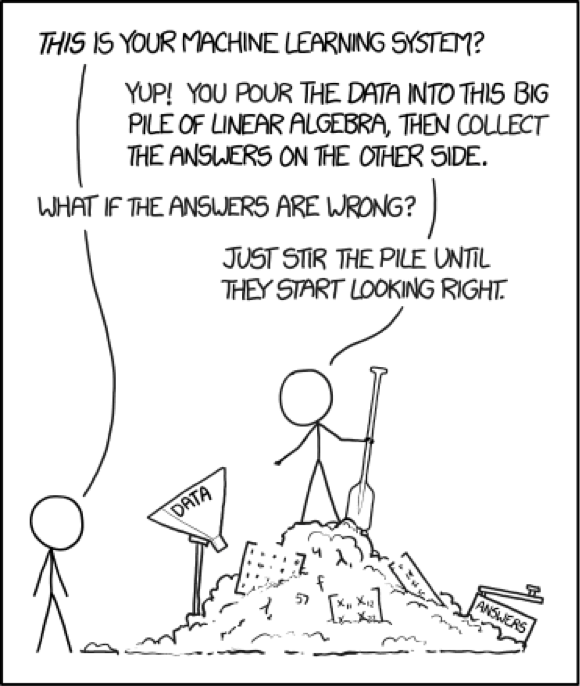
Courtesy of xkcd
Stahl’s colleague Steven Bregman spoke at the conference last year and discussed the specific effects of an “ETF Vortex,” which he expanded upon at the Grant’s Interest Rate Observer fall conference in 2016.
In discussing “The Apostasy of Jeremy Grantham,” Jim Grant, in the very same Interest Rate Observer, noted that though some lofty valuations may be warranted in recognition of the technological moats of Amazon and Google, an investor in the S&P 500 is asked to pay a premium earnings multiple for companies those firms are presumed to be in the midst of disrupting.
To underline the point: the current mix of Graham-style value investors, quantitative strategies, and even less informed investors that inform the pricing process today isn’t perfect. However unkempt it may appear, the pile of linear algebra won’t be the least-informed participant in the pricing process.
Faith and critical reasoning
Since the conference was held a few hundred feet away from where I’d finished my undergraduate degree, memories came coursing back. In particular, I found myself dwelling on a required class that granted access to a snippet of the insight stemming from Fordham’s Jesuit traditions: faith and critical reasoning.
I’m not much for piety, but at the time, contemplating the limits of reason surprised me. I certainly did not expect to locate my own version of faith, which is easier than it sounds. To do it, remember that faith is what remains after the limit of comprehension. Curiosity will take you to this point easily as anyone who’s ever met a child familiar with the question “why?” can attest.
Value investors are accustomed to asking “why?” and hearing nothing back, and commonly profess their faith in the discipline. In the preface to the gold-leafed edition of Security Analysis on my desk, Seth Klarman wrote that, “because there is no certain way to predict what the market will do, one must follow a value investing philosophy at all times.”
Klarman’s conclusion to that same preface should give the active manager cause for hope even as we enter the epoch of the algorithm:
“The real secret to investing is that there is no secret to investing. Every important aspect of value investing has been made available to the public many times over beginning in 1934 with the first edition of Security Analysis.”
For better or worse, the question of whether this time is different is left to the reader.
Will Ortel is a researcher and content manager for the CFA Institute.
© CFA Institute 2017. This post first appeared in the Enterprising Investor.
Read more articles by Will Ortel