Advisor Perspectives welcomes guest contributions. The views presented here do not necessarily represent those of Advisor Perspectives.
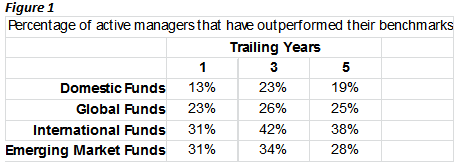
According to the ongoing SPIVA analyses, most equity mutual fund managers have failed to keep up with their respective benchmarks recently. In fact, roughly 60% of domestic managers and 65-70% of international managers underperformed in 20141 – a phenomenon that most investors observed in their own portfolios. But that is not a reason to abandon active management, assuming you own active managers for the right reasons.

Source: S&P Dow Jones Indices, CIO WMRA, Data reflects period ending 12/31/2014.
Although such underperformance is undoubtedly disappointing, it shouldn’t be completely unexpected. How often should you expect a high-quality active manager to underperform on a year by year basis? The short answer is roughly 4 out of every 10 years. The longer answer is a bit technical;2 feel free to skip the next paragraph if you want to trust me on this point.
If we assume a manager can achieve a pre-fee information ratio (IR) of 0.5 (for context, Warren Buffett’s IR was 0.663 over his career), that means a 0.5% alpha for every unit of tracking error from the benchmark. Looking at the probability distribution of that information ratio and assuming reasonable fees, roughly 40% of the occurrences, or 4 out of 10 years, will fall below the benchmark. Since the popularity of many strategies is cyclical, we can expect some of those underperforming years to happen at the same time.
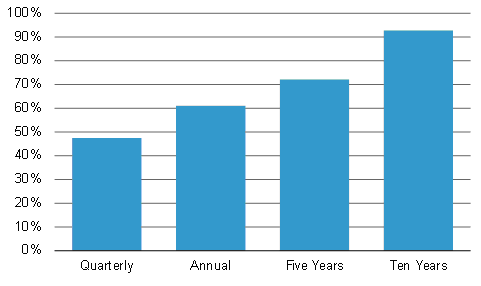
Buffett is a good example for setting expectations. By many accounts he’s the greatest investor of the last 50 years. However, over the last 20 years he underperformed the S&P 500 about 35% of the time on a calendar-year basis. On a quarterly basis, he underperformed 53% (yes, more than half) of the time! It’s only once the time horizon is extended that his brilliance becomes evident. Over five-year rolling periods, he outperformed 73% percent of the time (which means he still underperformed in 23% of them) – beating the S&P by a cumulative 450% over 20 years. An investor with a rear-view mirror that only looks back one quarter would find the Buffett experience mediocre at best. But an investor judging success over multiple market cycles would be well rewarded for his or her patience.
Figure 2: Berkshire Hathaway – Frequency of outperformance 1995-2015
Source: Bloomberg, CIO WMR
Benchmarking and other false prophets
Renowned behavioral economist Richard Thaler said the following4:
Benchmarks are one of the great evils in preventing successful investment at every level… The rational way to think about this is the total portfolio and how it all fits together. And whether some particular asset is or is not beating the benchmark to which it’s being compared is less important than how it fits in with the rest of the portfolio.
What Thaler described happens every day. I own security x, security y goes up more than x, I happen to notice that I have underperformed and think “maybe I should sell some x and buy some y.” X and y could be specific stocks, asset classes, bonds or managers; the investment changes but the refrain is the same.
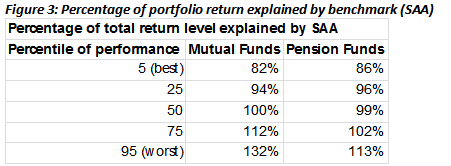
Knowing that we should expect active managers to underperform fairly frequently mitigates this tendency to some extent, but there’s also the problem of impact. Most people have heard the statistic that asset allocation explains 90% of total returns. It’s a misunderstood statistic. On average, asset allocation explains 90% of the variability in a portfolio’s return over time5. The other 10% comes from deviations caused by tactical trades and security selection (done in the rearview mirror or otherwise).
The real number is 100%. On average, asset allocation explains 100% of the level of the investment return over time. Because the average investor will not win or lose based on tactical allocation or security selection, asset allocation has to explain 100% of the level or return. Of course, advisors hope to provide better-than-average advice around tactical trades and manager/security selection to our clients, but we need to keep the impact in perspective. Obsessively shifting between managers seeking quarterly outperformance is self-defeating. It’s only by taking the longer-term view and embracing patience that we can expect to find (and stick with) modern-day Warren Buffetts. Importantly, another reasonable conclusion is that if you are uncomfortable with looking at an account statement and seeing underperformance roughly half the time, a shift to passive instruments will likely make you better off financially in the long run.
Source: Ibbotson, Roger G. and Kaplan, Paul D., Does Asset Allocation Policy Explain 40, 90, 100 Percent of Performance?. Financial Analysts Journal, Jan/Feb 2000, Vol. 56, No. 1.
Other (better?) reasons to use active management
If consistent quarterly or annual outperformance is an unreasonable expectation for even the best active managers, why use active management at all? Here's a short list of reasons:
To access specific markets or parts of markets that cannot be accessed otherwise. Some sectors of the bond market (e.g., distressed debt) fit into this category, as do private equity, hedge funds and others.
To lower your beta. Many investors want to be involved in the equity market but also want to avoid the full extent of a bear market. Low-beta managers are one way to try to achieve that objective, as are low-beta exchange traded funds. They typically underperform in a bull market and outperform in a bear market.
-
To take a fairly concentrated bet on idiosyncratic company risk or a specific theme. For instance, our equity sector strategists put together thematic lists based on economic or social trends. Mutual fund and separately managed account managers might do the same.
Tax considerations (although this may also be a reason to not use some active managers).
Yield-seeking or concentrated risk considerations.
There are dozens of other good reasons as well. They are all part of building a well-constructed investment portfolio that helps an investor achieve his or her goals.
The bottom line
My intention with this article is to provide some perspective in regard to active management. Ultimately, a short-term view of performance is doomed to failure, and a longer-term view doesn’t guarantee success. Even with the appropriate market-cycle timeframe, it is still vital to pick high-quality managers through a due-diligence process that doesn’t succumb to the same hindsight bias that persists among individual as well as many institutional investors.
In the past, I’ve recommended holding a blend of active and passive management when constructing portfolios. That remains my best advice. However, it’s likely that making the active versus passive decision is best done at the investment-specific level instead of from a top-down perspective.
Finally, investors must maintain perspective when defining success. If outperformance is the goal, it will take 5-10 years to know whether or not that objective was achieved. If the manager was utilized for any other reason (like the ones I suggested or otherwise), holding the manager accountable to that value proposition is important. Ultimately, though, the active-passive decision is unlikely to be the major factor to determine whether or not you meet your goals and objectives. As Dr. Thaler suggests, focusing on the total portfolio and if it is designed correctly is what matters. Short-term relative performance against a benchmark (positive or negative) is a distraction.
Michael Crook is an executive director and head of Portfolio & Planning Research in Wealth Management Research, where he advises investors on global investment strategy, asset allocation, investment planning, and portfolio construction.
Read more articles by Michael Crook