Advisor Perspectives welcomes guest contributions. The views presented here do not necessarily represent those of Advisor Perspectives.
Sound financial planning requires neither the determination of safe withdrawal rates nor the use of Monte Carlo simulations. Relying on the past to predict the future is unnecessary. Instead, one must focus on how much can be spent each year, given expected returns and inflation, and then consider how negative and worst-case scenarios would affect retirement planning. That is the basis for the annual available spend (AAS) methodology I describe here.
I developed the retirement-planning methodology and model described in this article to assist me with my retirement planning. I have been using this model for four years, and it provides with what I need to plan my retirement. I hope that others will also find it helpful.
My general investment philosophy is passive, following that of Jack Bogle, Bill Bernstein and Larry Swedroe. These individuals generally agree with Bernstein's caveat in the Retirement Calculator from Hell, Part III: any estimate of long-term financial success greater than about 80% is meaningless. Given this uncertainty, my approach relies less on science and more on judgment applied to a thorough understanding of the client's facts.
My initial focus was solely on my specific situation, so I was particularly careful to obtain all relevant and material information. Detailed focus on the specific client situation is essential. I have implemented the model in an Excel spreadsheet and have included examples from it.
General framework of methodology
Implementing the AAS requires a six-step procedure:
- The advisor will work directly with the client to determine all parameters of his or her expected spending needs during retirement.
- The advisor will obtain a complete analysis of all sources and types of the client's income. Each of these items will constitute a different column in the model. All items will be entered after tax, so it is necessary to have a full understanding of the client's income tax position.
- Fundamental returns and inflation will be applied. A conservative year of death will be included. The model will then compute the base-case annual available spend – the amount that can be spent each year, with the value of the investment portfolio decreasing to zero in the year of death.
- Negative and worst-case scenarios will be entered into the model. The scenarios chosen will be keyed to the specific situation of the client.
- The AAS model can be set to automatically adjust for market value changes and recompute the base-case AAS. Cash and portfolio quantities can be updated monthly. The advisor must determine if and when the base case or negative assumptions should be revised.
- The advisor will review the AAS scenarios with the client and evaluate the client's spending and investment plan on a periodic basis. Changes will be made as necessary and appropriate.
Let’s look at each of those steps in more detail.
- Spending needs
Determining the retirement spending needs of the client is, of course, a routine exercise in retirement planning. The client should keep a monthly record of expenditures, with or without a detailed budget. Large or exceptional items should be noted. As part of this methodology, income taxes should be eliminated from annual spending totals, since they are netted against income in the model. Of course, the more prior years included, the better the feel for required and discretionary spending. Consideration should also be given to unusual and contingent future expenditures.
Just as clients differ with regard to investment risk tolerance, they will differ with regard to spending tolerance. Some may feel very strongly about maintaining certain minimum living standards, while others may be much more flexible regarding their ability to cut back if the need arises. Attention to these and other behavioral issues is essential.
- Income analysis
In order to properly evaluate the client's situation, it is necessary to obtain a full analysis of all types of client income – pensions, annuities, deferred compensation, Social Security, taxable investments, tax-deferred investments, Roth IRAs, required minimum distributions (RMDs), etc. Each of these items will be included in a separate column of the Excel model. Income taxes are netted against the various income items. The estimated taxes need not be precise, but they must be materially correct. It is necessary to compute both base tax and marginal tax. Make sure that the total differential between all items of gross income and after-tax income included in the model is materially the same as taxes computed using TurboTax or a similar application.
Program the model to properly source the income for spending from the appropriate pots of income. Typically, income will first come from deferred comp, pensions, annuities and Social Security, followed by RMDs, taxable investments or Roth and tax-deferred accounts.
- Base-case AAS model
Following is an example simplified base-case AAS model:

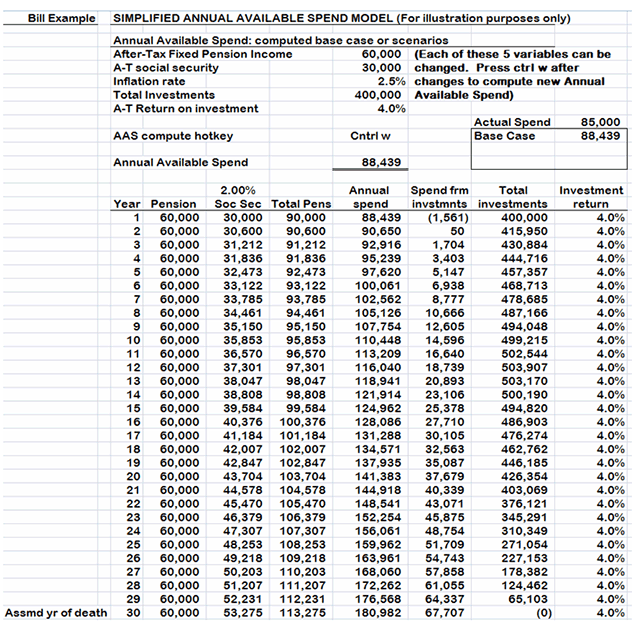
This model establishes a base case for a hypothetical client, Bill. In this example, all investments are included in a single column, and the model assumes Bill has a 50/50 stocks/bonds split. This simplified example does not include a column for tax-deferred investments or RMDs. Each type of after-tax income is included in a separate column. The three assumptions for the base case model are after-tax return on investment, inflation rate and year of death.
The model does not assume historical investment returns. Instead, it assumes the widely used "fundamental" returns that consider current market valuations. There is a broad general consensus regarding what these returns should be. For purposes of illustration, it is assumed that the equity-fixed real returns approximate 5% and 1%, respectively. This would result in combined nominal returns of 5.5% and roughly a 4% after tax return. The assumed inflation rate of 2.5% also represents an approximate, generally accepted current inflation rate. The model increases annual expenditures each year by the inflation rate, and it increases the after-tax Social Security income by the inflation rate less 0.5%. If Bill is now 70, his assumed year of death will be age 100. Advisors will differ on which rates and ages to assume. A slight edge to conservatism in all assumptions is desirable. Tax effecting will vary depending on individual circumstances.
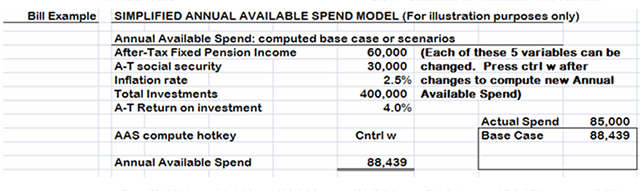
I then run an Excel macro that applies what-if analysis and goal-seeking to determine the amount Bill can spend each year, with the investments declining to zero in the assumed year of death. In this example, Bill's annual available spend is approximately $88,000. We can now compare the base case AAS to the $85,000 of spending needs. .
This and the next examples deal with a single individual and ignore the spouse. A later example will consider the surviving spouse situation.
- Negative scenarios – The planning begins
The advisor has assembled the necessary information. Now, the planning begins. All will agree that computation of the base-case AAS cannot be the end product in itself. We must decide how to deal with sequencing of returns, black swans and the like.
There are various approaches to retirement planning. Many prefer approaches that are more actuarial or "scientific." All such approaches have validity, but considering the inherent uncertainty that cannot be overcome, my methodology relies on the knowledge and judgment of the advisor coupled with a detailed understanding of the individual client's situation.
Once we have our base-case AAS, we can factor in negative scenarios. This may seem to be an impossible task. There is always a worse worst-case scenario, until we get to the point where the Earth implodes and disappears into a black hole. Instead, we must attempt to come up with negative scenarios, including reasonable worst-case scenarios. We will look to the past – not to determine what event might happen, but to get a feel for the degree and scope of potential problems.
Any choice of negative or worst-case scenarios must be keyed to the client's specific situation. Worst-case market scenarios will not be particularly helpful for Bill, whose income is primarily from fixed pensions. In his case, increased inflation will be a much greater concern than market declines. William Bernstein discusses various types of risk in his recent book, Deep risk: How History informs Portfolio Design. Using Bernstein's terms, there are shallow risks, where market declines reverse in a relatively short time, and deep risks, where declines may never reverse or where there is high inflation or deflation.
Although seemingly difficult, it is possible to obtain a reasonable worst-case general consensus for such scenarios among financial advisors. For example, with respect to a reasonable worst-case market decline, we might start by suggesting a permanent 60% decline in equities, as occurred in Japan in 1990. Would a group of advisors reach general agreement that this example is too severe, or not severe enough? Could a broad general consensus be reached? I believe that it could.
Regardless of any consensus, the important task for the advisor is to pick various negative scenarios that are relevant and appropriate to the specific situation of the client. Following are three simple case studies to illustrate this approach. In each of these, the market decline scenario assumes a 50/50 stocks/bonds split and that equities suffer an immediate permanent market decline of 60%. This results in an overall investment decline of 30%. In each case, it is assumed that the client rebalances to 50/50 immediately following the decline.
Bill’s example: High percent of fixed income holdings
As can be seen from the base-case model run above, the majority of Bill's after-tax income comes from fixed pensions. Here, again, is the base-case summary:
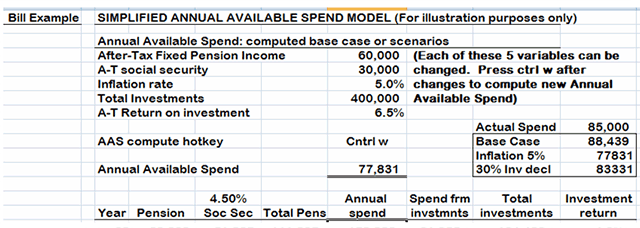
I selected two reasonable worst-case scenarios for Bill. One is the 30% permanent decline in investments discussed above. The second is an inflation increase from 2.5% to 5%. Each scenario was independently entered into the model and a revised AAS was computed. The inflation scenario inputs and AAS are shown below. The results of the two scenarios are shown in the box on the right:
In step one, we assumed that the advisor and client agreed to an actual spend of $85,000. We can see from the market decline scenario result that even in the worst case, the impact on spending is not substantial, from $88,000 to $83,000. However the effect is much more severe in the inflation scenario, because of the fixed pension income.
In the inflation scenario, the model adjusts nominal rates of investment returns and Social Security increases in order to maintain real rates at the same level. This scenario shows a $10,000 decline in AAS, with spending $8,000 below the initial actual spend. Of course, any number of additional negative scenarios is possible. There is no formula to deal with election of scenarios and analysis of their implications. This is up to the skill and judgment of the advisor.
Joe’s example: Moderately sized investment portfolio
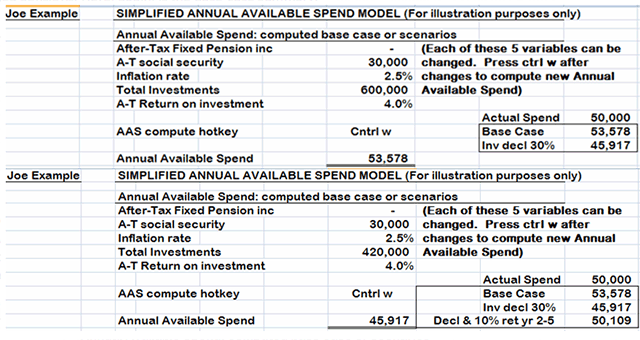
Joe has a moderate portfolio of $600,000, after-tax Social Security income of $30,000 and no fixed pensions or other income. Following are the base-case summary and the worst case 30% permanent reduction in total investments summary:
The investment decline scenario reduces Joe's AAS about $8,000 below base case and $4,000 below actual spend. Maybe Joe has little concern regarding spending and believes he could easily live on $46,000. Maybe he has considerable concern and feels that $50,000 is tight. In the latter situation, the advisor might explain the remote possibility of the worst case occurring and present alternative negative scenarios to Joe, as discussed below. Maybe the advisor will consider spending adjustments or investment changes. There are many ways this might play out between advisor and client. In such cases, the judgment of the advisor is much more important than the "science" of alternative approaches.
The investment decline scenario assumes a permanent 30% decline in total investments (60% in equities). This is intended to represent a reasonable worst-case scenario, since the decline is permanent. In the more typical case in which the losses reverse in subsequent years, the reduction in AAS would be much less severe. In Joe's case, if we assume that the after-tax investment return increases from 4% to 10% in years 2-5 following the decline (similar to the U.S. 2008 decline and recovery), Joe's AAS increases from $46,000 to $50,000.
Al‘s example: More than enough assets
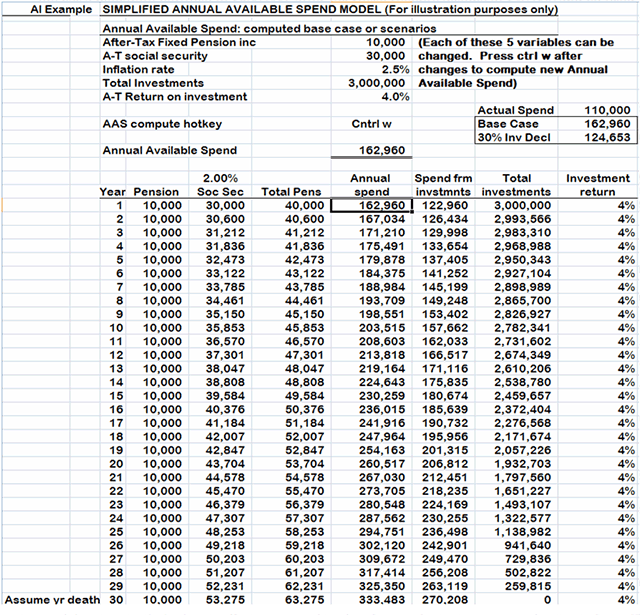
Al has a portfolio of $3 million and is not excessive in his spending habits, with actual spending at $110,000. He has only a moderate fixed pension, and his retirement income will be sourced primarily from his Social Security and investments. Following is Al's base case AAS model run:
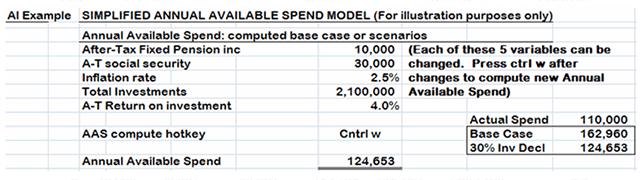
The base-case AAS of $163,000 substantially exceeds the actual spend of $110,000. This demonstrates that Al could, for example, gift approximately $53,000 to heirs each year and not worsen his base-case financial position. The next item of note is the size of the estate available for heirs if Al does not live the full 30 years until age 100. At age 90, under the base case, Al's estate will approximate $2 million. Now let's consider Al's worst-case scenario of a permanent 30% decline in investment assets:
This methodology can be particularly helpful in situations in which the client has more than enough assets. Often, behavioral factors arise, and the client must be convinced that he or she can easily spend more. For example, Al can make substantial gifts to children or grandchildren without fear of a serious shortfall in the future. Even under the worst-case scenario of a permanent 60% decline in equities, Al's AAS will still be almost $15,000 more than the actual spend. Assurances of 100% odds of success in meeting one's goals may be less convincing to Al than seeing the computations of how worst-case scenarios will still leave him with an AAS greater than his actual spend. The model is also helpful in demonstrating the minimal effect on AAS of increased one-time spending.
Bill's spouse example: pension reductions
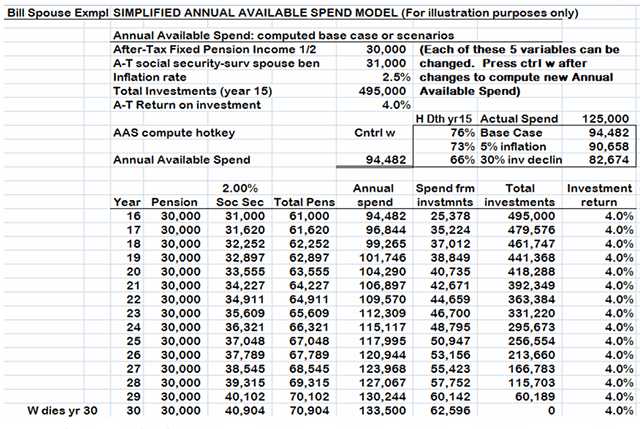
The above examples do not consider the case of the spouse of the client. In those cases in which the primary sources of income are Social Security and investments, there should be little impact on one spouse if the other predeceases. In Bill's case, most of his income comes from fixed pensions. If we assume those pensions provide for a 50% survivor benefit on Bill's (H) death, the AAS will decline substantial for Bill's surviving spouse (W). Assuming Bill dies at age 85 and his spouse survives until age 100, here is the AAS of the spouse:
In Bill's base case AAS model run, we can see that in year 15, his actual spend increased to $125,000 and his total investments increased to $495,000. In actuality, after 15 years, Bill's situation is likely to change materially and might not resemble anything close to the above. However for initial planning purposes, it is necessary to follow the original plan to evaluate the relative effect on W in the event H predeceases.
In the above example, the spouse inherits the investments in year 16, but her Social Security is reduced to survivor benefits and pension income is cut in half to $30,000. At Bill's death, their joint annual spend had increased to $125,000, but spouse's new base case is $94,000, or approximately 76% of the couple's actual spend. The high inflation scenario will not substantially change this, but the 30% investment decline scenario will result in an AAS decline to approximately 66% of the prior actual spend. Declines of AAS to 76% or even 66% might seem be acceptable to H and W, or they might consider this problematic. It is essential that the advisor explain the relative differences in AAS of the surviving spouse to the client and proceed as appropriate with the planning.
- Continual updating and periodic review
The Excel model can be set to automatically update values of investments and recompute the base case AAS. Changes in quantity of investments and cash balances can be input monthly, together with updates to actual spend. The client with access to such a model will readily see that most market moves have relatively little impact on the AAS. Similarly, what may seem a large additional spend could barely budge the AAS. The base case inputs are generally conservative, so it may well be that the client observes a continual gradual increase in AAS, which may allay some market fears.
Once set up, the advisor can monitor the changes but typically will not need to adjust the model. Of course, very major market shifts, up or down, might occasion a revisit. The base case assumptions of expected returns, inflation and life expectancy would not require frequent revisions. Hopefully, given the conservative nature of these assumptions, changes will more often be for better than for worse.
- The overall plan – Summary
This methodology does not attempt to develop a formulaic or scientific approach to retirement planning. Instead, it looks to obtain the best and most complete client information and then compute a base-case AAS using generally agreed-upon conservative fundamental returns, inflation and life-expectancy assumptions. The approach accepts the uncertainty of future returns. It does not attempt to apply historic patterns or statistics, nor does it attempt to assess probabilities of success through modeling sequencing of returns.
The advisor will need to select negative and worst-case scenarios that are most material and relevant to the client's situation. Presentation of a reasonable worst-case scenario is mainly to prepare the client for how bad it could be, in the context of AAS. The advisor will explain that there is a very low probability of the worst case occurring. The advisor may also wish to run less negative scenarios, like in the above Joe example.
The client should easily understand the model output, since the AAS scenarios can be compared directly with his actual spend. Joe is concerned with having enough and setting the right spending levels, Bill is concerned with inflation and reduced pension amounts available to his wife and Al may need to understand that he has the ability to spend more than at present.
Advisor investment advice is beyond the scope of this article. An advisor's recommended investments might range from passive to active, conservative to aggressive. The AAS modeling can play an important role in making these investment decisions and, importantly, explaining their impact to the client.
I have found this method to be very useful in my personal retirement planning, and I hope others will as well.
John D. Craig is a retired tax attorney and CPA. His career was in international tax planning; first as a tax partner with a major international CPA firm, and next as a vice president for tax for a large multinational corporation. He is now retired with no aspirations to become a financial planner.
Read more articles by John Craig