Advisor Perspectives welcomes guest contributions. The views presented here do not necessarily represent those of Advisor Perspectives.
Even the name robo-advisor is derisive. It evokes an image that is uncaring, lacks humanity and is inflexible. But it is the term being used by advisors to describe a new breed of startups that directly connect tech-savvy investors with suites of analytic tools to create financial plans or investment portfolios.
A name this disparaging makes us ask why advisors fear this new model of financial advice.
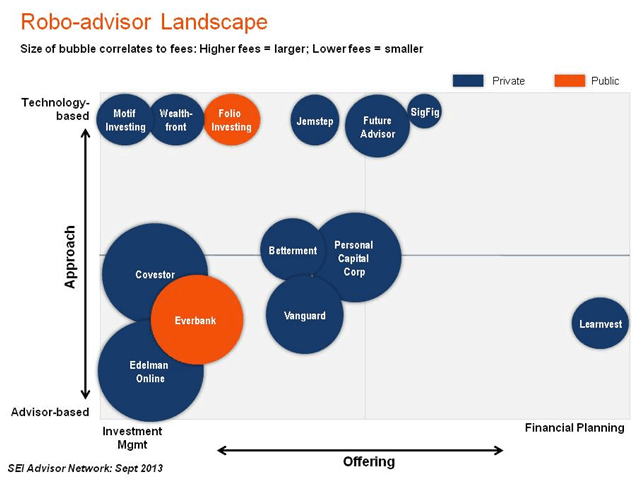
To answer that question, let’s look first at the three types of robo-advisor:
- Pure technology websites, devoid of advisors, that allow investors to do everything themselves (such as Motif Investing and Jemstep)
- Companies that include advisors who only communicate with their clients online (such as Personal Capital and Learnvest)
- Established financial service companies that have recently expanded their online advice offerings (such as Vanguard and Edelman Online)
FUD
Recent news about these companies has spurred fear, uncertainty and doubt (FUD). The Wall Street Journal did a detailed piece focusing on the cost of robo-advisor services. Finovate highlighted the venture funding behind these companies.
Whether you think robo-advisors are the latest fad that will go away or a vision of how financial advice will be given in the future, they will definitely disrupt and change the way that advisors interact with their clients.
What it means for you
In our research and discussions with advisors, these are the ways that robo-advisors are most likely to impact you:
- Increased fee pressure: Robo-advisors offer lower fees than traditional advisory practices do for technology-centric services. This will set an expectation for lower fees, especially for younger investors.
- A call for transparency: Investors will want more transparent fee structures. The emerging robo-advisor model charges a fixed fee for lower assets (say, under $100,000) and a basis point fee for larger assets (where the services provided are broader).
- Pressure to accommodate a younger generation: Robo-advisors will reach a younger, tech-savvy, growth-accumulating generation who will continue taking advice from the same source as they grow wealthier.
- More technology: Investors will increasingly demand that they interact with the advisor in the way they choose. This will include web conferencing, the ability to schedule time with an advisor online and intuitive ways of working on documents together.
- Access to comparative data: Investors want information about how they are doing compared to their peers, and they want their advisors to present other views (both expert and non-expert) on investment-related subjects. Comparative data allows the investor to be better informed in financial decision-making.