Advisor Perspectives welcomes guest contributions. The views presented here do not necessarily represent those of Advisor Perspectives.
We are deluged with information. Richard Saul Wurman, the godfather of information architecture, calculated that there is more information in a single issue of the New York Times than the average citizen in the 17th century would have been exposed to in his or her lifetime. And that calculation doesn’t even take into account the explosion of information available through new technology. The issue is particularly acute for investors, who can access up-to-the-minute stock quotes on their iPhones, check the value of their portfolios on an iPad and choose from a multitude of television shows, magazines and newspapers to bathe in the information stream of financial markets, economics and politics.
Shortage of information isn’t the problem: shortage of insight is.
Recent events have not provided any relief from this malady. Fiscal cliffs, debt ceilings, European crises, market volatility, political dysfunction and more have competed for investors’ attention, making it increasingly difficult to glean meaning from a cacophony of headlines. This distinctly modern challenge is known as information overload, a condition in which too much information obscures what is genuinely important. Information overload can lead to the inclination to react to each and every new data release or, at the opposite extreme, to do nothing and succumb to paralysis. Clay Shirky, a thinker and writer on the role of technology in society, claims that there is no such thing as information overload — only filter failure.
So what filters should investors have in place to enable them to hear the signal through the noise and not be distracted to their own detriment?
We offer a series of related beliefs that guide our thinking about investing at the levels of asset allocation, security selection and identification of the third-party managers we engage to help manage our clients’ assets. These investment tenets are important in any environment, but they are critical in a time characterized by heightened uncertainty.
1. Risk is not volatility
One of the cornerstones of modern portfolio theory (MPT) is that risk is defined as volatility, and that the primary objective of portfolio management is to minimize that risk for a particular level of desired return. On initial consideration, this makes sense. Exaggerated volatility of market returns is certainly unappealing to most people. Yet on second thought, most investors like upside volatility – it’s the downside volatility they can do without. So we find that the fundamental assumption of MPT is imperfect at best and one we do not share. Volatility is undesirable, but the real definition of investment risk is the possibility of permanent loss of capital: losing money and not getting it back.
Indeed, for the disciplined investor, volatility is an essential contributor to investment success. Price volatility creates the opportunity for a patient investor to acquire a security at an appropriate discount to intrinsic value1. That discount creates a margin of safety2 should unanticipated changes occur, either at the level of the company or issuer or in the broader investment environment. At the same time, upside price volatility requires the discipline to sell securities – even ones with good fundamentals – if a rally pushes the price beyond the intrinsic value of the asset.
If anything, a lack of volatility presents a serious risk, as it indicates a degree of complacency that can magnify the reaction of a market or specific security to adverse developments. As an example, consider the long stretch of price stability that characterized the equity market just before the onset of the 2008 recession. On average, the S&P 500 moves by more than 2% in either direction on about 25 days a year3. But from 2004 through 2006 – a three-year period – the market only had two such days. Complacency reigned as imbalances built up, bubbles inflated and investor sentiment implied that nothing could go wrong. Of course, a lot did go wrong, and the market’s complacency in advance of that exacerbated the severity of the bear market that followed.
Price volatility may be uncomfortable and undesirable, but it’s not the best definition of investment risk, and it can even act as a complement to a value-based approach to investing.
2. Price and value are different things
The concept of price has the advantages of availability, transparency and frequent changes. Functioning markets and rapid reporting mean that we can all agree on the price of a security. Prices change constantly, and those changes are updated instantly on a variety of pricing sources, widely available to professional and personal investors alike. The problem with prices, as outlined in the previous section, is that they can be quite volatile.
Value, on the other hand, has the opposite attributes of price. Value is opaque, unavailable and stable, but it enjoys less volatility. Whereas an investor can watch the price of a stock change throughout the course of a trading session, the value of the underlying company is only derived through patient and careful analysis and is therefore a far more robust notion than price. Benjamin Graham elegantly framed the distinction between price and value by noting that in the short run the market is a voting machine, whereas in the long run it is a weighing machine. The “votes” of countless traders determine price day-to-day and second-to-second. Weighing the underlying economic viability and free-cash flows generated by a business determines value, a far more durable concept than price. Investors primarily interested in the preservation and growth of their wealth over the long-run are better off focused on value than price for precisely these reasons.
1. Intrinsic Value: What one estimates to be the true value of a security based on analysis of both tangible and intangible factors.
2. Margin of Safety: the difference between what we believe to be the intrinsic value of a stock and its market price.
3. From the periods of January 2001 to December 2012. Sources: Bloomberg and BBH Analysis.
Price and value are obviously interconnected concepts, but investors should keep the relationship in perspective. Investing based on value acknowledges the volatility of prices and recognizes that price volatility creates the opportunity to acquire fractional shares in a business at an appropriate discount to the underlying value of the company. An investor who makes price his or her sole or primary investment variable is like a man searching for his missing car keys underneath a street lamp because the light is better, not necessarily because the keys are there. Price is transparent, but true value is rarely discovered underneath the street lamp.
3. Investors must know what they own
To assess the risk of permanent impairment to capital or the intrinsic value of an investment, an investor first must understand that risk and value. This requires significant research into the security, enterprise and industry under consideration for a direct investment, or a deep understanding of the investment philosophy and approach when engaging a third-party manager. Without knowing what you own, it is impossible to handle the information overload – to distinguish between developments that meaningfully affect value and those that merely move prices. Even if the distinction can be made, without a deep knowledge of the investment, it is challenging to determine whether a price movement adequately reflects a possible change in underlying value. In the absence of this insight, volatility ceases to be an opportunity and becomes an enemy.
There are at least two strong implications that follow from the idea of knowing what you own. First, it does not make sense to invest in securities or portfolios where you don’t have visibility into the investment rationale, process or holdings. When performance is weak and very little is known about the underlying causes, what is an investor to do? Buy more because it’s cheap? Sell before it falls further? Ignorance of the underlying fundamentals leaves only emotion as a driver of action, and hope and fear make for poor investment strategies. We prefer to rely on analysis and conviction when others are buying and selling based on emotion.
Second, holding too many investments prevents an investor from knowing them well enough. Portfolios should be appropriately diversified, but they can easily become over-diversified, thereby introducing the risk of not acquiring knowledge of and conviction in what is owned. Maintaining fewer investments allows investors to dig deeper into each one, which will serve them well when price volatility inevitably tests their convictions.
4. There is no such thing as passive investing
In an attempt to avoid underperforming the market over any time period – short or long – many investors shun active investing in favor of the apparent safety of passive, or index, investing.
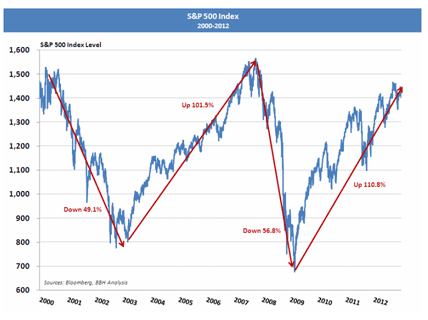
Let’s consider the success of an index approach achieving the preservation and growth of wealth. The graph below depicts the track record of the S&P 500 Index (by far the most popular passive strategy) since the beginning of the 21st century.

From Dec. 31, 1999, through Dec. 31, 2012, the S&P 500 Index provided a compound annual return of -0.2%. Performing in line with the equity market over this 13-year period qualifies as a Pyrrhic victory at best, as it would have left an investor’s equity portfolio pretty much right where it had been at the turn of the century (without taking inflation into account). Furthermore, human nature being what it is, the temptation to sell into weak markets and buy into strong markets would have likely resulted in even worse results for most investors. Volatility may not be the best definition of investment risk, but it is a powerful motivator to act, whether justified or not.
There is, furthermore, no such thing as truly passive investing. Investors naturally assume that a passive approach avoids the necessity of determining which strategy is best suited to their needs or best positioned to provide good returns. In an attempt to avoid making the wrong decision, an investor may decide to make no decision and invest passively. But no decision is still a decision, as there is no strategy-less investment approach. Index funds are designed to replicate the returns of a passive index, most of which are constructed based on market capitalization. The larger a company is (where market capitalization is defined as price-per-share times the number of shares outstanding), the bigger its weight in an index and the more of it a passive investor, or index fund, needs to buy to ensure replication. The more of it an investor buys, the more upward pressure there is on the price, the more the market capitalization grows, the larger its weight in the index … you can readily see where this iterative exercise leads. To the degree that most passive approaches are built on market-capitalization-weighted indices, they are, at their essence, price-momentum strategies. That works fine in a bull market, but price momentum works in a bear market as well, and this downward price momentum helps to explain the cyclical bull and bear swings shown in the preceding graph.
The good news about passive investing is that it allows you to access a price-momentum strategy relatively inexpensively. Index funds are cheap to own, but, as is always the case (and here’s the bad news), you get what you pay for. We prefer to employ investment strategies that rely on fundamental analysis and the identification of value, rather than those that depend on price momentum.
5. Preserving wealth is the first step towards growing it
The ultimate objective of investing is the preservation and growth of our clients’ wealth. There may seem to be two goals embedded within that one statement, but preserving and growing wealth aren’t two different pursuits – one is a necessary condition for fulfilling the other. A focus on wealth protection isn’t an expression of conservativism for the sake of conservativism, but a recognition that the pursuit of growth without an appreciation for protection can lead to loss of principal.
The graph of the S&P 500 Index shown earlier demonstrates this dynamic in action. Mathematically, if your net worth drops by 50%, you need a 100% increase to return to the original starting point (the broad equity market has done this precisely twice in the past decade or so). If, on the other hand, your portfolio doesn’t experience the full downside of a bear market, then you don’t need to participate fully in the rebound to regain and exceed (there’s the growth part) your original portfolio value. Stated colloquially, if you don’t dig a hole as deep as the market, you don’t need as long a ladder to get out.
The best way to express this belief in building portfolios is, as mentioned earlier, investing at a discount to the intrinsic value of the investment in order to create a margin of safety. This calls for patience and fortitude on behalf of investors. For all of its benefits, value often proves to be a poor tool for timing precise turns in a financial market. Securities that are undervalued can remain so for extended periods of time, while overvalued securities can become more so in momentum-driven markets. Nevertheless, we find that valuation is as close as it gets to a law of gravity in the investment world.
6. There is a difference between wealth and money
The difference between wealth and money is purchasing power. It is easy to overlook this simple observation in a period of modest inflation, but for longer-term investors, inflation stands as the most persistent threat to the goal of wealth preservation and growth. It not how much money you have that counts, but what goods and services that money can acquire.
Not all inflation is created equally. Each of us has liabilities (mortgage payments, tuition bills, the desire to travel, lifestyle maintenance, retirement, charitable intent, etc.) that we look to support to some degree with the assets we have accumulated. Asset allocation is therefore essentially an exercise in balance-sheet management: matching today’s assets to today’s and tomorrow’s liabilities. To the extent that our liabilities experience inflationary pressure, our assets must also keep up with that inflation in order to keep the balance sheet balanced.
Your own liability structure may or may not grow in line with the Consumer Price Index (currently 1.7%). Beating your own idiosyncratic rate of inflation is the key goal. For most people, that figure is higher than the CPI.
Today’s relatively modest rate of inflation will at some point begin to rise, exacerbating the challenge of protecting wealth in a real sense. Central banks at home and abroad have created the easiest monetary conditions any of us has ever seen, which eventually will exert upward pressure on prices. Indeed, fostering more inflation has become a specific goal of the Federal Reserve. Furthermore, more inflation would ameliorate some of the fiscal challenges facing the nation, primarily by reducing the real outstanding obligation of federal debt. Inflation may be the worst enemy of the owner of financial wealth, but it is the debtor’s best friend. This is not to say that inflation would ever become the explicit policy of the United States government, but benign neglect can go a long way.
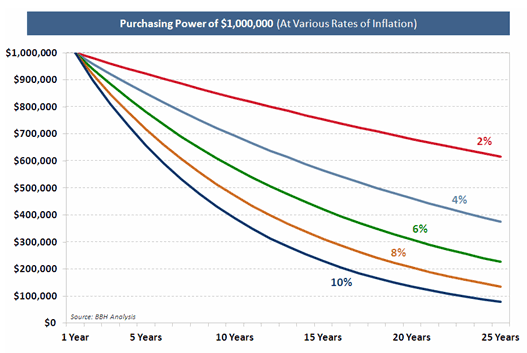
Finally, investors should take into account today’s modest rates of inflation. We are all familiar with the miracle of compound interest: how a very small amount of money, even at a very modest interest rate, can compound into a great fortune over enough time. Inflation is simply that dynamic in reverse: how a great fortune, even at a very modest rate of inflation, can lose substantial purchasing power over time. As the graph below shows, even at a relatively low 2% rate of inflation, a dollar loses close to 40% of its purchasing power over a 25-year period.
Yes, inflation today is relatively modest. But small things matter. (If you don’t think so, try getting a restful night’s sleep in a room with a single mosquito.)
7. Cash provides option value to an investor
Liquidity, or ready access to funds, is a good thing, and good things typically have value. In a normal interest-rate environment, investors can obtain both yield and liquidity in traditional shorter-maturity fixed-income instruments or even cash. Money markets provided yields close to 5% as little as five years ago. Those twin benefits of yield and liquidity are fragmented in the current environment, requiring investors to look in different parts of the market to obtain them. Liquidity is still valuable, and the current interest-rate environment requires investors to pay for it in the form of negative real (after-inflation) yields.
Given the combination of modest inflation and historically low yields, traditional fixed income currently plays a limited role in our asset-allocation policy. Yields on high-quality municipal or Treasury bonds are below the current rate of inflation for shorter and intermediate maturities, and we have been unwilling to extend the maturity of our fixed-income portfolios in search of yield, due to the exaggerated risk in longer-dated instruments. Fixed-income still does play a role in our allocations, however, due to the value of cash — the ability to put money to work in more productive assets when presented with appealing opportunities to do so — we keep a substantial portion of our clients’ fixed-income allocation in strategic reserves, which we invest with an eye toward a little bit of return and healthy liquidity.
As illustrated earlier, price volatility needn’t be the enemy of the disciplined, value-driven investor. It can provide the opportunity to acquire securities at a discount to intrinsic value. The liquidity associated with cash or strategic reserves provides the “dry powder” to act on these opportunities, and as such, liquidity plays an important long-term role in portfolio construction. There is a critical distinction between this understanding of the role of cash in a portfolio and market timing. Market timing is the effort (usually futile) to forecast future price movements and position a portfolio accordingly. An appreciation of the option value of cash, on the other hand, offers the ability to respond to valuation opportunities as they arise. Investors should feel free to hold cash instead of compromising on investment discipline just to remain fully invested.
8. Diversification is an inadequate tool for managing risk
In addition to defining risk as volatility, MPT favors diversification as the means of managing and minimizing that risk in a portfolio. The idea hinges on the idea that investors should own assets that are less than perfectly correlated — that is, whose prices don’t move together in lockstep. A portfolio comprised of assets that move in different directions winds up with less volatility than any one security alone, as some holdings are zigging while others are zagging. It’s a theory that works well on paper but doesn’t always hold true in practice. (Therefore, it stands as a proof statement of that delightful aphorism ascribed to Yogi Berra that “in theory, there is no difference between theory and practice. But, in practice, there is.”)
In practice, correlations between the price movements of securities are not static and usually even rise in periods of market stress, thereby diminishing the advantage of diversification. For example, holding a broadly diversified portfolio of global equities in late 2008 meant that an investor owned a lot of different things that went down in value. It is a perverse characteristic of most financial markets that, precisely when an investor most needs the benefit of diversification, those benefits disappear. Also, in the context of an increasingly global economy and interdependent financial markets, correlations have generally risen over time. A recent review of the relationship between commodity and equity prices showed that correlations are twice as high in recent years versus longer-term periods. Similarly, what happens in Europe or Asia affects the U.S. markets (and vice versa) more than ever before. None of this is to deny the wisdom of appropriate diversification, but an investor who relies on diversification as his or her sole method of risk management is likely to find that protection evaporate in periods of financial crisis.
This observation harkens back to the fundamental idea that the whole point of investing is to protect and grow wealth. Risk is the possibility of permanent loss of capital. That risk cannot be managed through diversification alone, but only by knowing what you own and why you own it. Diversification is not a substitute for fundamental analysis. This is why investing with a margin of safety is so important. Owning securities at a discount to the intrinsic value of the enterprise provides a valuation cushion should unanticipated developments arise at either the microeconomic or macroeconomic level.
Conclusion
Investment success is a marathon, not a sprint. The application of these precepts may not work every time, but that they work over time. In fact, the investment philosophy entailed within these principles is the best way to invest. These tenets are not widely shared throughout the wealth management industry and are far easier to put down in print than to put into practice. Although we did not explicitly state this, contrarian thinking and action are necessary corollaries to each of these ideas, which is not easy in an industry dominated by herd mentality and overwhelmed by the flow of information. It is, however, somewhat easier in a privately managed firm. Free from the distractions of public ownership, we can take a genuine long-term investment perspective and serve a client base that aligns with that perspective. These principles guide us as we craft client portfolios through asset allocation, security selection and the identification of other investment managers and strategies that complement our own investment solutions.
Scott Clemons is the Chief Investment Strategist and Michael Kim is the Chief Investment Officer of Brown Brothers Harriman Wealth Management. To access other BBH articles published alongside this one in their quarterly investment journal, click here.
Read more articles by Scott Clemons and Michael Kim