Advisor Perspectives welcomes guest contributions. The views presented here do not necessarily represent those of Advisor Perspectives.
According to the “wisdom of the crowds” theory, under the right conditions, a large, diverse group of people will outsmart a single expert or small group thereof, regardless of the subject matter. It’s a concept the efficient market hypothesis depends on by default – the market is efficient because all available information is assimilated by investors and thus reflected in prices.1 That is, prices are “accurate” because all relevant data is not only available, but also applied with collective if not individual wisdom.
The notion of the wisdom of crowds entered the popular mindset with the publication of a fascinating bestseller of the same name by James Surowiecki in 2005.2 The text begins with a century-old study by the British scientist Francis Galton. In 1906, Galton observed individuals at a county fair competing to guess the weight of an ox (the more modern version involves estimating the number of jelly beans in a clear glass jar). Contrary to his expectations, the averaged estimate came within a pound of the animal’s weight.
According to Surowiecki, such is the ostensible power of collective wisdom that it doesn’t matter whether the subject is bovines or businesses, or even whether most of the people within the group are especially well-informed. Providing certain basic conditions described in his text are met (sufficiently diverse perspectives, independent opinions, and a method for aggregating information), the group will reach a collectively wise decision.3
It may be the case that, when applied to groups focused on relatively narrow quantitative questions, collective wisdom displays the effect Surowiecki describes. But its utility with respect to issues of both quantitative and qualitative complexity, such as valuing companies, is more suspect.
However, even if we suspend our skepticism regarding the basic premise, there’s a more obvious, practical impediment investors face when attempting to exploit the apparent wisdom of the crowd: If every financial transaction necessarily involves two crowds – buyers and sellers – without the benefit of hindsight, how do investors know which crowd to follow?
As with every investment or trade, the profits that accrue with the passage of time eventually prove one party the wiser. However,of what practical value is the notion of collective wisdom if investors can’t consistently identify the “wise” crowd before the fact?
The Crowd Reacts to the Challenger Disaster
Consider one of Mr. Surowiecki’s first anecdotal examples: the stock market’s reaction to the explosion of the space shuttle Challenger in January 1986.4
Of the four major contractors that participated in the launch, on the day of the accident the shares of Morton Thiokol, the manufacturer of the solid-fuel rocket boosters (SRBs) that proved the cause of the accident, fell by much more than the shares of the other contractors. In other words, despite no public news as to why the shuttle exploded, the market immediately both correctly identified the responsible party and imposed the appropriate discount. The smart money sold.
This assessment is problematic for a couple of reasons.
To begin with, it’s questionable how much genuine insight it required to settle on SRBs manufactured by Morton Thiokol as the most probable source of the problem. The SRBs are used only during lift-off and generate ungodly amounts of heat and thrust.5 They may not have been the inevitable culprit, but they were among the most likely.
Note, however, that those who sold had to be convinced not only of the technical causes of the calamity, but Morton Thiokol’s legal culpability and the financial consequences thereof as well. As Surowiecki wrote:
The steep decline in Thiokol's stock price – especially compared with the slight declines in the stock prices of its competitors – was an unmistakable sign that investors believed that Thiokol was responsible, and that the consequences for its bottom line would be severe… [T]he market was right.6
Was it? On January 28th, 1986, was the smart money buying or selling? It’s a question that, based on subsequent events, has a fairly objective answer.
Morton Thiokol inarguably paid a steep price for its role in the disaster, especially with respect to its reputation. It eventually entered into a settlement with NASA, under which it agreed to take no profit from the $409 million worth of work required to fix future rockets, and to replace the boosters lost on January 28th (the SRBs were reusable and thus recycled for future missions). And when NASA sought bids on a new booster design, Morton Thiokol lost out to Lockheed Corporation.
However, when the development costs of Lockheed's trouble-plagued booster eventually exhausted NASA’s patience, the agency turned back to Thiokol, which in 1991 contracted to supply 142 solid rocket motors for the space shuttle program through 1997.
1. The subject text explicitly draws this connection: “The idea of the wisdom of crowds is not that a group will always give you the right answer but that on average it will consistently come up with a better answer than any individual could provide. That’s why the fact that only a tiny fraction of investors consistently do better than the market remains the most powerful evidence that the market is efficient.” The Wisdom of Crowds, James Surowiecki, Anchor Books, 2004, 2005. Ours is the August 2005 edition. Pgs. 235-236
2. See citation immediately above.
3. Surowiecki discusses these elements throughout his text, but also provides a helpful overview thereof in his introduction.
4. Surowiecki, pgs. 7-11. Study referenced therein: “The complexity of price discovery in an efficient market: the stock market reaction to the Challenger crash,” Journal of Corporate Finance 9 (2003) 453– 479, Michael T. Maloneya, J. Harold Mulherin, (http://myweb.clemson.edu/~maloney/papers
/crash.pdf).
5. The SRBs described are the largest solid-propellant motors ever flown.
6. Surowiecki, pg. 8, italics mine.
In the end, the company retained NASA’s business and paid an immaterial fine – all of $10 million.
Assume one bought Morton Thiokol shares on the day of the accident and paid $34/share (the stock was trading at $37.25 at 11:00 AM that day, and following a brief trading halt was down to $34.38 at 1:00 PM).7 What did that buyer eventually receive? The event timeline is generally as follows:
To summarize, as a result of the spin-off and subsequent transactions, the “unwise” buyer of Morton Thiokol stock at $34 in January 1986 eventually received:
- .341 shares of Autoliv in 1997
- $37.13 per Morton International share from Rohm and Haas in 1999
- $57 for each Cordant Technologies share from Alcoa in 2000
From 1997 through 2000, Autoliv’s shares traded roughly between $30 and $40. Assuming our shareholder sold near the low, he received approx. $10 (.341 x $30 = ~ $10) for each fractional Autoliv share.
Add that to the $37.13 he received from Rohm and Haas and the $57 he received from Alcoa, and he collected $104.13, a 206% gross gain (excluding dividends). This may not be a stellar compounded annual return relative to the bubble-fueled gains of the period, but it’s difficult to frame buying at $34/share as “unwise” – especially compared to those who sold if they realized a loss by doing so.8
What were the sellers in January 1986 collectively concluding? Did they expect net income to materially decline?
In fact, for nine months ending March 1987, Morton Thiokol reported net income of $101.6 million, or $2.14 a share, a decline of 1% from the $102.8 million, or $2.17 a share, achieved during the same period in 1986.9
How many sellers were appropriately discounting the potential value of Morton Thiokol’s air bag inflator business? The sales in this category were admittedly minor – less than $10 million by the end of FY87. But the company was already Mercedes’ sole supplier. Wouldn’t a wise crowd have recognized the potential of this business, which Morton Thiokol was already positioned to dominate? By FYE June 1992, Morton's Automotive Safety Products Group revenue had reached $329 million, with net income of $31 million. By 1996 those figures had risen to $1.4 BN and $152 million, respectively.10
Of course, in hindsight one could always argue that Morton Thiokol is merely an exception that proves the rule. If that’s the case, it’s a uniquely awkward anomaly, because as Surowiecki himself notes in the footnotes of his text, shareholders were ostensibly wrong about Morton Thiokol not once, but twice.11
On the day in February 2003 when the space shuttle Columbia tragically disintegrated during re-entry, the shares of Alliant Techsystems, a successor entity to Thiokol and manufacturer of the booster rockets, plummeted. The investigation that followed confirmed that the disaster was in fact caused by foam insulation striking the Columbia’s wing. Had investors forgotten that the booster rockets were jettisoned following launch, and thus couldn’t possibly be implicated?
To be fair to Mr. Surowiecki, whom I both admire and avidly follow, anecdotal evidence is only that; neither his conclusions regarding Morton Thiokol nor mine categorically or scientifically prove anything. But I find it compelling that evenwith the benefit of hindsight, Surowiecki arguably picked the wrong crowd. His apparent mistake only reinforces our point: Unless they are able to consistently identify the “wise” investment crowdthe concept of collective wisdom is of no value to investors.
Consistency is emphasized because it is absolutely essential to long-term investment outperformance. Nothing is more critical to overall returns than limiting losses relative to gains. Which is to say, outperformance requires very rarely mistaking the unwise speculators for the wise investors.
Excluding short sellers who borrowed stock, many of those who sold plummeting Morton Thiokol shares on the day in question weren’t just forfeiting an eventual profit – they were locking in a loss. Was doing so the objectively intelligent, “wise” thing to do?
One could argue that it depends upon when one bought and sold, that investment wisdom itself is ultimately a function of time horizon. And it is undoubtedly the case that on the day the Challenger was lost some investors made money by taking advantage of the prevailing sentiment. But shorting and short-term trading are not investing as most define the practice. And exploiting highly variable, volatile, transient trends in equity prices effectively and consistently enough to deliver superior long-term profits requires timing more adroit than I’ve ever encountered.
7. Maloneya and Mulherin, pg. 457.
8. If to simplify the math we assume that the shareholder received the entire $104.13 in 2000, the 206% gross return on the original $34 share purchase equates to a compounded annual return of approximately 9%. Certainly less than the rate of appreciation during the bubble that burst later that year – the S&P 500 gained roughly 580% from January 1986 through May 2000 – but a respectable return regardless, and arguably an attractive one when adjusted for the actual risks assumed.
9. Morton Thiokol Profits Flat, Chicago Tribune, April 15, 1987 (http://articles.chicagotribune.com/1987-04-15/business/8701280723_ 1_net-income-quarter-and-nine-months-morton-thiokol)
10. http://edgar.brand.edgar-online.com/EFX_dll/EDGARpro.dll?FetchFilingHTML1?ID=1462115&SessionID=QuZFHHHAD_em6P7, pg. 21.
11. Pg. 287.
From Space Shuttles to Sedans: The Crowd Descends on Toyota
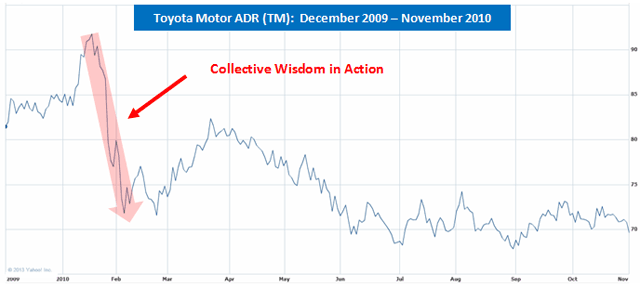
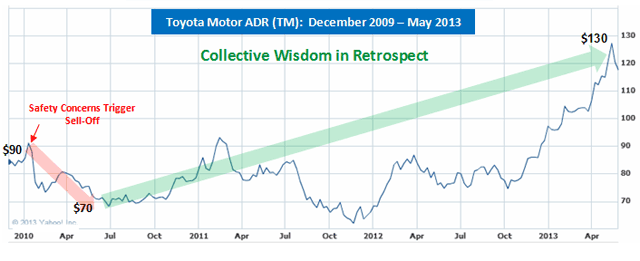
Consider a very similar, more recent event: The panicked sell-off of Toyota shares in 2010 [Disclosure: My firm was a purchaser of Toyota equity during the period discussed and continues to hold the ADRs].

Perhaps the most difficult episode in Toyota’s history began on August 28, 2009, when four people riding in a Lexus ES 350 loaned by a dealer were killed in a two-car collision. The National Highway Traffic Safety Administration (NHTSA) released a safety investigation report on October 25th, finding that the accident vehicle was incorrectly fitted with all-weather rubber floor mats meant for the RX 400h SUV, and that these were not secured by either of the two retaining clips designed to hold the proper mats in place. Apparently, as a result the driver’s-side floor mat slipped up and over the gas pedal, pinning the accelerator to the floor and leading to the accident. On November 25, 2009 Toyota amended its floor mat recall to include reconfiguring the accelerator pedal, replacing the all-weather floor mats with thinner mats, and installing a brake override system.
Despite the obvious role of the floor mat in the ES 350 crash and no evidence of a serious design flaw or problem with the electronics, rumors of unintended acceleration took hold. Testifying before Congress in early February 2010, Secretary of Transportation Ray LaHood fanned the hysteria by suggesting that Toyota owners “stop driving” their cars.
Given the loss of life and dramatic nature of the events, it’s easy to understand why people might have been inclined to overreact. However, collective wisdom aside, was it even rational to conclude that the industry’s quality leader had suddenly devolved to fabricating death traps?
Toyota had for decades set the quality standard in auto mass manufacturing, building some of the safest, most defect-free cars ever produced. The legal settlements, fines paid, and public mea culpas motivated by reputational damage control were concerning, and perhaps distracting to the easily alarmed. But those who viewed the company through the prism of its accomplishments weren’t much surprised when the subsequent investigation regarding unintended acceleration came up empty. On February 8t, 2011, the NHTSA released the details of the intensive study of Toyota’s electronics led by NASA. LaHood said, “The verdict is in. There is no electronic-based cause for unintended high-speed acceleration in Toyotas. Period.”
Fortunately for the company, however distracting and expensive, neither the franchise nor its earning power suffered any long-term impairment.12 If anything, management’s response only bolstered Toyota’s prospects.
Viewed in long-term retrospect, the “wise” crowd’s response to misguided safety concerns looks a lot like short-term panic.
Early on in his text, Surowiecki characterized the extremes of collective behavior – riots, asset bubbles, etc. – as mistakes that serve as “negative proofs” of the power of collective wisdom, suggesting that they only underscore the importance of diversity and independence to good decision making.13 However, as a practical matter, those extremes are exactly the circumstances investors pursuing above-market returns should be seeking.
12. On July 19, 2013, Toyota Motor Corp. won final approval of a settlement, valued at as much as $1.63 BN by plaintiff lawyers, with U.S. consumers who claimed that recalls related to sudden, unintended acceleration caused their vehicles to lose value. The subject recall involved more than 10 million vehicles worldwide in 2009 and 2010 for problems related to possible unintended acceleration, including sticky accelerator pedals and floor mats that could shift out of position. The settlement did not resolve personal-injury and wrongful-death lawsuits based on allegations accidents caused by unintended acceleration.
13. Surowiecki, pg. XIX.
Exceptional returns derive from the extreme mispricings that only a strong consensus can create
The crowd’s buying and selling sets the price, but not the value. Hence, when price and value diverge, it’s because the dominant crowd is wrong.
In his chapter about financial markets, Surowiecki stated “…the fact that only a tiny fraction of investors consistently do better than the market remains the most powerful piece of evidence that the market is efficient.”14 He carefully qualified this statement in the very next paragraph, writing that “[e]ven so, financial markets are decidedly imperfect at tapping into the collective wisdom.”15
That vague, conflicted language – the market is “efficient” but “imperfect” – leaves the impression that Surowiecki was straining to avoid contradicting his theory. He offered several reasons for the apparent mispricings – susceptibility to speculation, potentially infinite timeframe and the tendency for “wrong” prices to persist, among others. But the problem with this line of argument is its obvious circularity: The market cannot be blamed for not “tapping into” the crowd’s wisdom because the market is the crowd.If the market isn’t consistently efficient, it’s because investors aren’t consistently wise.
If collective wisdom works to such remarkable effect in so many other contexts (a broad theoretical point I’m neither rejecting nor conceding), what is it about financial markets in particular that short-circuits the crowd’s inherent genius? Surowiecki hinted at one influential factor when he stipulated that, in order for the group to be smart, “there has to be at least some information in the ‘information’ part of the ‘information minus error’ equation.”16
Insight obviously doesn’t materialize in a vacuum; it requires a minimum of information. It follows that in order for the crowd to be collectively wise, it may not be necessary that every member be brilliant, but they must be sufficiently informed.
In most of Surowiecki’s examples this occurs by design. Whether attempting to isolate the SARS virus, locate a missing submarine or predict the outcome of an election, in each case the group becomes informed as a result of a deliberate, explicit process (however loosely orchestrated).17 This is characteristic of groups that share a specific objective. Except, that is, for investors, who are neither organized nor particularly well-informed.
They may have a common goal (profit), but individual investors do not coordinate their efforts toward it. This absence of any formal organization is one reason why speculative bubbles arise with such regularity.
When a dangerous biological virus emerges, the more organized the afflicted community or region, the easier it generally is for the authorities to contain it; epidemics typically inflict the most harm on those countries or communities most lacking in infrastructure. But there is very little to prevent a speculative contagion from permeating the financial markets.18
It’s no mystery why uninformed investors are more prone to stampede; ignorance is very poor insulation against overreaction. What is less obvious is why investors make so little effort to become informed when it’s plainly in their own best interests. Perhaps it’s the dry, somewhat alien nature of the information. Simple overconfidence may also play a role. But whatever the reasons, most investors (including the “professionals”) do little more than peruse the same superficial Wall Street research consumed by everyone else. Needless to say, this anemic effort does little to cultivate the independent mindset and diversity of opinion that Surowiecki emphasizes as essential to the crowd’s wisdom. In short,
The crowd’s collective investment wisdom is pre-empted by its indifference
With so little knowledge to inform their decisions, it is inevitable that investors react to price – what else do they actually know ? That said, investors’ Pavlovian response to price volatility reflects a kind of perverse insight. Contrary to what Surowiecki suggested, the crowd isn’t “blind to its own wisdom”; if anything, it’s wise to its own ignorance.19
After all, chasing prices is hardly irrational if other investors probably are better informed (near-complete ignorance is a very low threshold to clear). If only subconsciously, the investment crowd knows how little it knows.
Investors also know what they have at stake – which is to say, much more than someone trying to guess the number of jelly beans in a jar. The consequences at the individual level are absolutely key, because the prospect of significant monetary gain or loss introduces emotions that influence behavior in ways that distinguish investing from other challenges with more potentially serious but less immediately personal ramifications.
The scientists tasked with isolating the SARS virus shouldered an extremely important responsibility – more grave, most would agree, than any investment decision. However, the nature of the consequences didn’t materially undermine the detachment they required to exercise their best judgment. Among the examples Surowiecki cited, investors are unique in the degree to which the consequences of their actions pollute their judgment.
In the final analysis, Surowiecki delivered a mixed message to investors: Despite the fact that the market does an imperfect job of tapping into the collective wisdom it requires to be effective, it nonetheless is efficient, and the scarcity of outperformance proves it.20 Notwithstanding our foregoing observations on the subject, the error of taking underperformance as proof of market efficiency is rather obvious: The infrequency of outperformance isn’t “powerful evidence” that the market is efficient;it only confirms the difficulty of consistently exploiting its inefficiencies.
The market may be hard to beat, but that doesn’t make it wise. Or efficient. Or unbeatable.
Steven Grey is the founder and managing principal of Grey Value Management, a privately-held investment firm.
14. Surowiecki, pgs. 235-236.
15. Id. at 236. Italics mine.
16. Id. at 10.
17. Among other examples in his book, Surowiecki describes the search for the USS Scorpion submarine, which disappeared in May 1968.
18. What few effective tools the government has at its disposal, such as raising interest rates, it has historically been very hesitant to utilize. Given the ripple effects, including the impact the financial markets have on the broader economy, this aversion is logical, especially in light of the broad disagreement as to whether speculative bubbles can even be identified without the benefit of hindsight. Other measures, such as raising margin requirements, are more targeted, but much less potent and also applied very sparingly.
19. Id. at 36.
20. Id., pgs. 235-236.
Read more articles by Steven Grey