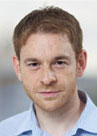
Dylan Grice
For someone who started his remarks proposing to “kill all the economists,” Dylan Grice can wax surprisingly sentimental, with a fresh, human take on monetary policy that leads him to some worrisome conclusions. Making a case for gold, cash, and other safe havens, Grice said the biggest threat to investors today is a problem that has plagued societies throughout history – mistrust.
Grice, who is leaving Societe Generale’s Global Strategy Team to take a buy-side position, argued that recent bouts of quantitative easing (QE) and other “monetary experimentation” in the world’s major economies may be sowing the seeds for a worldwide breakdown of social cohesion – which, among its unsavory consequences, could translate to a big spike in interest rates. He delivered his remarks – part market commentary, part history lesson, and part philosophy seminar – last week at a strategy conference hosted by his soon-to-be-former employer in London.
The core of Grice’s thesis was his view of money: He doesn’t define it merely in technical terms, as a unit of exchange or a store of value, but rather as something deeper. “Next to language, money is the most important way that we communicate with one another as a society,” he said. “It’s how we implicitly express our values: the value of other people’s labor, the value of what other people have, and the extent of exchange that we have with each other.”
As a result, Grice said, questions of trust are “fundamentally embedded” in the marketplace. “You’re not going to exchange with someone if you don’t trust them,” Grice told his audience. “You work for your employer because you trust them to pay you. You get into a airplane because you trust the pilot not to crash. It’s trust that moves the economy.”
This feature of money, Grice warned, is why inflation can have pernicious and unseen effects, and that’s what Grice is worried about today. “You cannot have this trust if you do not have money that you can trust,” Grice said. “When you devalue money, you devalue trust.”
What’s $1 trillion among friends?
Quantitative easing, printing money, devaluing currencies, monetizing debts – the increase in these activities in recent years is what has Grice concerned. He led his audience in a thought experiment to explain why.
First Grice asked his audience what happens when a government creates, say, $1 trillion out of whole cloth. (Whether by direct printing of money or by interest rate adjustments, it’s all “basically the same mechanism,” Grice said.) The answer is simple: It spends it, one way or another. It builds a road, or a school, for instance.
“If we print a trillion dollars, we can now spend a trillion dollars,” Grice said. “We have absolutely benefited from this. We have a trillion dollars that otherwise we wouldn’t have had. But the question is: Who pays for that trillion dollars?”
On the one hand, you have direct, tangible beneficiaries of that money – government contractors who see an uptick in business, employees they hire or pay more as a result, and so on as multipliers play out. But those who miss out on the windfall pay the cost, in the form of slightly higher prices for goods and services. For instance, maybe one of these non-beneficiaries would have bought a new house, Grice said, but a newly enriched contractor got it first by offering to pay a little more – the cost, in other words, is slightly higher prices for goods and services, even though not everyone has extra money to pay those new prices.
But Grice framed this a little differently than it’s taught in Economics 101; when government expands the money supply in such ways, Grice said, “what it’s done really is redistributed the wealth.”
This has consequences. Non-beneficiaries get angry at those who are newly better off – after all, thanks to their increased ability to spend, you might have missed out on your dream house or been priced out of your favorite restaurant. The beneficiaries, meanwhile, feel victimized as well. Their response, Grice said, is: “‘We didn’t do anything wrong. We got the contracts, we employed people – we did what we were supposed to do!’”
This, Grice believes, is the deeper cost of loose monetary policy. “What we’ve effectively done with this $1 trillion increase, this $1 trillion money-printing exercise, is to turn society against itself,” he said. “We’ve actually weakened the trust, we’ve weakened the fabric of society.”
Would Keynes be a Keynesian today?
Even John Maynard Keynes shared similar sentiments, according to Grice; after posing the question above, Grice quoted the famous British macroeconomist as having argued the following in 1921:
“By a continuing process of inflation, Governments can confiscate, secretly and unobserved, an important part of the wealth of their citizens. By this method they not only confiscate, but they confiscate arbitrarily; and, while the process impoverishes many, it actually enriches some. … Those to whom the system brings windfalls … become ‘profiteers’ who are the object of hatred. … The process of wealth-getting degenerates into a gamble and a lottery. … Lenin was certainly right. There is no subtler, no surer means of overturning the existing basis of society than to debauch the currency. The process engages all the hidden forces of economic law on the side of destruction, and it does it in a manner which not one man in a million is able to diagnose.”
The emphases are Grice’s, and he stressed that the above quote captures the way he thinks about monetary policy today.
“It’s not about inflation; it’s about wealth redistribution – this unseen, insidious wealth distribution,” Grice said. “As Keynes said, nobody is quite capable of diagnosing it, but it nevertheless is very real and has very real effects.”
Witch hunts, beheadings, and the Sex Pistols
Grice came armed with historical data intended to illustrate that the link between inflation and societal breakdown has a long track record, dating back at least as far as ancient Rome.
According to Grice’s data, the silver content of ancient Roman currency dipped from approximately 50% to next to nothing during the 3rd century, around the same time that the emperor Diocletian began widespread persecution of Christians within the Roman Empire.
Grice presented an overlaid graph purporting to show that, as the rate of inflation rose in England during the late 16th and early 17th centuries, the incidence of witch trials spiked. Similarly, the beginning of Robespierre’s infamous guillotine-heavy “Reign of Terror” during the French Revolution “coincides with a collapse in the currency,” Grice said. (“Notice I say ‘coincides,’” Grice cautioned, “not ‘causes.’”)
Perhaps the “most spectacular” – and most familiar – example, according to Grice, is the rampant inflation in Weimar Germany that paved the way for Hitler’s rise to power and the Holocaust.
Grice acknowledged that he was presenting “very, very extreme examples,” although he noted that the most recent period of inflation in the US – the 1970s – had its own milder symptoms of social breakdown. “This was a decade wracked with social tension, wracked with political scapegoating,” Grice said. He said the 1970s album by the Sex Pistols, “No Future,” captured the 1970s zeitgeist nicely – money and saving are essentially about creating “links to the future,” Grice said, and those bonds frayed in the ’70s.
“You save money so you can spend it tomorrow,” he explained. “You only do that if you can reasonably expect to have something left, that your savings will be worth something.”
Back to the future?
Grice acknowledged that none of this may seem, at first blush, to be relevant today – after all, the US hasn’t experienced serious inflation since those Sex Pistol days more than 30 years ago. But he sees signs that some of the “hallmark features” of these turbulent episodes are “bubbling to the surface” once again.
“In the US, median household income has gone nowhere for 20 years. Median incomes have been flat, per capita real income zero – no growth,” he said. “This is a staggering thing. This isn’t supposed to happen.” Meanwhile, he noted, “income inequality has been becoming a political issue,” both in the US and more explosively in Greece.
To Grice, these are telltale signs of the kind of misunderstood and unpredictable redistributive effects that accompany reckless monetary policy. In the current case, he said, the handsomely bailed-out financial sector has been a highly visible beneficiary of economic and monetary policies, while a record proportion of US households have gone onto food stamps in the wake of the financial crisis. It’s no coincidence that the rhetoric of “the one percent” and “the 47 percent” has dominated in recent years.
“This wealth redistribution has absolutely been there for all to see, and it’s not necessarily a natural thing,” Grice said. “We’re seeing the consequences of past monetary experimentation.”
Ongoing developments will only perpetuate and exacerbate the trend. “We’re already seeing more money printing, more monetary experimentation,” he said.
“Bullish on safe havens”
This outlook – trust is breaking down, the past seems to be repeating itself – is why Grice said his investment outlook is very conservative for 2013.
“This may sound philosophical, but it isn’t. Financial markets don’t exist in a vacuum,” Grice said. “That breakdown in trust, the financial market analog of that is higher yields. If you don’t trust someone, what do you do? You want a high risk premium. You want higher interest rates.”
That’s why Grice said he is “bullish on safe havens.”
“I think this is the world that we’re moving into,” Grice said. “It hasn’t shown up in the markets yet. I expect it to.”
“With quality equities, gold, some cash, you have – I think – a reasonably robust portfolio of safe havens, which will actually do reasonably well for you,” he said.
Kill all the economists?
Though most of his talk was spent explaining the comingled dangers of rising inflation and declining trust, Grice included some distrust of his own, aimed squarely at the economics profession generally and the world’s central bankers more specifically. (Grice did not mince words, although, to be fair, he quickly abandoned his suggested mass slaughter for the milder proposition that most if not all economists should at the very least be ignored.)
Singling out Fed Chairman Ben Bernanke and his British counterpart, Mervyn King, Grice said they proved themselves overconfident and unreliable in the run-up to the 2008 crisis, and he doesn’t trust them now. He contrasted the past assurances of Bernanke (“We’ve never had a decline in house prices on a nationwide basis,” in 2005) and King (“People won’t be talking about this a year from now,” as the crisis began to unfold in September 2007) with what they’re saying now: Bernanke is “100 percent” confident the Fed can control inflation; King has “absolutely no doubt” that the British central bank will have an easier time reducing its balance sheet than it did expanding it.
“I think we should have doubts,” Grice countered. “If we had a little more doubt, we wouldn’t be in this mess.”
Grice said that recent history has shown the framework used by economists to be flawed, and that the central bankers should learn the same lesson he’s trying to instill in his 16-year-old son: “Mistakes are fine if you learn from them, it’s the systematic mistakes that are the problem.” But he’s worried that in neither case is the message sinking in. “I’m coming to think that the central banks have that kind of teenager about them,” he said.
Michael Skocpol is an editor and staff writer for Advisor Perspectives.
Read more articles by Michael Skocpol