Advisor Perspectives welcomes guest contributions. The views presented here do not necessarily represent those of Advisor Perspectives.

The following is excerpted from the December 13 edition of “Breakfast with Dave,” a publication from the Canadian research firm Gluskin Sheff:
- The Fed is going to replace Operation Twist, which expires at year-end, with $45 billion of outright buying of Treasury securities (the Fed is also now throwing five-year notes into the mix … and as such the average duration is a tad shorter than it was under the OT program – this could be one reason why the yield curve steepened yesterday). This will boost its balance sheet by that much since there will no longer be any offset from selling short-dated securities. Some pundits thought the mix might have had some incremental buying of mortgages but the wording says long Treasuries (and it is maintaining its $40 billion of agency mortgage purchases per month).
- If there was a new wrinkle, the Fed got rid of mid-2015 with regard to the earliest date the Fed would move away from its zero-interest-rate policy and replaced it with numerical targets, including a 6.5% unemployment rate (though it will look at a broad range of labor-market indicators – a drop in the U-rate premised on an ever-declining participation rate is unlikely to impress the FOMC) and near-term inflation expectations of 2.5% or higher. This overt attempt at not stopping this process of money printing and ultra-low policy rates until it has triggered an increase in inflation expectations that is a half-point higher than the Fed’s target is likely one reason why the back end of the Treasury curve sold off while the gold price rallied as it approached the 50-day moving average in the initial response to the FOMC decision. The DXY index was a casualty.
- On the economy, there were just some modest tweaks. No mention of fiscal uncertainties but Sandy blamed somewhat for the sluggish economy (but the Fed chairman did say in the Q&A session that “fiscal policy becomes very contractionary, I think the economy will go off the cliff”). It did mark up its assessment of unemployment, but it downgraded the consumer. At the margin, the Fed became less tentative in its more positive view on housing, but the bearish tone on business capital spending was left intact. The inflation background was marked down too from “picked up somewhat” on October 24 to “somewhat below the Committee’s longer-run objective.”
At the pace the Fed is going, the funds rate will end 2013 near-zero for the fifth year in a row and the Fed’s balance sheet will expand from $2.8 trillion to $3.8 trillion (it was $800 billion before the QE programs were put into place). So as a share of GDP, the Fed’s balance sheet expands from 18% now to 23% a year from now.
The Fed is going to have to make it clear that it is not just a 6.5% but what drives it that is going to be the key. I am surprised they opted for this lagging indicator, subject to benchmark revisions, that can often decline because the economy is weak, not strong, as a signal for its future policy intentions. This risk brings more, not less, volatility and confusion to the marketplace, in my view.
The equity market likes the prospect of more money printing and the Fed’s more forceful efforts to reflate the economy, and stocks are a far better inflation hedge than bonds are, of that there is little doubt (though I have to say that yesterday’s reversal from the intra-day highs reminds me so much of how the market could not hold onto its gains after that last “blowout” easing message from the Fed back on September 13th – investors may well be getting a case of “Fed fatigue”). Commodities even more so. But here is what I am concerned about. Security valuations are going to become even further distorted as this monetary life-support reinforces the trend and time frame for negative real interest rates. At the margin, the Fed is trying to brace investors for an even lengthier and more open-ended period of financial repression, a policy that is deliberately forcing savers to go further out on the risk curve. I am concerned of the unintended consequences of these experimental nature that have no precedence, but perhaps these consequences lie too far ahead in time from a “tactical” sense, but we should be aware of them. The last cycle was built on artificial prosperity propelled by financial creativity on Wall Street and this cycle is being built on an abnormal era of central bank market manipulation.
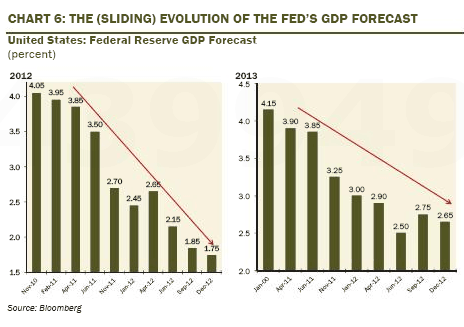
I wonder, for the private client, whether the Fed’s actions are going to create more fear about the future as opposed to being a confidence builder. Only in the institutional investor/fast money trader universe, does a nutty world make any sense where economic weakness is perceived as good news because the central bank is going to print more money indefinitely. I don’t recall ever seeing such a downcast assessment of the overall economy in a Fed press statement in the fourth year of a recovery, but the markets instead are focused on this more open-ended strategy for monetary stimulus. The Fed yet again cut its GDP forecast – this time to 1.75% for 2012 from 1.85% in September, 2.15% in June and 2.65% in April (on a year-over-year basis). For 2013, the outlook was trimmed to 2.65% from 2.75% in September and 3% at the turn of the year. And 2014 was cut to 3.25% from 3.4%. As an aside, the base case from the FOMC is for the unemployment rate to finish 2014 slightly above 7% (more on this below).
All I can be assured of is that we are heading further down the road of a risk-on/risk-off world where securities prices are and time horizons are divorced from economic fundamentals. This augurs for relative-value strategies and I would have to assume that gold/gold miners would do well; raw materials in general should benefit if for any reason other than they are priced in US dollars. I see nothing here that causes me to turn bullish on the economic outlook or the greenback.
What is fascinating is that the Fed is voicing its intent to create inflation which is bad for government bonds and yet it will resist upward pressure on yields by emerging as the captive market for long-dated Treasuries. It’s like a bartender giving you a shot of Johnnie Blue alongside a double espresso.
Let’s try to assess how long it’s going to take the Fed to achieve these unemployment rate and inflation rate targets – this is going to be worse than watching paint dry, let alone grass grow.
The Fed’s preferred inflation rate is the core PCE deflator, and if it wants it at 2.5%, then just consider that in the past two decades, the YoY trend has been at this level or higher less than 2% of the time (the Fed could be referring to survey data, and even on this score, the Livingston poll shows that over the past 15 years, inflation expectations one to two years out have been 2.5% and higher just one-third of the time; and the inflation expectation survey of professional forecasters by the Philly Fed has been over this level just a quarter of the time over the same period). Talk about an elusive target! The Fed may never have to make another announcement again… just keep on expanding its balance sheet by a trillion dollars a year to perpetuity.
In terms of getting to a 6.5% unemployment rate, this will also take a very long time. Yes, the move down from the 10% peak in October 2009 to 7.7% now is a step in the right direction, but that required a 1½ percent reduction in the participation rate as discouraged workers dropped out of the labor force (if not for that, the jobless rate would be 9.8% today). So much of the heavy lifting has been done on this score. In the past, from the point where we got as low as 7.7% in mid-cycle to 6.5%, it took an average of more than two years, but by the time it happened, real GDP growth had accelerated to over 3.5% on a year-over-year basis. It’s been over eight years since we saw such a pace of real economic activity.
Assuming the working-age population growth 208k per month (post-recession average pace) and the participation remains constant at the November level of 63.6%, the economy needs to generate an average of 272k jobs per month to get the jobless rate down to 6.5% from 7.7% by the end of next year or an average of 201k per month to pull the jobless rate down to 6.5% from the current level by the end of 2014.
It would take 176k per month under the same assumptions to get to 6.5% by the end of 2015, so you can see why ”de facto” the Fed really did extend the term of its commitment to maintaining this unusual degree of monetary accommodation – but without getting bogged down to a specific date this time around (a date he has changed in the press release no fewer than three times since the summer of 2011… Bernanke was obviously getting upset with this constant embarrassment of changing the time-stamp). And assuming we could create 163k jobs per month, it would take until the end of 2016 to bring the unemployment rate down to 6.5%. It’s not as easy as it seems.
Finally, assuming that the new normal for job creation is the 150k we have averaged thus far this year, we would not see the jobless rate hit the Fed’s ‘target’ of 6.5% until the fourth quarter of 2018! And then we have to consider where the trend in the core PCE deflator is at that point – the YoY trend is now 1.6%, the six-month trend is running at a 1.2% annual rate and the three-month at a mere 0.9% (so heading in the wrong direction for the inflation advocates).
But let’s just say that beneath the veneer, what the Fed really did yesterday was move from a mid-2015 time stamp to an end-of-2018 time stamp. Six more years of financial repression. Get used to it.
And think not only of the absurdity but the enormity of what this means. If our assumptions are anywhere in the ballpark, the Fed’s balance sheet expands from $2.8 billion or 18% of GDP today to nearly $9 trillion or practically 50% of GDP by the time the unemployment rate gets to the 6.5% Holy Grail. At that point Holy Grail is likely to turn into “Holy Cow” as the Fed embarks on the inevitable process of unwinding all of this monetary largesse.
For the here and now, all anyone needs to know is that if there was even the slightest hint of inflation, Ben Bernanke would never have said what he said yesterday.
Nobody on Wall Street was alive when we last had a bout of deflation, and pundits really have no clue as to how much more difficult it is to turn around than inflation, when all one needs to do is raise rates. Paul Volcker had a much easier time than Ben Bernanke, that much is for sure.
So for what it’s worth, I say we need to have a deflation-inflation barbell to guard against both extremes. That means extending duration in bond portfolios to hedge against the deflation prospect and increasing exposure to gold/raw material plays to hedge against the inflation prospect (not to mention the hedge against an ever-rising supply of greenbacks… as Paul McCulley is fond of saying, “Bernanke has the printing press, and he gets the ink for free”).
One last thing to note – sentiment on the bond market has become extremely negative (the legendary Ray Dalio is the latest to turn negative on Treasuries), there is a big bold article on page 25 of the FT that’s titled Fed Easing Brings Closer the Date of Bond Reckoning. Since it is typical for a secular bull market to only end once the public becomes enamored with the asset class in question … that is hardly the case today with the fixed income market, historically low yields notwithstanding.
Read more articles by David Rosenberg