Advisor Perspectives welcomes guest contributions. The views presented here do not necessarily represent those of Advisor Perspectives.
 This essay is excerpted from a recent version of The Credit Strategist (formerly the HCM Market Letter). To obtain the complete issue, you must subscribe directly to this publication; Please go here. The Credit Strategist is on Twitter - @credstrategist
“The more money becomes the sole centre of interest, the more one discovers that honour and conviction, talent and virtue, beauty and salvation of the soul, are exchanged against money and so the more a mocking and frivolous attitude will develop in relation to these higher values that are for sale for the same kind of value as groceries, and that also command a ‘market price’.”
“The search for mere stimuli in themselves is the consequence of the increasing blasé attitude through which natural excitement increasingly disappears. This search for stimuli originates in the money economy with the fading of all specific values into a mere mediating value. We have here one of those interesting cases in which the disease determines its own form of the cure. A money culture signifies such an enslavement of life in its means, that release from its weariness is also evidently sought in a mere means which conceals its final significance – in the fact of ‘stimulation’ as such.”
George Simmel, The Philosophy of Money (1907)
In 1977, the United States launched two small satellites, Voyager 1 and Voyager 2, to explore the universe. Thirty-four years later, these two man-made miracles are still emitting daily readings of their travels through the universe. Recently, it became apparent that Voyager 1, which is now more than 11.1 billion miles from earth, may be on the verge of exiting our solar system and headed into interstellar space. It takes 16 hours and 38 minutes for data to travel the billions of miles from Voyager 1 to the antenna of NASA’s Deep Space Network on Earth. Astrophysicists parsing this data apply three criteria to determine whether Voyager has left our solar system: the stream of particles coming from the sun should decline, the stream of charged particles coming from the galaxy should increase, and the direction of the magnetic field surrounding the satellite should change. Over the summer, these changes began to be detected. Ed Stone, Voyager project scientist at the California Institute of Technology, explains: “The laws of physics say that someday Voyager will become the first human-made object to enter interstellar space, but we still do not know exactly when that someday will be. The latest data indicate that we are clearly in a new region where things are changing more quickly. It is very exciting. We are approaching the solar system’s frontier.” Those of us whose physical bodies are earthbound and spend our days pondering politics and markets might take a moment to reflect on this incredible achievement. Man is capable of great highs and great lows. Those of us in the worry business, charged with protecting other people’s capital, tend to dwell on the lows. Voyager reminds us not to ignore the highs, and to appreciate the remarkable capabilities of the human minds and souls that built that little spaceship now rocketing into regions of this infinite universe that human consciousness can barely imagine.
Politics
Back here on Earth, all eyes are rightfully on November 6, when American voters will face one of the most consequential decisions in their lifetimes. The momentum that had been building toward a crescendo on Election Day appears to have been broken by Hurricane Sandy. Whether the country’s attention, which was already being tested by overexposure of both candidates, can be recaptured remains to be seen. The U.S. Constitution has survived civil wars and world wars, so it will survive Sandy. Our system of government was designed to withstand the forces of war and nature, and to allow change to happen only incrementally. But the choice between Barack Obama and Mitt Romney will have dramatic short-term consequences. Is this the most important election in our lifetimes? It is difficult to say. Had Al Gore defeated George W. Bush in 2000, it is highly unlikely that the U.S. would have invaded Iraq, or that large tax cuts would have been occurred. In retrospect, the outcome of the 2000 election looks just as monumental as today’s.
From an economic standpoint, 2014 will be just as important, if not more important, than 2012. Ben Bernanke’s term as Chairman of the Federal Reserve expires in 2014. While there are reports that Mr. Bernanke is not interested in another term, it would not be easy for him to say no if the then sitting president asked him to stay on. We already know that Mitt Romney will not make such an offer, while Mr. Obama’s thoughts on the matter are unknown. So at the very least, a Romney victory will virtually guarantee the end not only of Mr. Bernanke’s term but of the unprecedented period of central bank activism and monetary accommodation over which the former Princeton economics professor has presided. While markets are likely to greet a Romney victory with a short-term rally, more considered reflection could lead them to conclude that the days of easy money will be coming to an end.1 Moreover, they would end long before mid-2015, the period through which the current Open Market Committee has promised zero interest rates. The prospect of a Federal Reserve Chairman in the “tough love” mode would not bode well for stocks or bonds. Unfortunately, it is precisely what the economy needs in order to recover.
The latest adventures of the Bernanke Fed will likely go down as among the most misguided central bank policies in history. It is one thing to step up with emergency measures during a crisis, as Mr. Bernanke did in 2008, in order to prevent a global financial collapse. Mr. Bernanke acted appropriately then and deserves credit. But it is quite another to extend those policies for years after the crisis has passed and prevent free market functions from resuming. That is particularly true with respect to the housing markets that lay at the heart of the crisis. One would have thought that of all people, the chairman of America’s central bank and a former economics professor from Princeton would have learned the primary lesson from the U.S. housing bust – housing is an unproductive asset that enjoys far too much policy support. Yet housing is precisely the sector that Mr. Bernanke has targeted with his open-ended commitment to purchase $40 billion per month of mortgage paper. Perpetuating abnormally low mortgage rates distorts the free operation of the markets and delays the necessary market clearing that has to occur for the housing markets to return to health. Moreover, by continuing to allocate more capital to the unproductive housing sector, the Federal Reserve is depriving other productive sectors of capital. This is another example of the authorities insuring failure by attempting to eliminate it. It hasn’t worked before and it won’t work now. Paul Volcker understood that in the 1980s. Hopefully there is another Paul Volcker out there and the next president will find him and appoint him to replace Mr. Bernanke in 2014.
On a longer term basis, however, much has to happen to render the outcome of the election truly decisive. The long-term trajectory of federal and state finances is so negative that only radical reform can alter our fate. The candidates can speak until they are blue in the face about various proposals to create jobs and stimulate economic growth, but the U.S. economy will continue to grow slowly as long as it is suffocating beneath trillions of dollars of public and private sector debt. Too much capital is being drained by debt service, even with record low interest rates. When interest rates rise again – and it is a matter of when, not if – it will be game over for any hope of economic growth. We are currently spending no more on interest on the federal debt than we did in 2007 when the debt was only 40% as large as it is today – the result of interest rates on the debt being so much lower today than in 2007. That situation is not going to persist forever. Ben Bernanke is not going to be the Federal Reserve Chairman forever (and that is why if Mitt Romney wins on November 6 this issue may rock markets sooner than many expect). The U.S. has barely been able to eke out 2.0% GDP growth over since 2009; with higher interest rates, growth would quickly sink into negative territory. This is the crisis we are facing and the reason something must be done yesterday to address the problem.
Regardless of who is elected, the federal debt is almost certain to exceed $20 trillion by 2016. There is a chance this figure will be slightly lower if whoever is elected is able to work with Congress to adopt a plan on the order of that proposed by the President Obama’s Deficit Commission headed by Alan Simpson and Erskine Bowles. But even that plan only modestly alters the accumulation of budget deficits rather than eliminates them, recognizing that anything more drastic would send the economy into a tailspin. Anything short of drastic entitlement reform, serious cutbacks in defense spending (I don’t believe for a minute that a President Romney would increase this spending by $2 trillion), and serious tax reform that alters incentives away from speculation in favor of production will leave this country stuck on the dangerous path it is on today.
How many more Voyagers will be sending into space if we continue to debauch our economic capabilities here on earth?
1. I recently read a report arguing that a change in the Chairman wouldn’t lead to a radical change in Federal Reserve policy because of the many dovish Federal Reserve Governors. I think this argument underestimates the significant cultural and institutional bias inside the central bank that gives the Chairman the ability to steer the Open Market Committee to his point of view.
Markets
It is tempting to dismiss current market action as a sideshow as we close in on the Presidential Election, but it would be an error to do so. There is a great deal of information to be gleaned from recent earnings reports. In particular, reports from tech giants such as Apple, Inc. (AAPL), Amazon.com, Inc. (AMZN) and Google, Inc. (GOOG) are pointing to some important changes in the tech sector. Moreover, those changes are pointing to some broader changes in the economy that will have significant consequences for investors.
These changes are best capsulized in the contrast between two stocks: AAPL and AMZN. AAPL, despite a slightly disappointing quarter, remains one of the most profitable companies in the world, while AMZN (which also disappointed) is barely profitable at all. Yet AAPL trades at less than 10x earnings, while AMZN trades at more than 100x earnings. This is one of the rare instances in which markets are focusing on a time period longer than the half-life of a fruit fly. AAPL is being buffeted by competition for all of its products from all sides: Google, Samsung, Barnes & Noble and, yes, Amazon. On the other hand, AMZN has carved out such a dominant role in Internet commerce that its position is viewed as all but unassailable (of course, that is a dangerous assumption to make and one I would reject). Nonetheless, AAPL’s competitive lead is perceived to be eroding while AMZN’s competitive edge is viewed as widening. For that reason, investors are willing to be patient with the latter but not with the former. On the day that AMZN announced disappointing earnings, its stock rose 13 points! I can hear Jeff Bezos cackling all the way from Seattle.
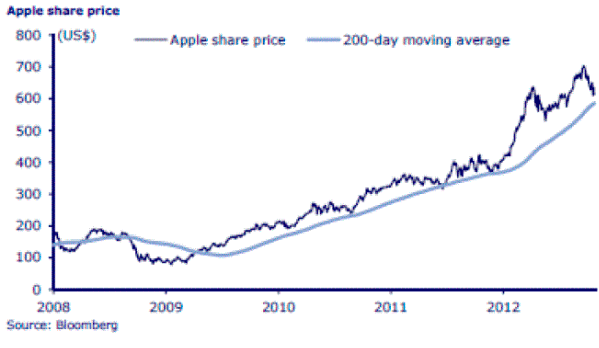
As of the end of trading on October 31, Apple, Inc. stock had plunged by about 110 points (almost 16%) since hitting its high of $705/share this summer (Figure 1 doesn’t really do the price drop justice). By the close of trading on November 2 it had fallen further to $576.80/share. There are multiple issues affecting Apple stock; in addition to increasing competition, the market is also concerned about disappointing new product introductions, supply chain issues and significant management changes. People need to remember that the stock was much lower at the time of Steve Jobs’ death in October 2011. In the post-Steve Jobs era, the company is not going to be the same force it was when the founder and visionary was alive. For the most part, the company’s new products are extensions of existing products rather than groundbreaking new products. An accelerating product introduction cycle is creating an overcrowded market in a slow-growth economy, which is bound to slow AAPL’s growth. Increasing competition is going to pressure product prices and margins; digital deflation is one of the inexorable laws of technology. Even in the best of environments, it would be difficult for a company the size of AAPL to maintain growth on such a large base; needless to say, we are in far from the best of environments. Previous stocks that reached a 4% weighting of the S&P 500 all fell back, and AAPL is now doing the same. What happened to Microsoft (which once bailed out Apple) is now happening to AAPL. I would not look for Apple stock to rally from here. With over 200 hedge funds, including many large ones, heavily invested in the stock, this sell-off is going to make a disappointing year for most hedge funds even worse.
Figure 1
Apple, Inc.
Turning to AMZN, the company’s management continually stresses that it is not focused on earnings; the financial performance of the company certainly isn’t making liars of them. After more than a decade of not generating much at the bottom line, however, one has to wonder whether there is a method to Jeff Bezos’s madness or whether it is time to question the company’s business model. AMZN is pouring enormous amounts of money into building out its Internet and physical infrastructure as well as new product offerings such as the Kindle to compete with the likes of AAPL. Whether the company has genuine earnings leverage, however, remains to be seen. Any company that is not interested in making a profit is doomed to failure, but I don’t believe for a moment that Jeff Bezos is not driven by the profit motive. The stock continues to trade as though the company will be enormously profitable on an operating basis, and it is not.
Finally, consider GOOG. GOOG also missed earnings based on lower than expected results in mobile advertising, an area that has also haunted Facebook, Inc. (FB). GOOG stock collapsed by 10% after its earnings miss; in contrast, FB rallied by almost 25% after it actually produced some revenues from mobile advertising (about $150 million, a number that didn’t impress us but impressed everybody else). In my estimation, FB’s rally was absurdly overdone, especially coming in the face of almost one billion shares being released from lock-up (and sure enough the stock quickly moved back below $20/share). Both GOOG and FB are wrestling with what appears to be the next transition phase in consumer and business technology – the move from the desktop to smart phones. I believe the mobile advertising opportunity is grossly overstated on smart phones – at least until human beings attain sharper eyesight, or technologists figure out how to stretch the mobile telephone screen. Tablets may offer a genuine opportunity to sell advertising, but the screens on telephones are just too small (maybe I am showing my age, but I don’t think so). FB stock will eventually hit single digits, and GOOG will continue to struggle to maintain its impressive growth rate on a large base.
Figure 2 below is instructive in comparing the current price/earnings multiples (as of Nov. 2 close, except AMZN as noted) and market capitalizations of these large technology stocks. The first thing to note is that AAPL, at under $600/share, suddenly seems a long distance away from becoming the first trillion dollar company. By way of comparison, one of AAPL’s primary competitors that is not included on Figure 2, Samsung, has a market capitalization of $163 billion and a P/E ratio of 15.6x. If AAPL stock were to decline further, its market capitalization could quickly decline to the neighborhood of those of GOOG and MSFT. Technology ascendancy can be a fleeting phenomenon; Bill Gates understood that and so did Steve Jobs. I am as big a fan of AAPL’s products as anyone, but while the company’s products leaped from nowhere2 to their current status as cultural and consumer and technological icons, their future growth will be much slower. If I were a long-term holder, I would take my gains now (especially with capital gains tax rates going up at the end of the year).
Figure 2
In The Clouds? Company |
P/E |
Market Capitalization |
AAPL |
13.8 |
$541.0 |
AMZN* |
120.0 |
$105.3 |
GOOG |
21.6 |
$225.5 |
FB |
109.7 |
$45.9 |
MSFT |
15.6 |
$248.3 |
* AMZN's P/E ratio based on 2013 estimated earnings. |
2. We forget that the IPhone hadn’t yet come to market when Barack Obama assumed the presidency. Those were the days!
Finally, if I were to put on my corporate finance hat for a moment (I am ashamed to admit that I was an investment banker in my previous life)3, and think outside the box for a moment, this chart might raise some interesting possibilities. For example, if AMZN were to prove unable to leverage its enormous infrastructure spending into profitability, perhaps the company would be an interesting merger candidate for a large tech or consumer giant, or even for a financial giant with a consumer focus. Amazon has its hand in two key sectors of the digital future – ecommerce and mobile technology. For a company like Walmart, or MSFT, or GOOG, AMZN could be an enormously powerful partner if the proper creative thinking were applied to the combination (and the necessary egos were buried). The degree of difficulty in doing such a deal would be extremely high, but if the economics were compelling enough it would not be impossible. Of course, we have seen this type of movie before – the catastrophic Time Warner/AOL combination. But the world is changing rapidly, and the boundaries between different types of businesses (hardware and software, finance and technology) are breaking down. Just some food for thought.
These technology stocks are important on a broader basis because they are the future of the American economy. For all the spouting on the campaign trail about a so-called manufacturing renaissance in the United States, the reality is that the U.S. economy will thrive through intellectual and not physical capital in the 21st century. The large technology companies discussed above illustrate just how challenging and fleeting business hegemony is in today’s world. Physical capital, such as the nation’s enormous energy resources, will play a major role, but only if exploited by technological and intellectual capital. It is the underlying technology common to all digital delivery systems that is driving the changes in all businesses today and must be understood by investors seeking to stay ahead of the curve. Companies as diverse as Chesapeake Energy Corporation (CHK) in the shale gas industry and J.C. Penney Company, Inc. (JCP) attempting to change the face of general merchandising and retail are both dependent on technology to drive change in their businesses. The world’s entertainment giants are almost wholly dependent on what is happening in the technology space for the future of video and music delivery. Years ago the heart of the U.S. economy may have been bending metal, but today it is manipulating bytes of data. For that reason, it is more important than ever for investors to understand what is happening in the technology space.
The U.S. economy
Tech stocks tend to be market leaders because intellectual capital is the main engine of the U.S. economy. But that also means that the market suffers when these stocks falter. It should therefore not come as a surprise that the run in large technology stocks coincides with a weakening economy. It is hardly a coincidence that the Hewlett-Packard’s and Dell’s of the world are struggling, or that even Microsoft is at risk of falling seriously behind if Windows 8 proves to be a bust. Even AAPL, which was thought to be immune to the normal laws of economics and markets, is now proving to be mortal. Technology earnings have disappointed because the U.S. economy is weak. It is of particular concern that these earnings are faltering in the midst of the introduction of so many new products. Despite all of the alleged data about consumer confidence rising and consumer spending increasing, U.S. consumers don’t have any real money to spend. It may be a different story in the emerging markets, but how many phones or tablets or computers does a consumer need, and how often does he need to replace the one(s) he already has?
Third quarter headline GDP was stronger than expected at 2.0%. But a closer look disclosed that a spike in defense orders was responsible for much of the growth. If one were to back out the defense contribution, growth would have been an even more anemic 1.4%. Housing was the leading growth sector with an unsustainable 14% annualized growth rate or, as our friend David Rosenberg so succinctly put it, “the most unproductive part of the capital stock posted the largest gain.”4 Business spending was marginally down for the quarter. In reality, the economy is getting worse, not better. For the life of me, I don’t know what all of the talking heads are thinking as they chirp about an improving economy on CNBC. In fact, the more the economy slows, the louder they chirp!
Thus far in 2012, the economy has grown at a pathetic 1.7%. So which economy is doing well? The one on Pluto? Back here on Planet Earth, the U.S. economy is highly likely to slow even more between now and the second quarter of 2013 as higher taxes and lower spending kicks in regardless of who sits in the Oval Office. Even if the full fiscal cliff is avoided, part of the spending cuts and tax increases are certain to kick in (i.e. the payroll tax cut will reverse). Buffeting an already weak economy, these headwinds could push nominal growth under 1%, which for all intents and purposes would constitute a recession (as far as I am concerned we are already in a recession). It also remains to be seen what steps the Federal Reserve will take after January 1 to extend Operation Twist; it has already made clear that its misbegotten mortgage repurchase program is open-ended. What is of most concern, of course, is that trillions of dollars of Fed stimulus have only pushed growth up to a feeble 1.7% this year. Without the Fed, growth would be close to zero, which means that on a real (inflation-adjusted) rate it is well into the negative. The reason for this, as I have written many times before, is the albatross of debt hanging around the necks of the public and private sectors.
Credit
Credit markets continue to party like its 2007. As noted in the October 15 issue of this publication, private equity firms have turned on the PIK-toggle spigot again, and idiotic junk bond buyers have opened their mouths to drink the poison again. I have always marveled at the short memories of junk bond buyers. There is a high correlation between PIK-toggle notes and defaults because there are only two reasons why a company would issue such a bond: one, because it is so highly leveraged that it can’t pay its interest in cash; or two, because its private equity sponsor is desperate to cash out its investment, leaving it with much less incentive to support the business. It’s a free country, so these companies and private equity firms can do what they want. But I am certainly not going to support them with my clients’ money, and those managers that do so should be summarily fired by their clients. Money managers are supposed to generate attractive risk-adjusted returns for their clients. PIK-toggle notes exponentially increase their odds of generating risk-unadjusted losses!
Nonetheless, there is little sign that the credit markets will sell off any time soon for two reasons. First, corporate defaults remain low, and second, interest rates remain invisible. As long as companies don’t default and the Federal Reserve continues to deliver low rates into mid-2015, investors focused on short-term performance will continue to lap up whatever thin gruel Wall Street underwriters and the clients to whom they are indentured deign to serve them. It is a serious mistake, however, for investors to chase yield in the current environment (just as it was a mistake for any investor who chased equity returns after the Federal Reserve and European Central Bank tripled down on their debt monetization schemes this summer). Having seen this movie before, I can say with a great deal of confidence that investors should not sit around and wait for the end to see what happens to the hero. As the great Gordon Lightfoot sung, “Heroes often fail.”
Investment recommendations
This section is available only to paid subscribers.
Michael E. Lewitt
[email protected]
3. For the uninitiated, investment banking is a profession in which one spends one time trying to convince corporate executives to do things that they shouldn’t do. While not exactly the same thing as private equity, it is in many (but not all) cases very similar.
4. Gluskin Sheff, Breakfast with Dave, October 29, 2012, p. 3.
Disclaimer
All opinions and investment recommendations expressed by Michael E. Lewitt in The Credit Strategist as well as on Twitter under the Twitter name @credstrategist are solely the opinions of Mr. Lewitt and do not reflect the opinions of Cumberland Advisors or its affiliates or employees, managing directors, owners or principals.
Disclosure Appendix
This publication does not provide individually tailored investment advice. It has been prepared without regard to the circumstances and objectives of those who receive it. This report contains general information only, does not take account of the specific circumstances of any recipient, and should not be relied upon as authoritative or taken in substitution for the exercise of judgment by any recipient. Each recipient should consider the appropriateness of any investment decision having regard to his or her own circumstances, the full range of information available and appropriate professional advice. The editor recommends that recipients independently evaluate particular investments and strategies, and encourages them to seek a financial adviser’s advice. Under no circumstances should this publication be construed as a solicitation to buy or sell any security or to participate in any trading or investment strategy, nor should this publication or any part of it form the basis of, or be relied on in connection with, any contract or commitment whatsoever. The value of and income from investments may vary because of changes in interest rates or foreign exchange rates, securities prices or market indexes, operational or financial conditions of companies, geopolitical or other factors. Past performance is not necessarily a guide to future performance. Estimates of future performance are based on assumptions that may not be realized. The information and opinions in this report constitute judgment as of the date of this report, have been compiled and arrived at from sources believed to be reliable and in good faith (but no representation or warranty, express or implied, is made as to their accuracy, completeness or correctness) and are subject to change without notice. The editor may have an interest in the companies or securities mentioned herein. The editor does not accept any liability whatsoever for any loss or damage arising from any use of this report or its contents. All data and information and opinions expressed herein are subject to change without notice.
The Credit Strategist
Michael E. Lewitt, Editor
The Credit Strategist is published on a monthly basis by Michael E. Lewitt. Address: 5030 Champion Blvd., G6 #161 Boca Raton, FL 33496. Telephone: (561) 239-1510. Email: . Delivery is by electronic mail. Annual subscription rate is $395 for individuals and $995 for institutions. Visit our web site at www.thecreditstrategist.com. Copyright warning and notice: It is a violation of federal copyright law to reproduce or distribute all or part of this publication to anyone (with the exception of individuals within the same institution pursuant to the subscription agreement) by any means, including but not limited to photocopying, printing, faxing, scanning, e-mailing, and Web site posting without first seeking the permission of the editor. The Copyright Act imposes liability of up to $150,000 per issue for infringement. Information concerning possible copyright infringement will be gratefully received.
Read more articles by Michael Lewitt