Advisor Perspectives welcomes guest contributions. The views presented here do not necessarily represent those of Advisor Perspectives.

This essay is excerpted from a recent version of The Credit Strategist (formerly the HCM Market Letter). To obtain the complete issue, you must subscribe directly to this publication; Please go here. The Credit Strategist is on Twitter - @credstrategist
“We have built an economy out of $50 trillion of credit over the past 50 years. When credit expands, it creates both an asset and a liability. The sustainability of the entire economic superstructure depends on how that credit is used going forward. If it is used for consumption, then it can generate no return and the superstructure will collapse. That is the mistake that led to this New Depression. If it is invested in projects that generate a high enough return to pay the interest on the debt, then it will not only support the economic structure now in place, it will support a larger and more prosperous economy.”
Richard Duncan, The New Depression (2012)1
In today’s world, every financial instrument represents some form of credit. Whether something is called a “stock” or a “bond” or a “commodity,” its value is ultimately determined by the ability of another party to fulfill its payment obligations. An obligation to pay is a debt. Unfortunately, there is not enough money in the world to repay all of the obligations that exist. As Richard Duncan writes, “We do not have capitalism now…Our economic system is not one in which the accumulation and investment of capital drives the production process. It is one in which the creation and expenditure of credit does.”2 In an era in which economies are driven by the creation of fiat money by central banks, and where the base of hard money is dwarfed by the volume of outstanding debt, every form of capital is tied to credit. In 1919, William Butler Yeats famously wrote that “the center cannot hold.” A century later, there is no center.
Instability and disequilibrium are the hallmarks of modern markets. As much as we would like to pretend that investors have improved their ability to deal with such conditions, nothing could be further from the truth. In fact, the very devices that human beings have developed to manage risk still fail to properly account for discontinuity and abrupt change. This is most apparent in derivatives, which not only fail to protect against such risks but tend to increase them because of their inherent leverage, opacity and counterparty risk component. Even the institutions most highly respected for their ability to manage risk still explain their attempts to do so in terms of a largely discredited tool such as VaR (Value at Risk). VaR theoretically measures the maximum amount of loss on a portfolio. Unfortunately, it is incapable of measuring changes in market conditions caused by irrationality or emotion. Phenomena such as feedback loops or discontinuity are far more influenced by factors that cannot be measured mathematically. For that reason, the utility of VaR as a risk management tool is undermined by the very language in which it speaks. As a mathematical expression of potential loss, it suffers from the limitations of mathematical language. It is very difficult for mathematics to distinguish different kinds of risks because it reduces everything to quantities of the same thing. History teaches us that it is extremely dangerous to rely on numerical tools to measure the non-quantifiable risks that move markets. The very commonality of mathematical expression renders it inadequate to measure the types of unquantifiable risks that exist in today’s world.
Moreover, markets are motored by technology. Money is moved around the world by massive computer power that reduces every form of capital to the same thing – bytes, or 1s and 0s. This leveling of differences is essential to facilitate the flow of money around the world, but it does not come without a cost. The treatment of everything as the same thing conceals the very real differences that lie behind the numbers. Technology creates the illusion that capital is stable and continuous when it is in fact highly unstable and susceptible to abrupt discontinuities. The failure to understand the dynamic nature of capital heightens the risks involved every time an investor takes cash and exchanges it for a stock or bond or tangible asset.
Its stewardship by human beings is what renders capital unstable. Even the most rational human being is highly irrational and driven by emotion. Human beings suffer from a fascinating dichotomy – they live their physical lives sequentially but are endowed with minds that are not bound by time. We live our lives in order but we can think them out-of-order. The ability of the human mind to remember and to imagine introduces an enormously influential element of unpredictability and emotion into human action. An investor’s greatest challenge is to reconcile this dichotomy, which is an ineluctable part of the human condition. And while an investor can try to rely on models that by their very nature simplify reality, he must acknowledge and include in his calculations the incalculable.
Credit is therefore the ultimate human construct. It relies on the past to predict the future. It enlists both memory and imagination. And it is subject to discontinuities that can lay ruin to the best laid plans. Central bank creation of limitless amounts of credit out of thin air is the ultimate human act. But it must be understood for what it is: not something that reduces risk, but an act that radically heightens systemic risk. The “consensus” appears to believe that recent actions by the European Central Bank (ECB) and the Federal Reserve to support their respective economies have removed “tail-risk” from the markets. That view is both dangerous and wrong. “Tail-risk” is how we describe the types of risks that result from discontinuity and instability. The term is generally used to describe outcomes that are thought to be unforeseen and unpredictable. By extending their liquidity operations into an open-ended phase, central banks have not reduced financial fragility and market instability: They have exacerbated it. Only the precise timing of the bad outcomes guaranteed by these policies is unknown.
1. Richard Duncan, The New Depression: The Breakdown of the Paper Money System (Singapore: John Wiley & Sons Singapore Pte. Ltd., 2012), p. 146. I highly recommend this book to everyone.
2. Ibid., p. 146.
Europe
The ECB’s announcement of a new, open-ended bond buying program called Outright Monetary Transactions (OMT)3 was just the medicine the doctor ordered for markets focused on tail risk. As noted above, I do not believe for a moment that this plan reduces that risk; it may buy time for fiscal reforms to be adopted but the entire plan is premised on convincing the markets to continue funding bankrupt countries. OMT is just another massive scheme to monetize Europe’s debts.4 Markets with the attention spans of fruit flies rallied on the news. But what John Maynard Keynes said of human beings happens much faster for fruit flies: They all die in the end, and they die quickly. So should any belief that this latest acronym can rescue the European Union from its terminal flaws.
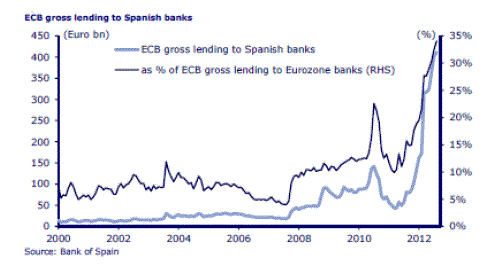
Spain is in dire straits. In August, gross ECB lending to Spanish banks increased by another €9.5 billion to €411.7 billion, accounting for 34% of total gross ECB lending to European banks. The flight from Spanish banks continued unabated in August with another 1% drop to total assets of €1.49 trillion from €1.51 trillion in July. Some might find cold comfort in the fact that this was the lowest outflow since April 2008, but I would chalk it up to the summer holidays and expect it to increase in September. After all, July saw the largest outflows in 15 years and little has changed since then except the calendar.
Figure 1
ECB lending to Spanish banks
The bank stress test that was released on September 28 showed a collective capital shortfall of €59.3 billion, with the already bailed-out Bankia needing to raise €24.7 billion, Catalunya Caixa requiring €10.8 billion and Novagelicia €7.2 billion. Seven banks did pass the stress test – Banco Santander, BBVA, Caixabank, Unicaja Ceiss, Bankinter, Kutxabank and Sabadell. The test performed by the consulting firm Oliver Wyman arguably includes some questionable assumptions that paint a more positive picture than is warranted by the data. Previous stress tests have proven unreliable so this one – despite its better pedigree – appears from my reading to understate the problem. Readers who are interested should read the report and determine for themselves whether the assumptions used were reasonable.
This report was released a day after the government announced another €40 billion of budget cuts in order to satisfy the conditions to request an ECB bailout. As I have written in El Mundo, the unrelenting austerity demands of Germany and the ECB are both unproductive and unrealistic. Spain will be unable to reduce its deficit to the level set by the Maastricht Treaty (3% of GDP) by 2014 as it has promised. Moreover, these very austerity cuts will lower GDP, which means that Spain is basically chasing its own tail. Spending cuts withdraw desperately needed capital from circulation and deny the economy the fuel it needs to grow. In order to achieve its potential, capital must be spent in ways that spawn additional capital. Spain has made a good faith effort to eliminate its budget profligacy but the cuts have reached the point of diminishing returns. The economy is now being starved of the capital it needs to recover because Germany and the ECB continue to cling to outmoded economic thinking.
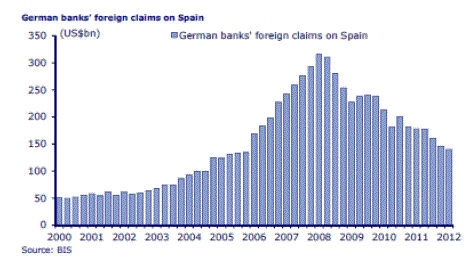
There is another underlying dynamic that Christopher Wood points out in his latest GREED & fear (September 28, 2012). As Figure 2 below illustrates, German banks were major lenders to Spain during the boom period – their foreign claims on Spain rose from $49 billion in early 2000 to a peak of $315 billion in early 2008 and have subsequently dropped to $140 billion at the beginning of 2012 (this is entirely separate from the huge Target2 imbalances whereby the Bundesbank has extended another €900 billion of credit to the weakest European economies). The exposure of German banks to sick sovereigns has created both economic and political pressure on Germany to make concessions throughout the crisis. Germany is living the adage that if you owe your banker $100 you have a problem, but if you owe him $100 million it is the bank’s problem. Germany, even more than the ECB, is Europe’s bank and it has a big problem indeed.
Figure 2
German banks’ exposure to Spain
3. A September 7th Buttonwood column in The Economist captured my feelings about this program very well: “The ECB and OMT: OTT, OMG or WTF?”
4. Realistically, the ECB has few options other than monetization because there is no way that the EU collectively or countries such as Spain, Italy, Portugal and Greece can repay all of the debt that they owe without the aid of time, devaluation or default.
The United States
The Federal Funds rate has been near zero for four years yet real GDP continues to deteriorate – from 2.4% in 2010 to 2.0% in 2011 to 1.7% year-to-date in 2012 (after the downward revision of second quarter GDP to 1.3%). The four-week average of unemployment claims remains elevated at 375,000, signaling that the country is facing a structural rather than a cyclical jobs crisis. While the “official” unemployment rate remains above 8%, it would actually be above 11% if the work force still counted the millions of people who have deserted it since President Obama took office. The “official” U6 unemployment rate, which includes the discouraged and under-employed, is 14.7% but the real number is undoubtedly much higher. The August durable goods report showed a 13.2% drop due to lower aircraft and automobile orders; perhaps this is a preview of what the fiscal cliff will look like. Housing may be improving but it is recovering from depression levels and remains a huge drag on the economy.
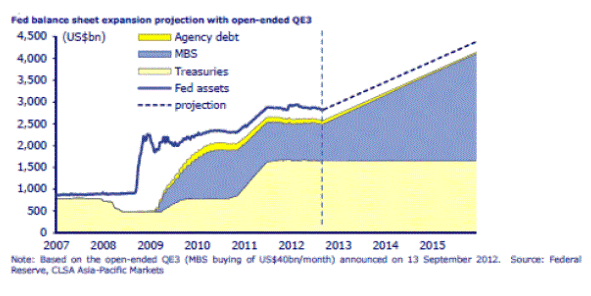
Figure 3
Federal Reserve’s Open-Ended Balance Sheet
Whether or not the United States drives over the fiscal cliff, even the best case scenario for 2013 is below-trend growth. It is going to take several months for Congress and the President to come to terms on budget issues, which suggests that the uncertainty holding back the economy will persist into the first half of 2013. Some believe that there is huge pent up demand waiting to be unleashed once policy uncertainty dissipates. I do not share that optimism but would love to be wrong. The future course of markets will continue to be determined by central bank policy. And it is going to be virtually impossible for the Federal Reserve to reverse its current policy course and begin withdrawing monetary stimulus. It is all well and good to ponder when the Federal Reserve will be able to start withdrawing monetary stimulus, but that debate is primarily theoretical. We are unlikely to see a Federal Reserve balance sheet of $900 billion (its level prior to the financial crisis) again in any time frame that matters for investors. Moreover, the federal deficit is on a course to hit $20 trillion by 2016 and is growing faster than GDP, leading to an ever-increasing debt-to-GDP ratio. The influence of central bank policy on markets is certain to remain the dominant feature of the investment landscape for years to come. It is time for investors to haul out their history books and start educating themselves about our central bank.5
Credit spreads tell a different story although they are arguably grossly distorted by four years of zero interest rates designed to force investors into riskier assets. The credit markets are priced as though the economy is much healthier than it actually is. The Barclays High Yield Bond Index closed Friday, September 28 at an average spread of +556 basis points, more than 300 basis points wider than its historic low of +238 basis points on May 31, 2007. While these spreads are appropriate in the context of solid corporate credit quality and a low default environment, they have resulted in the lowest yields in history as a result of depressed Treasury yields. As explained below, corporate spreads are acting this way because companies are in much better shape than the overall economy. But the impact of prolonged zero rates – and the prospect of several years more – has distorted not only credit spreads but capital formation itself. These distortions are growing more apparent by the day. David Malpass, who wrote perhaps the best analysis of QE3 of the (too) many that I’ve read, points out that the value of loans in the interbank market has plunged to $10 billion from $80 billion prior to the 2008 crisis, while the value of outstanding loans in the Fed funds market has similarly collapsed to $100 billion from $400 billion during that period. Capital is being hoarded by banks and corporations based not only on their uncertainty about the future but on their memories of the recent past. The record levels of corporate bond financing are being driven primarily by companies refinancing existing debt rather than borrowing to seed new projects. No doubt a great deal of capital is being underpriced and therefore misallocated as a result of zero interest rates. Future bubbles are building although for now the corporate bond market appears to be stable.
But the credit markets are sending signals that are increasingly unreliable and difficult to decipher. There is something terribly wrong with the American economy. The argument that a debt crisis should lead to a slow recovery is debatable despite its highly respected Reinhart and Rogoff pedigree. Severe recessions have often given rise to more robust recoveries than mild recessions. That is clearly what is not occurring today in the United States, most likely because the combination of an enormous amount of debt and an economic policy vacuum is weighing down economic growth. We do know one thing: current policy is not going to fix what ails us and new initiatives are needed. The challenge for investors is distinguishing a disappointing macro recovery with what has been a robust micro recovery. How long corporations can flourish in a slow growth world is a difficult question to answer, but the answer is certainly not forever.
Investment recommendations
This section is available only to paid subscribers.
Michael E. Lewitt
[email protected]
5. In that respect, the recently published biography of Paul Volcker (Paul Volcker: The Triumph of Persistence) by William L. Silber should be required reading for everyone.
Disclaimer
All opinions and investment recommendations expressed by Michael E. Lewitt in The Credit Strategist as well as on Twitter under the Twitter name @credstrategist are solely the opinions of Mr. Lewitt and do not reflect the opinions of Cumberland Advisors or its affiliates or employees, managing directors, owners or principals.
Disclosure Appendix
This publication does not provide individually tailored investment advice. It has been prepared without regard to the circumstances and objectives of those who receive it. This report contains general information only, does not take account of the specific circumstances of any recipient, and should not be relied upon as authoritative or taken in substitution for the exercise of judgment by any recipient. Each recipient should consider the appropriateness of any investment decision having regard to his or her own circumstances, the full range of information available and appropriate professional advice. The editor recommends that recipients independently evaluate particular investments and strategies, and encourages them to seek a financial adviser’s advice. Under no circumstances should this publication be construed as a solicitation to buy or sell any security or to participate in any trading or investment strategy, nor should this publication or any part of it form the basis of, or be relied on in connection with, any contract or commitment whatsoever. The value of and income from investments may vary because of changes in interest rates or foreign exchange rates, securities prices or market indexes, operational or financial conditions of companies, geopolitical or other factors. Past performance is not necessarily a guide to future performance. Estimates of future performance are based on assumptions that may not be realized. The information and opinions in this report constitute judgment as of the date of this report, have been compiled and arrived at from sources believed to be reliable and in good faith (but no representation or warranty, express or implied, is made as to their accuracy, completeness or correctness) and are subject to change without notice. The editor may have an interest in the companies or securities mentioned herein. The editor does not accept any liability whatsoever for any loss or damage arising from any use of this report or its contents. All data and information and opinions expressed herein are subject to change without notice.
The Credit Strategist
Michael E. Lewitt, Editor
The Credit Strategist is published on a monthly basis by Michael E. Lewitt. Address: 5030 Champion Blvd., G6 #161 Boca Raton, FL 33496. Telephone: (561) 239-1510. Email: . Delivery is by electronic mail. Annual subscription rate is $395 for individuals and $995 for institutions. Visit our web site at www.thecreditstrategist.com. Copyright warning and notice: It is a violation of federal copyright law to reproduce or distribute all or part of this publication to anyone (with the exception of individuals within the same institution pursuant to the subscription agreement) by any means, including but not limited to photocopying, printing, faxing, scanning, e-mailing, and Web site posting without first seeking the permission of the editor. The Copyright Act imposes liability of up to $150,000 per issue for infringement. Information concerning possible copyright infringement will be gratefully received.
Read more articles by Michael Lewitt, Editor, The Credit Strategist