Advisor Perspectives welcomes guest contributions. The views presented here do not necessarily represent those of Advisor Perspectives.
 This essay is excerpted from a recent version of The Credit Strategist (formerly the HCM Market Letter). To obtain the complete issue, you must subscribe directly to this publication; Please go here. The Credit Strategist is on Twitter - @credstrategist
“As Rogoff and his co-author Maurice Obstfeld put it in the magnificent, awe-inspiring Foundations of International Macroeconomics…,’The behavior of dynamically inefficient economies wreaks havoc with much of our intuition about the laws of economics.’ Put more bluntly, dynamic inefficiency makes a large part of macroeconomics worthless. Financial markets are in a sense ahead of academic macroeconomics in responding: traditional ‘fundamentals’ have now largely been transformed into one overarching ‘fundamental’: the assessment of solvency. As a result, markets are exhibiting binary behavior (‘risk-on’ or ‘risk-off’). Mathematically, dynamic inefficiency, bubbles and Ponzi games are linked very closely together. The world economy has become a collection of Ponzi games. And which country’s assets constitute a ‘safe haven’ is largely a question of whether one country’s Ponzi game can attract new participants (or even hold on to existing ones) longer than another’s.”
Bernard Connolly1
Bernard Connolly has never been one to mince words. In 1997, Mr. Connolly published The Rotten Heart of Europe: The Dirty War for Europe’s Money which featured an illustration of a young cherub perched atop a monument bearing the initials “ERM” and urinating on a map of Europe. That image pretty much summed up Mr. Connolly’s Eurosceptic views, and he remains as dubious today about the prospects for success of the European experiment as he did 15 years ago. While Europe is hardly the only region running a Ponzi game, it is certainly running the Ponzi game that is closest to coming apart. As Mr. Connolly accurately describes it, “what deters new participants in a Ponzi game is not an accumulation of debt but a destruction of wealth, or more accurately, a realization that the wealth supposedly backing debt is illusory….if the wealth of debtors is illusory, the wealth of creditors must also be illusory.” I am unaware of anyone who believes that countries such as Greece or Portugal or Spain are in a position to service or repay their debts. It must be acknowledged that these countries’ economies are incapable of generating sufficient income to do so.
For that reason, as Mr. Connolly writes, “the suggestions often put forward (largely driven by interpretations of Rogoff-Reinhart) that debt forgiveness or a ‘bit more inflation’ to reduce the real burden of debts can get the world out of the mess are quite wrong. The underlying problem is dynamic inefficiency, which reduces future consumption possibilities; and this in turn means that much of recent and current fixed capital formation…has been based on excessively optimistic excessively optimistic expectations of future demand.” In other words, whatever schemes the European Central Bank (ECB) may cook up over the next few months will only prove short-term liquidity relief to what are long-term insolvency problems. Like any Ponzi scheme, the last money in is going to be hurt the worst when the charade comes to an end. In the meantime, investors proceed at their own risk.
Europe
The ECB meets on September 6, at which time it could announce another interest rate cut as well as release further details of its planned repurchases of Spanish and Italian debt through the European Stability Mechanism (ESM). No action will be taken at that meeting with respect to the debt repurchases, however, because everyone is waiting for the ruling of the German Constitutional Court on September 12.
The Court is not being asked to make a final determination on the question of whether the ESM violates the German Constitution. Rather, the September 12 ruling is limited to requests for an emergency injunction that would place German ratification of the ESM on hold until the Court decides the cases in full. A final verdict is not expected until sometime in 2013. According to legal experts, however, the Court chose to hear the case through an unusual procedure that renders it unlikely that the final ruling will deviate significantly from its September ruling. Rather than follow the normal procedure involved when a claimant is asking for a preliminary injunction, the Court chose a different path. Normally, the Court would evaluate the injunction question without ruling on the substantive issue. It would determine whether the complaint describes conduct that, if proven, poses an immediate and direct threat to Germany’s Constitution. The Court would grant an injunction only if it found not only that such a threat existed but that the potential constitutional violation outweighs the consequences of delaying a final decision.
In this case, however, the Court decided to adopt a different procedure – one that allows it to decide the injunction question while also making a preliminary judgment on whether the ESM is consistent with the German constitution. Such a procedure renders it unlikely that the Court will make a preliminary finding of constitutionality and then later reverse it. For that reason, the September ruling will be considered dispositive. What is unusual here is that the Court could permit Germany to enter into the ESM without rendering a final ruling. Depending on precisely how the Court frames its decision, this may provide sufficient certainty for the financial markets. Then again, it may not.
Many observers believe that the Court will issue a finding of constitutionality coupled with a series of conditions designed to preserve German fiscal sovereignty. It may add those conditions the requirement that the stability of the euro currency be enhanced by the ESM. While I received my legal training in the United States and therefore hardly qualify as a German constitutional expert, I remain concerned that matters may become muddled when the German Constitutional Court rules.
First, Germany is already dancing very close to the line set by the Constitutional Court regarding limits on its economic sovereignty. Germany is facing a bill that is likely to be in the trillions of euros whether or not the EU survives. It will either be bailing out its banks from their losses on holdings of defaulted Greek, Portuguese, Spanish and even Italian debt, or continue writing checks into what is basically a black hole of Target2 and ECB obligations to keep the European enterprise afloat. Either scenario, it seems to me, could be construed as ceding of its fiscal affairs. The issue will come down to whether German politicians will be willing to consciously decide to employ German resources to support other nations. The question is how conscious such a decision can actually be. There is a decision between “ceding” fiscal control and consciously deciding that devoting enormous amounts of Germany’s economic resources to supporting other countries is in Germany’s economic interest. There can be little question that such decisions have a great bearing on what the Court has previously described as “fundamental fiscal decisions on revenue and expenditure.” But whether such transfers constitute a “ceding” of control over such fiscal matters is something that only the Constitutional Court can determine.
The current President of the Court, Prof. Dr. Andreas Vosskule, has already expressed his view that the parameters of Germany’s Constitution are close to being exhausted. If he and his brethren view the ESM as a step too far in terms of transferring the Bundestag’s budgetary authority to the European Parliament, they could go so far as to effectively require a constitutional amendment in order for Germany to lend further support to ECB efforts to prop up Spain and Italy. A decision like that would throw Europe into chaos. At the very least, it would not be unreasonable to expect for the Court to set a high bar on the procedural steps that the German Parliament must follow in order to exert control over the country’s fiscal affairs and prevent them from being overly influenced by the demands of the EU. Germany already requires parliamentary pre-approval of each and every ESM financing program, a requirement not found in other EU countries. The Court could require even further parliamentary control as a condition of further German support.
The formation of the ESM has ripened these issues for decision at the Court. But the conditions that raise questions about whether Germany is already dangerously close to violating the Court’s prior rulings have been building steadily as economic conditions throughout the region have deteriorated. Bernard Connolly tells it like it is: “In the case of the [European Union] Ponzi game, the crisis has arisen because only one conceivable new participant can prevent collapse: the German taxpayer (and German demographics mean there will be fewer German taxpayers in the future, even if current taxpayers were to accept the role of the ‘bigger fool’).” If Germany has not reached the limits of the Constitutional Court’s rulings already, the ESM may push it right up to the line. We live in an investment world characterized by fat tails, which is investment parlance for unlikely outcomes that have a disproportionately large impact on investment returns. The September 12 ruling by the German Constitutional Court has the potential to be one of those fat tail events.
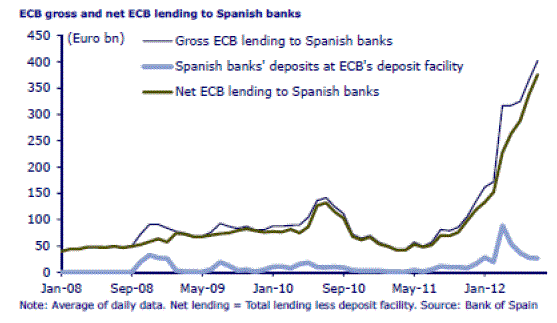
Figure 1
Spanish Banks
1. Bernard Connolly, “Rethinking the Rogoff-Reinhart Thesis,” in The International Economy, Summer 2012, p.48.
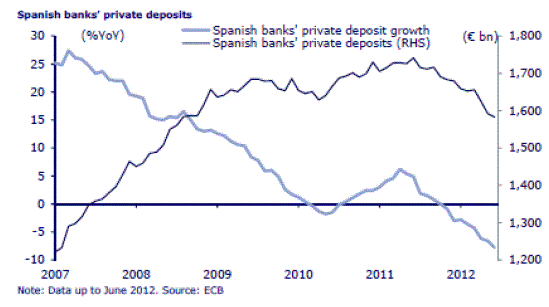
Spain’s economy is not waiting for Germany’s Constitutional Court of anybody else to keep dropping off a cliff. One-by-one, Spain’s regions are approaching the central government for bailouts. These are not small bailouts either, but multi-billion bailouts. Moreover, the heads of these regional governments are demanding assistance while claiming they will not accept any conditions on any support they receive. At the same time, the Spanish banking system grows more infirm by the day. In July, gross ECB lending to Spanish banks rose to a record €402 billion from €365 billion in June. This accounted for a full 33% of ECB lending to Eurozone banks (see Figure 1 above) and illustrates that Spanish banks have nowhere else to go to fill their funding needs (would you put your money in a Spanish bank? Or lend money to one?). This latter point was confirmed by the latest data on capital outflows from the banks. Private deposits fell another €8 billion in July and have fallen by €158 billion over the last 12 months to €1.58 trillion, the lowest level since June 2008 (see Figure 2 below). Why would capital want to remain in Spanish banks when a restructuring is imminent? This is the same question that was asked of Greek banks before that country’s faux-restructuring, and the answer is the same – there is no good reason for any sane person or business to keep money in a bank inside a nation that is likely to default on its obligations.
Figure 2
Money Flows Out of Spain
Speaking of Greece, that country is back once again asking for more time to meet its prior promises to Germany and the rest of EU to cut its expenditures to the bone in exchange for prior support commitments. It is now asking its police and other previously untouchable civil servants for steep pension cutbacks, which has triggered the expected protests and strike threats. Greece is being bled dry by austerity demands from Germany and the result is going to be disastrous. One would think that Greek leaders would figure out what is abundantly clear to its people by now, that the so-called benefits of membership in the EU are not remotely worth the years of impoverishment that remaining in this club are going to cost. For the sake of the Greeks and the sake of the Germans who are going to have to pick up the tab, it is long past time to let Greece leave the EU in peace. Greece is asking for a two-year extension to meet austerity demands, but honestly it could ask for two hundred years and it wouldn’t make a difference. Enough is enough.
The United States
Politics and regulation
Some people may think that Clint Eastwood embarrassed himself at the Republican National Convention, but those same people should remember that Mr. Eastwood has been awarded the Legion d’donneur in France. And France, after all, was the adopted home of the great Irish playwright Samuel Beckett, author of one of the most profound works of literature of the 20th century, Waiting for Godot. Mr. Beckett surely would have appreciated the image of Mr. Eastwood addressing Barack Obama as an empty chair. After all, in Happy Days, Mr. Beckett buried his characters up to their neck in dirt, while in Play he had them standing in urns. He was never lacking for a sense of the absurd. Then we come to Mr. Obama, a man who, if truth be told, was little more than a specter when elected, a politician long on wind but completely bereft of any tangible accomplishments. Almost four years into office, his signature accomplishments are a stimulus plan that didn’t stimulate, a healthcare bill that was sold as a faux-civil rights law and fails to do what it intended , and a financial reform bill that reforms leaves the financial system more fragile than it was before. The Senate has not passed a budget in three years during his administration (for which the Republicans share the blame), although that has not stopped the government from running up another near $6 trillion in deficits. But that is not the worst of it. Some of Mr. Obama’s most strident supporters, such as Paul Krugman and Robert Reich, complain that the stimulus bill wasn’t big enough and that the government didn’t spend enough!2 They claim that had we only spent another $1 trillion on shovel ready jobs that even the President has joked weren’t as shovel-ready as he thought, things would be much better! Both Samuel Beckett and Paul Krugman were awarded Nobel Prizes, but only one of these men had any insight into the human condition – and it surely wasn’t the economist.
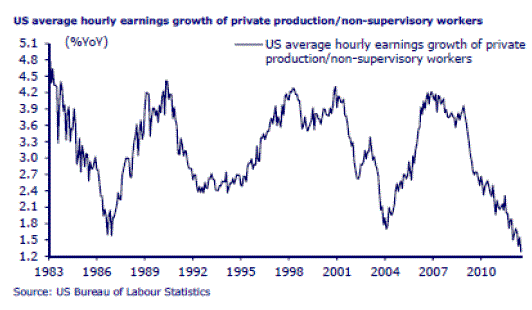
During the convention, Mitt Romney asked people if they were better off today than they were four years ago. Figure 3 suggests that many people are not better off. While there is blame enough to go around, there is only one incumbent President. It would be very surprising for any incumbent to retain office in the face of plunging hourly earnings or endless months of 8%+ unemployment. Mr. Obama can look to the fact that unemployment has come down sharply in some key battleground states as Ohio, Michigan and Wisconsin, but whether that will be enough remains to be seen. Mr. Obama was dealt a bad hand, but nobody put a gun to his head and forced him to run for president, and more importantly nobody compelled him to focus on a deeply flawed healthcare bill that lacked public support at the expense of putting more people back to work. If Mr. Obama becomes a one-term president, he may try to blame George W. Bush, or John Boehner, or Mitch McConnell, but the truth is he should only blame himself.
Figure 3
Obama’s Worst Nightmare
The outlook for Wall Street has deteriorated significantly during Mr. Obama’s administration. That does not mean that the financial system is more stable than it was prior to the financial crisis – I would argue the opposite. But Wall Street’s profitability has been severely diminished by the Volcker Rule and virtual elimination of proprietary trading. To the extent some institutions thought they could out-clever the rule, the London Whale put an end to that hope. Large banks, led by J.P. Morgan’s Jamie Dimon, spent a great deal of money and political capital fighting off the restrictions contained in Dodd-Frank, but thus far they have had far more limited success than I would have expected. The London Whale pretty much snuffed out any hope that the Volcker Rule will go gently into that good night. Where the banks did succeed, unfortunately, is in neutering many of the necessary restrictions on derivatives trading. Dodd-Frank, which in addition to insultingly bearing the name of the politician who single-handedly did more than virtually anyone else in Washington to enable the GSE’s to cripple the economy, fails where it matters most – in reducing systemic risk.
The global financial system is even more fragile today than it was before the crisis. This fragility is not only a result of there being fewer too-big-to-fail institutions (Tim Geithner still doesn’t get it, and will likely never get it), nor of the massive government borrowing used to prevent a total systemic collapse, but of an abject failure to regulate derivatives in any meaningful or intelligent manner. Today, the 25 largest institutional derivatives traders collectively have approximately $230 trillion of gross derivatives positions on their books. Their net derivatives positions are probably about 10% of that, or somewhere around $25 trillion.3 As Jim Rickards reminds us, in a systemic crisis, it is the gross rather than the net figure that matters since many counterparties will be unable to fulfill their contractual obligations. Accordingly, the derivatives market is not merely out of control; it is uncontrollable. The folly that requiring derivatives to be traded on an exchange demonstrates just how unqualified those charged with regulating these instruments are for the job. All the creation of an exchange will do is bring into existence another entity that will have to be bailed out in a crisis. The CEOs of the institutions that trade these derivatives don’t understand them, the regulators don’t understand the, legislators don’t understand them and many of the people who trade them don’t understand them. Allowing them to trade in volumes that dwarf the footings of the global financial system is so reckless that one has to wonder if even the self-interested [fill in the blank] who lobbied against their regulation don’t have a death wish. As you will see, this is not merely a theoretical discussion for me. It has led me to seriously alter my investment recommendations at the end of this newsletter. Ignoring this issue is going to come back to haunt every one of us, mark my words.
2. Mr. Krugman is not alone; he has been joined by Michael Grunwald, who has a new book describing the stimulus as too small. And of course we know that Christina Romer and Larry Summers thought more was needed (as much as $1 trillion more in Romer’s case according to Noam Scheiber in his book The Escape Artists) but realized that a larger plan was thankfully politically impossible. The argument is that economic growth and job growth would be even smaller without the stimulus, and would have been more robust with a larger stimulus; the counter-argument is that the stimulus was poorly designed, wasteful, and was one more attempt to cure a debt problem with more debt. I am firmly in the latter camp. The economy was suffering from overcapacity heading into the crisis; the last thing it needed was more debt-financed capacity.
3. I didn’t even have to do press a button to make those numbers red – they just turned red by themselves!
Economics
I am not pointing out these problems because I enjoy being critical but because the failure to effect meaningful regulatory change is something that is likely to affect investors in an extremely negative way in both the short and long term. A weak economy coupled with systemic fragility and insufficient regulatory architecture is a combination that requires investors to proceed with caution in their investments. These dangerous conditions offer little in the way of support for the view that stock prices should move higher from here on any sustained basis. At some point investors will reach the top of the wall of worry and fall off. Economic fundamentals are sluggish at best. 2Q12 GDP growth was revised to 1.7% from its initial 1.5% reading, which was actually better than I expected (I thought it would be lowered to about 1.2%). But a closer look at the numbers is hardly cause for confidence (thanks to friend David Rosenberg for this analysis). One sign of unexpected strength was higher consumer spending, but it turns out that most of this came in the form of higher spending on utility bills resulting from the hotter summer and higher air conditioning bills. The trade deficit was also slightly lower than expected thanks to a combination of stronger exports and weaker imports. In particular, import growth was only 2.9%. Inventory accumulation slowed and actually subtracted 0.2% from growth, while business capex dropped grew at only a 4.7% rate from 7.2% prior to the revision. Of more concern is what we will see in 3Q12. Exports will likely be weaker as Europe falls deeper into recession and China’s economy weakens further. Businesses are likely to continue to sit on their hands as they wait for the outcome of the election. The odds of 3Q12 growth coming in higher than 2Q12 growth are about as high as the odds of Joe Biden not putting his foot in his mouth from now until Election Day.
The media and many pundits were making a great deal of fuss about Federal Reserve Chairman Ben Bernanke’s speech at Jackson Hole on Friday, August 31 (it was a slow August for news I guess). Mr. Bernanke’s speech has come and gone and as I expected he suggested he stands ready to step in if the economy falters. That said, I doubted before the speech and continue to doubt that the Federal Reserve will act before the election for several reasons. First, as I’ve said before, the stock market may have performed its own intervention with its summer rally. High stock prices arguably remove the urgency for action, and it is certainly clear that Mr. Bernanke is highly conscious of stock prices. In his speech, he said the following: “it is probably not a coincidence that the sustained recovery in U.S. equity prices began in March 2009, shortly after the FOMC’s decision to greatly expand securities purchases. The effect is potentially important because stock values affect both consumption and investment decisions.” Second, while the economic data has been flaccid, it has arguably not been sufficiently weak to meet the high hurdle that would be necessary two months before a Presidential Election. The risk of appearing to be acting politically, which could harm the central bank’s legitimacy (and despite criticism it still maintains great legitimacy in the market’s eyes), is greater than the risk of waiting two or three more months before acting. Third, it appears that opinion on the FOMC is not uniform with respect to the efficacy or wisdom of engaging in further quantitative easing, and it would be prudent to wait for a couple of months of additional data before acting. For these reasons, I believe the Fed will err on the side of inaction in September, which effectively takes it out of the game until after Election Day on November 6. This, by the way, is a good thing since further quantitative easing would likely have a limited effect and would extend policies that were unwise in the first place.
China
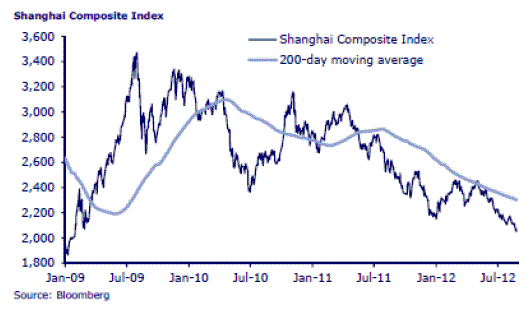
China is more than doing its part to complete the global slowdown trifecta. In his most recent report on China, ISI’s Donald Straszheim writes the following: “We are still using 7.0% y/y real GDP in our 3Q12 forecast because we still believe that is about the number that Beijing will announce. China’s GDP data are opaque at best. But when we go through the exercise of trying to add up the pieces that get to 7% we fall a couple of percentage points short. Bluntly, a 7% y/y real GDP growth number announced for 3Q12 will severely strain Beijing’s credibility among essentially independent outside observers.” Mr. Strazsheim is more polite than me. A 7% GDP print is nonsense. Those pouring over China’s PMI reports like Zen masters reading koans are wasting their time. The numbers are phony. If you want to really know what is going on in China, you are much better served by looking at the prices of the key commodities that China uses like iron ore and steel (according to The Gartman Letter, steel futures in China have moved to new life-of-contract lows), or listening to multinational companies such as Joy Global, Siemens, BASF, United Technologies, or Hitachi, all of whom have announced lower results and profits warnings attributed to lower Chinese demand. Some of China’s domestic consumer products companies are hurting as well such as Suning Appliance and Gome, two of the country’s largest electronics retailers, or Air China, who reported that profit will drop more than 50%. Profits at state-owned enterprises dropped 11.6% in the first half of the year from a year ago (which likely means they dropped even more since the source of this information was the state-owned companies themselves). Donwu Cement, which went public only a couple of months ago, has issued a profit warning (and cement along with electricity is a key indicia of economic health in China). It is little wonder then, as Figure 4 below illustrates, that China’s stock market is back to 2009 levels.
There are all kinds of reports about the heroic stimulus efforts in which the Chinese government is about to engage. China’s government took extraordinary steps during the financial crisis to prop up its economy as well as the world economy. The result has been even more overcapacity than what existed at the time. Stephen Roach, for whom we hold the highest respect, argues that China must build ahead in order to be prepared for the shift of hundreds of millions of people from rural areas to the cities. This is no doubt true, but the interim period before the newly built real estate and other capacity is absorbed is still likely to require adjustment and involve some degree of slowdown. This doesn’t mean that China’s economy has to fall off a cliff, just that the 10% growth rates that were seen in the last decade may be cut in half for a period of time. The problem is that growth in the U.S. and Europe is so sluggish that the loss of 4 or 5% of Chinese growth will be extremely damaging to a global economy that can’t pick up this lost growth from somewhere else. Rather than acting as a shock absorber for the global economy as it has been in the past, China will be reinforcing the slowdown. The question then becomes how to identify another source of global growth.
Figure 4
Chinese Stocks – Back to the Future?
Iran
Iran’s nuclear centrifuges continue to spin while the Obama administration continues to rely on sanctions to stop them. Unfortunately, while the sanctions may be making life difficult for Iran, they appear to be doing little to stop their nuclear progress. The International Atomic Energy Agency (IAEA) issued its quarterly report on Iran’s nuclear program on August 30 and the news was alarming. The agency accused Iran of cleansing the military site south of Tehran known as Parchin to prevent the agency from inspecting it. Iran has also reportedly been moving more of its nuclear fuel production into an underground facility known as Fordow near the holy city of Qom. This site is buried in a mountain and is seen by many experts as impregnable to attack. The IAEA believes that Iran has doubled its capacity to enrich uranium to 20% purity at Fordow over the last three months, and the number of centrifuges there has risen to 2,140 from 1,064 over that period (although most of the new ones are not yet purifying uranium gas). Iran has now produced about 190 kilograms of uranium enriched to 20% purity since 2010, of which 71 kilograms have been used to power Iran’s research reactor. Experts believe that Iran would need about 250 kilograms enriched to 20% purity for one atomic weapon.
Israel is running out of patience. Iran has been very clear that it would like nothing better than to wipe Israel off the face of the earth. The New York Times reported on September 3 that the United States is rushing to take additional steps short of war to reassure Israel that it is serious about restraining Iran (“To Calm Israel, U.S. Offers Ways to Restrain Iran,” p. A1). Among the actions that the U.S. plans to take are naval exercises in the region, installation of new antimissile systems in the Persian Gulf, more forcefully clamping down on Iranian oil revenues, and potentially new declarations by President Obama clarifying what would prompt American military action. As always, what is right is being governed by what is political. “The question of how explicit Mr. Obama’s warnings to Iran should be,” writes the Times, “is still a subject of internal debate, closely tied to election-year politics.” No doubt Mr. Obama’s amanuensis, Valerie Jarrett, will be guiding that debate, which means it is likely to sell Israel short.
Frankly, none of these mooted next steps impresses me in the least. If the U.S. wants to demonstrate real support for Israel, the next step it should take is to lead an immediate land and sea blockade of Iran. The U.S. should ask other Western nations to join in this blockade, but should not wait for them to debate the matter. Moreover, when Russia and China object to this action and run to the United Nations to block it, the U.S. should smile and tell them to take a hike. The blockade should not allow for any exceptions – not food, not medicine, not any type of humanitarian aid. If Iran challenges the blockade with military force, the U.S. should be prepared to use whatever force is necessary to defend itself and insure that Iran is confined to its borders. When the Iranian people revolt, the U.S. and other Western nations should provide whatever military and other support they can. The U.S. should not repeat the mistake of waiting as long as it did in Libya or doing nothing (as it is doing today) in Syria as Bashar Assad butchers his people in plain sight. America needs a president who understands that allowing a radical Islamic regime to gain nuclear capability is simply unthinkable. Frankly, I find the fact that this issue is open for debate further evidence that America has entered a lapsarian state from which it may never recover. If the U.S. does not do more and prevent Iran from getting the bomb, we will all look back at this period not only with regret but with a burning anger that we allowed something so obviously contrary to our interests to occur when we could have stopped it.
Investment Recommendations
This section is available only to paid subscribers.
Michael E. Lewitt
Disclaimer
All opinions and investment recommendations expressed by Michael E. Lewitt in The Credit Strategist as well as on Twitter under the Twitter name @credstrategist are solely the opinions of Mr. Lewitt and do not reflect the opinions of Cumberland Advisors or its affiliates or employees, managing directors, owners or principals.
Disclosure Appendix
This publication does not provide individually tailored investment advice. It has been prepared without regard to the circumstances and objectives of those who receive it. This report contains general information only, does not take account of the specific circumstances of any recipient, and should not be relied upon as authoritative or taken in substitution for the exercise of judgment by any recipient. Each recipient should consider the appropriateness of any investment decision having regard to his or her own circumstances, the full range of information available and appropriate professional advice. The editor recommends that recipients independently evaluate particular investments and strategies, and encourages them to seek a financial adviser’s advice. Under no circumstances should this publication be construed as a solicitation to buy or sell any security or to participate in any trading or investment strategy, nor should this publication or any part of it form the basis of, or be relied on in connection with, any contract or commitment whatsoever. The value of and income from investments may vary because of changes in interest rates or foreign exchange rates, securities prices or market indexes, operational or financial conditions of companies, geopolitical or other factors. Past performance is not necessarily a guide to future performance. Estimates of future performance are based on assumptions that may not be realized. The information and opinions in this report constitute judgment as of the date of this report, have been compiled and arrived at from sources believed to be reliable and in good faith (but no representation or warranty, express or implied, is made as to their accuracy, completeness or correctness) and are subject to change without notice. The editor may have an interest in the companies or securities mentioned herein. The editor does not accept any liability whatsoever for any loss or damage arising from any use of this report or its contents. All data and information and opinions expressed herein are subject to change without notice.
The Credit Strategist
Michael E. Lewitt, Editor
The Credit Strategist is published on a monthly basis by Michael E. Lewitt. Address: 5030 Champion Blvd., G6 #161 Boca Raton, FL 33496. Telephone: (561) 239-1510. Email: . Delivery is by electronic mail. Annual subscription rate is $395 for individuals and $995 for institutions. Visit our web site at www.thecreditstrategist.com. Copyright warning and notice: It is a violation of federal copyright law to reproduce or distribute all or part of this publication to anyone (with the exception of individuals within the same institution pursuant to the subscription agreement) by any means, including but not limited to photocopying, printing, faxing, scanning, e-mailing, and Web site posting without first seeking the permission of the editor. The Copyright Act imposes liability of up to $150,000 per issue for infringement. Information concerning possible copyright infringement will be gratefully received.
Read more articles by Michael Lewitt