Advisor Perspectives welcomes guest contributions. The views presented here do not necessarily represent those of Advisor Perspectives.

This essay is excerpted from a recent version of The Credit Strategist (formerly the HCM Market Letter). To obtain the complete issue, you must subscribe directly to this publication; Please go here. The Credit Strategist is on Twitter - @credstrategist
“Computer models alone can no longer calculate meaningful probabilities about what will happen next in the Eurozone. Instead, what really matters now in places ranging from Finland to Greece are non-quantitative issues such as political values, social cohesion and civic identity. Above all, the question of ‘credit’ is key to working out whether bonds can ever be repaid. But this is not credit in the mathematical sense by which banks have often defined (as a projected probability on a chart), but in the old fashioned, Latin – social – meaning (trust).”
Gillian Tett, Financial Times, June 5, 2012
The AMC television series Breaking Bad tells the story of Walter White, a high school chemistry teacher who has a son with cerebral palsy, an unwanted daughter on the way, a lousy second job at a car wash, and then learns that he is going to die of cancer in a few months. With nothing to lose, desperate to provide a financial future for his family, Walt comes up with a devilish plan to put his scientific skills to use as a cooker of the purest methamphetamine in the Southwest. Of course he has a brother-in-law in the DEA and a new business partner who happens to have been one of his most recalcitrant high school students who manages to wear his guilt on his sleeve as he self-medicates himself through the moral jungle of the drug underworld that he and Walt inhabit. Over the course of the series, we watch Walt transform from a man who was ostensibly good into a man who discovers the evil that lies in the heart of Everyman as he does whatever is necessary to protect his new business and provide for his family – which in his new business often includes killing people. The damage initially affects those who deserve bad things to happen to them, but inevitably it starts reaching those who don’t.1
One of the great characters in this complex drama is Walt’s wife, Skyler, who wrestles with what Walt is doing while trying to launder the money that it provides. Skyler has to provide adult supervision because one of Walt’s endearing traits is that he is an absent-minded professor and learning his criminal skills on the run. He is often his own worst enemy, which is when Skyler needs to step in and save him (and his family) from himself. At one point she delivers a line that could serve for the age we live in: “Someone has to protect this family from the man who protects this family.” With our largest business and government institutions - and the individuals running them - committing every conceivable act of legal or moral anomie, we have every right to ask who is going to protect the rest of us from those who have been entrusted with so much power and influence. The institutions that were supposed to be the lifeblood of our economy are the same institutions that inflicted the greatest harm on society – with ample assistance from the willful blindness or flat-out incompetence of the regulators. When the family has to be protected from the man who is supposed to protect the family, the family is in serious trouble.
Barclays
Are there too many laws or too many criminals? That was the question that we asked ourselves after hearing that Barclays settled claims that during the financial crisis it manipulated the price of Libor, the London interbank offered rate, a benchmark interest rate that is used globally to set the price of everything from credit card fees to mortgages and corporate bank loans. The last time Wall Street firms were involved in manipulating an instrument as essential to the workings of the financial market, it was Salomon Brothers corrupting U.S. Treasury auctions. Libor is perhaps the most basic benchmark of the banking industry; one might as well be manipulating the dollar (no doubt it is being done but has not yet been discovered yet). Most damningly, this conduct was irrefutably pre-meditated, which should subject the guilty individuals to criminal as well as civil penalties. Moreover, there were numerous people at multiple institutions involved in the daily price-settings of this benchmark interest rate so they were obviously widely known and tolerated. Some participants have expressed the view that they were trying to stabilize the financial system during the crisis. But there is abundant evidence that the individuals involved knew they were doing wrong but did it anyway, over and over again. On December 4, 2007, one Barclay’s banker wrote an email to another stating: “We are being dishonest by definition and [are] at risk of damaging our reputation in the market and with the regulators.”2 What in the world were Barclay’s compliance people doing? Even a basic email review (which in a large organization is presumably based on identifying key words in the enormous volume of email traffic that has to be reviewed) should have turned up the word “dishonest” without great difficulty. The second question is what the managers of these institutions were doing while their employees were busy breaking the law “systematically and over a period of many years, both before and during the crisis.”3
The resignations of Barclays Chairman Marcus Agius and its high profile CEO Bob Diamond are appropriate. If these men didn’t know what was happening on their watch, they should have known. In view of the large number of people involved in the daily price-settings, it particularly strains credulity to believe that Mr. Diamond was in the dark. Time will tell. What we do know is that a not insignificant number of Barclays’ employees were engaged in a criminal conspiracy to manipulate the financial markets. One can only hope that the U.K.’s Financial Services Authority will have the courage to do the right thing and punish all of the institutions and individuals that participated in this disgraceful chicanery to the full extent of the law. This was not a one-off event; it was a multi-year continuing conspiracy in which the illegal acts were repeated over and over again.
The spreading Wall Street stench
June was a particularly bad month for the reputation of the financial industry. First, the former head of the world’s leading management consulting firm, McKinsey & Co., Rajat Gupta, was convicted of insider trading after the jury deliberated for less than 24 hours. Then former hedge fund star Phil Falcone was finally sued by the Securities and Exchange Commission (SEC) on a number of charges, the most egregious being “borrowing” over $100 million from his fund to pay his personal taxes. This was done without being disclosed at the same time Mr. Falcone was preventing his investors from withdrawing from his funds, which were experiencing huge losses and illiquidity. We have written before that while not illegal, the way that certain large investors such as Mr. Falcone and John Paulson profited from the subprime meltdown – by working with investment banks to construct structured products that they knew would fail – was a dirty business, so we can’t help but find a kind of karma in their subsequent fall from grace. Mr. Falcone was a shooting star who had “blow-up” written all over him, and the investors he took down with him should have seen his downfall coming.
Many people complain that enough isn’t being done to punish the miscreants who brought the financial world to its knees in 2008, but these prosecutions suggest that regulators and prosecutors certainly haven’t been sitting on their hands. It would undoubtedly be gratifying to see the Dick Fuld’s, Stanley O’Neil’s, Jimmy Cayne’s and Joe Cassano’s of the world dragged to the figurative gallows, but apparently, as we are reminded every day, stupidity and hubris are not crimes (although they should be when such conduct harms so many people). After all, it’s not as though evidence has emerged that any of these individuals were acting in good faith or for the greater good – they were lining their own pockets at the expense of everyone else. But if neither stupidity nor hubris is a crime, complicity in the form of silence is at the very least a moral crime and should be conduct that disqualifies those who commit it from positions of responsibility. It is no longer credible to argue that so much illegal and, if not illegal, stupid and immoral conduct could have occurred without legions of so-called highly educated (and clearly grossly overpaid) professionals looking the other way or making excuses. The people who are paraded on CNBC and elsewhere to argue that “most of the people who work on Wall Street are honest, etc.” have become nothing more than apologists for a status quo that, not to put too fine a point on it, stinks to high heaven. If these defenses were valid, wouldn’t some of these honest people have stood up and spoken out against the rampant abuse of the public trust in which the financial industry has repeatedly engaged? The reality is that they rarely speak out due to fears about their own careers or financial interests. Those that do speak out pay a price for all the cowards that don’t.
1. In many ways, Walter White’s story is an inverted version of that of another iconic television character, NYPD Blue’s Andy Sipowicz (about whom I wrote in 2005). Just as we watch Walter transform from a good man to a man capable of doing very bad things, we watched Andy Sipowicz change from an alcoholic and racist to a family man and ultimately a precinct captain who won the respect of his colleagues and superiors. NYPD Blue ran from 1993-2005, a far different period in American life than Breaking Bad’s run since 2008. Certainly one could argue that the pre-9/11 period possessed an innocence and optimism that is absent from the period that followed that terrible day.
2. See Financial Times, June 30/July 1, 2012, p. 7.
3. Ibid.
The U.S. economy
It is increasing obvious that the U.S. economy is struggling. The string of weaker employment data that began during the second quarter continued through the final week of the quarter (week of June 25) when 386,000 new jobless claims were filed. The prior week’s figure (week of June 18) was revised upward to 392,000, and the four week average is now a depressing 386,750. We would not be surprised to see this figure exceed 400,000 before the summer is over, particularly in the wake of the Obamacare ruling that is likely to reinforce the reluctance of businesses to hire. There is little reason to think that, barring gross manipulation of the data (a possibility that should never be dismissed), the unemployment rate will stay above 8% between now and Election Day. First quarter GDP was revised to a tepid 1.9% and Wall Street strategists have been competing with each other to lower their second quarter and full year GDP estimates (which, if you think about it, would normally be a contrary sign if the evidence weren’t so compelling that they are likely to be correct). In the latest bout of Wall Street competition, both Goldman Sachs and UBS lowered their year-end S&P targets to 1250 and 1375, respectively. We are betting on Goldman Sachs’ target being closer to the mark than UBS’s. When the normally over-bullish Goldman Sachs starts lowering its S&P target, it’s probably time to take notice.
June’s ISM manufacturing report was filled with foreboding news. The index came in below 50 for the first time since July 2009 at 49.7. This is probably not yet signaling a recession, but it is starting to point to the possibility unless something changes. This figure was far below “expectations” (substitute: “hopes and wishes”) of 52.0 and May’s figure of 53.5. The 3.8 point drop from May is large and significant. New orders dropped to 47.8, the weakest since April 2009; backlogs fell 2.5 points to 44.5; and production shrunk to 51 from 55.6 in May. Inventories at the manufacturing level fell 2 points but rose at the customer level by 5 points, but most importantly were below 50 at both levels. Most telling was the 6 point drop in export orders, strongly suggesting that the growing weakness in Europe and Asia is starting to wash up on America’s shores. Prices paid were down 10 points to 37, the lowest since April 2009 as well, following the sharp drop in commodity prices. The Dow Jones-UBS Commodity Index has dropped 9% since February, with prices dropping for oil, copper, cotton and many other commodities. It should be noted with respect to the 2009 comparisons that in 2009 the ISM numbers were on an upswing; today they are on a downswing. The world is seeing a trifecta of slowing growth that started in Europe, spread to China, and is now coming to rest in the U.S. just in time for the Presidential election.
Europe
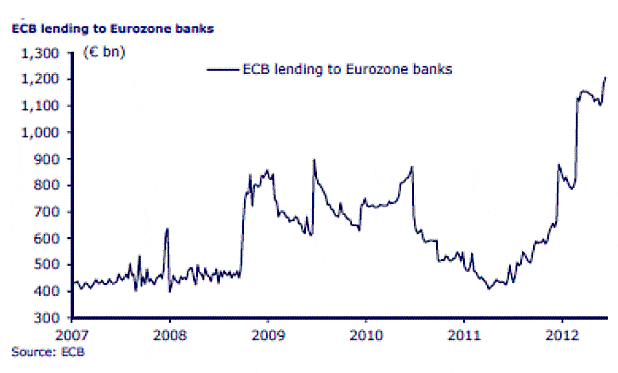
This was likely another case of “been down so long it looks like up to me.” Prior to the summit, financial conditions had grown increasingly desperate. For example, with Spanish 10-year bond yields piercing the forbidding 7% level and Italian yields not far behind, it was clear that the markets were no longer willing to extend credit to these countries at sustainable rates without some sign of EU support. The €100 billion Spanish bank bailout plan announced two weeks ago was greeted with justifiable disdain by the markets since all it offered was more debt to banks that are already insolvent. Even Keynes rolled over in his grave when he read about it in the FT. As I wrote in El Mundo on June 10 (“Waiting for Godot”), what Spanish banks require is a TARP-like plan in which money is infused as equity into the banks. But Spain’s plan offered nothing of the kind; the country was still trying to recapitalize its banks with borrowed money that will never be repaid. So as the latest summit approached, the European interbank market had completely shut down, leaving the European Central Bank (ECB) to fill the gap. Evidence of this is found in the data for the week of June 15 in which ECB loans to Eurozone banks increased by another €21 billion to €1.2 trillion.
Figure 1
ECB: Lender of Last Resort
This was the dire situation facing European leaders as they gathered in Brussels on June 29.
The public narrative that emerged from the meeting is that Italy, Spain and last-but-not-least socialist-led France were able to put enough pressure on Frau Merkel to produce a plan that, if nothing else, will prevent a “Lehman moment” from occurring right now in Europe. The patient could be taken off life support for the moment. There were several ostensibly positive announcements that emerged from the summit. Eurozone’s rescue funds (the European Stability Mechanism or ESM) would be allowed to infuse funds directly into Spain’s banks and to purchase Italian bonds without the funds having to flow through the respective sovereigns. Moreover, these funds would no longer claim payment seniority vis-à-vis private bondholders when they purchase Italian or Spanish bonds (which reversed a harebrained scheme that was hatched during the Greek bailout and effectively foreclosed private sector financing for European sovereigns). The new proposal also included a new system of European banking supervision under the ambit of the European Central Bank (ECB), which is being interpreted as a first step toward a full banking union (we are not holding our breath for that to occur). Finally, European leaders threw in a €120 billion “growth pact,” which TCS would dismiss as the equivalent of seagull droppings in the ocean.
Most observers believe that Frau Merkel was bullied into making concessions regarding what amounts to another debt monetization scheme. The German Chancellor returned home to a storm of criticism in the Bundestag but insisted that she had given up very little. Unlike the statements of most politicians, Frau Merkel was being truthful. The ESM, the monetization vehicle that will be used to prop up Italy and Spain, was not expanded beyond its €500 billion size, which means that Germany won’t be ponying up any more money for the moment. Unfortunately, it also means that the facility remains too small to stabilize Spain, Italy, Portugal, Greece and now Cyprus. Further, Frau Merkel successfully resisted granting the ESM a banking license, something for which Spain and Italy were pushing hard. Most of the fine print of the summit deal has yet to written, but Europe has broken too many promises and made too many false starts to be trusted. In reality, Europe’s economic situation is terminal without far more radical changes than those contained in this or likely any other pact that will be reached. Unless these agreements are followed by a steady series of radical fiscal policy changes, this summit will prove to have been just another false start on the way to the end of the European Union as originally constituted.
As Europe’s leaders fiddle, Europe’s economy continues to burn.4 Germany’s economy is clearly feeling the effects of the collapse of its largest trading partners’ economies; its manufacturing ISM was down to 45 in June from 54.6 a year ago and 48.4 six months ago. Ireland (which already defaulted) is the only European country whose manufacturing PMI is higher today than it was a year ago. The manufacturing PMI figures for countries like Spain (41.1) are nothing short of horrible while most other countries’ have numbers in the mid-40s. The overall unemployment rate in the EU hit 11.1% in June, with the youth unemployment rate hovering at 50% in many countries.
The EU’s second largest economy, France, is weakening sharply. France’s manufacturing ISM was 45.2 in June compared to 52.5 a year ago and 48.9 six months ago. France’s Cour des Comptes (CDC) (the rough equivalent of our Congressional Budget Office) released a report stating that France will have to cut the equivalent of 2% of GDP in order to meet EU budget deficit targets of 4.5% and 3.0% of GDP in 2012 and 2013, respectively. The CDC also reduced its 2012 and 2013 real GDP growth expectations to 0.4% and 1.0%, respectively. The response to this report from the new socialist government was all too predictable. After delivering a lovely rendition of La Marseillaise, Prime Minister Jean-Marc Ayrault promised to tax the rich to make up the difference. France’s new president Francois Hollande is still enjoying a honeymoon with the global media. He is being praised for standing up to Germany’s call for greater accountability in exchange for Germany underwriting a European recovery. Of course nothing of the kind is happening, but it sells newspapers. TCS will repeat here what we said before here, in El Mundo5 and elsewhere both before and after M. Hollande was elected –a socialist regime will prove to be disastrous for France and all of Europe. Media and other intellectual elites have been repeatedly seduced by the false promises of equality that socialists have offered up throughout the course of history, forgetting that true freedom demands equality of opportunity, not equality of result. M. Hollande’s reception is no exception, and like prior seductions it will end in broken hearts, recriminations and tears.
Obamacare
The Supreme Court’s decision upholding the Patient Protection and Affordable Care Act (“ACA”) was surprising in result and rationale. The majority decision proved to be highly ironic in a number of respects. First, it strictly limited Congressional power under the Commerce Clause while broadly expanding Congress’s taxing power. Second, the majority opinion was authored by a conservative Chief Justice who has argued that judges interpret laws but do not write them and then proceeded to rewrite the plain language of the law in question. And third, the ruling delivered President Obama and his Congressional allies a victory that clearly demonstrated that they had misrepresented the law to the American people. Mr. Obama and Congress are now left defending an Obama/Pelosi/Reid middle class tax hike four months before a presidential election. The ruling may prove to be a historic example of being careful what one wishes for. About the only aspect of the decision that isn’t ironic is its likely economic effect, which will be greater reluctance by businesses to increase employment as they absorb the higher costs imposed by the ACA.
The majority decision is deeply troubling in a number of respects. Chief Justice Roberts (for whom we maintain enormous respect despite our views on this opinion) ran roughshod over the plain language of the ACA. The Chief Justice simply cast aside the repeated use of the term “penalty” to describe the punitive payment uninsured individuals will have to make after the law takes effect. Instead, he decided that what Congress “really” meant was that uninsured individuals will be taxed. In doing so, he superseded the long history of jurisprudence that establishes different definitions of the words “tax” and “penalty.” In 1996, the Supreme Court wrote in United States v Reorganized CF&I Fabricators of Utah, Inc., 518 U.S. 213 224 (1996) (quoting two earlier precedents) that “’a tax is an enforced contribution to provide for the support of the government; a penalty…is an exaction imposed by statute as punishment for an unlawful act.’” Further, as Justice Scalia explained in the dissent (citing the 1992 Supreme Court case Child Labor Tax Case, 259 U.S. 20, 38), “[w]hen an act ‘adopt[s] the criteria of wrongdoing’ and then imposes a monetary penalty as the ‘principal consequence on those who transgress its standard,’ it creates a regulatory penalty, not a tax.” In order to achieve the result he wanted, the Chief Justice blatantly ignored this distinction as well as the specific language that Congress wrote and substituted the word “tax” for the word “penalty.” This may have been a clever political and strategic ploy, but it is profoundly flawed from a jurisprudential standpoint. In this case, the outcome is presumably consistent with legislative intent. But in other cases, this mode of constitutional interpretation (or statutory reinterpretation) could provide a basis for a future court to ignore plain statutory language to achieve a desired result that could be inconsistent with legislative intent. That is an odd legacy for a Chief Justice who was seeking to insulate the Supreme Court from politics.
Many conservatives have argued that the strongest part of the decision was its rejection of an unlimited Congressional power under the Commerce Clause. The Court followed the reasoning of attorney Paul Clement, who represented the states challenging the ACA, in agreeing that Congress does not have the right to force individuals into commerce. This finding protects an essential aspect of the American ideal of liberty – the right to be left alone. By going further to uphold the law under Congress’s taxing power, however, the Court implicated another important aspect of American liberty – individuals do not have the right to engage in behavior that harms others. The rationale for taxing people who voluntarily opt out of healthcare is that their choice will ultimately harm the larger community by imposing the cost of their medical care on others. Where healthcare costs are incessantly rising and imposing an unsustainable burden on governments, Congress does not have the right to compel an individual into commerce but does have the right to require a financially able individual to bear the cost of his own healthcare rather than impose it on others. There are two potential problems with this conservative attempt to salvage something from the majority decision.
4. Thanks to the always indispensable The Gartman Letter L.C., July 3, 2012, for this European data.
5. El Mundo, April 15, 2012, “Socialism is not the answer.”
First, the ACA was not written that way. Instead, President Obama and his Congressional allies dressed the statute up as a 21st century civil rights act and specifically and repeatedly described the payment that it would require of those who choose to opt out of medical insurance as a “penalty.” They did not describe the payment that way in the statute once or twice – they described it that way 18 times according to the dissent.6 They also repeatedly and publicly denied that it was a tax, which suggests to us that if the Republicans are at all capable politicians they should be able to paint this as Mr. Obama’s “read my lips” moment. But like a school teacher correcting a student’s paper, Chief Justice Roberts told Congress that what it “really” meant was that the payment is a “tax” and not a “penalty.
The Chief Justice’s purpose was clear: the wisdom of this law is a matter for the People and not for judges to sort out.
“Members of this Court are vested with the authority to interpret the law; we possess neither the expertise nor the prerogative to make policy judgments. Those decisions are entrusted to our elected leaders, who can be thrown out of office if the people disagree with them. It is not our job to protect the people from the consequences of their political decisions.”
We sincerely hope that the Chief Justice does not have a bad back because he had to twist himself into pretzels to come up with the ruling that he did. Moreover, we hope that the complex intellectual and political calculus that he employed does not come back to haunt him, the Supreme Court, and the country. But everything in life has a cost, and most likely this decision will reverberate through the chambers of Congress and the Supreme Court for many years. Chief Justice Roberts took great license in rewriting the ACA. Unfortunately, it was not his license to take. He dismissed the plain meaning of words and substituted his own meaning. His opinion ignored if not misinterpreted precedent and created a new one that is intellectually unsupportable and unsustainable. His opinion ignored basic traditions of statutory analysis that have guided American and British law for centuries. He had every right to uphold the statute under Congress’s taxing power had it been written as an exercise of that power, but it was not written that way.
Second, as The Wall Street Journal pointed out in a July 2 editorial, the Chief Justice may have eviscerated the Commerce Clause limitations set forth so boldly earlier in the opinion with his subsequent endorsement of a broad Congressional taxing power. As the Journal points out, “[f]rom now on, Congress can simply regulate interstate commerce by imposing ‘taxes’ whenever someone does or does not do something contrary to its desires…The reality is that Washington would love to regulate the ordinary economic choices that used to be beyond its purview, and now it will be able to abuse the ad hoc ‘tax’ permit that the Chief Justice has given it.” George Will, who has expressed his enthusiasm for the Commerce Clause section of the majority opinion, explained on ABC’s This Week last Sunday that conservatives are far more comfortable with an expanded taxing power than an unlimited Commerce Clause mandate because they believe courts will be able to reign in taxes. It may prove to be the case that an unlimited taxing power is unrealistic from a political standpoint. Nonetheless, Chief Justice Roberts’ ruling creates a new rationale for the government to impose its choices on the American people through the taxing power. We shouldn’t think for a moment that Congress won’t try to utilize this new tool. This will likely open a new line of constitutional jurisprudence that will explore the limitations of that power in the years to come. For the moment, those limits are undefined and theoretically very broad. We wish we could share Mr. Will’s optimism but we fear he was trying to put lipstick on a pig.
Chief Justice Roberts may have acted for the sake of the greater good, but the very purpose of the Constitution and its principles is precisely to prevent the end from ever justifying the means.7 We allow murderers to go free if their rights are violated. We tolerate hateful speech. We allow the American flag to be burned. Americans tolerate a great deal in order to enjoy our freedoms. The country could have waited a little longer for Congress to pass a properly written healthcare bill rather be forced to swallow a sloppily written bill that was rushed through Congress based on artificial political deadlines and passed through a reconciliation procedure that only required a slim majority of 51 votes because the Obama/Pelosi/Reid triad knew that the bill never would have passed had they been forthright about all of its provisions (including its tax increase on the middle class). Americans deserve healthcare – all of us, rich and poor, of every creed and color. But even more, we deserve an honest government and a Supreme Court that will enforce a Constitution that was written to protect everyone from precisely the type of arbitrary rulemaking and politically expedient thinking that this opinion contained. Just as there was a correct way to pass a healthcare bill and Congress chose the wrong way, there was a correct way to rule on the ACA and the Supreme Court chose the wrong way. Sooner or later, this country is going to discover that it is impossible to govern without principle. Democracy is poisoned by expediency.
J.P. Morgan
Jamie Dimon, who we still think is better qualified than virtually anybody else to lead J.P. Morgan, is keeping his fingers crossed that his Chief Investment Office’s trading loss will not balloon as much as recent press reports suggest. There is a big difference between $2 billion and $9 billion even for a CEO of the reputation of Mr. Dimon and even for a bank the size of JPM, and a loss on the larger end of this scale will open a whole new set of problems for both Mr. Dimon and his bank.
TCS still does not believe that the true story of this trading loss has been told. In all of the discussion of this topic in the media, there is one subject that has received little attention: the bank’s Chief Investment Office was a lousy investor even before the whale blew his spout. Based on everything we have read and discussions with people who know far more than we do, it appears that the CIO was at best generating very low single digit returns on the bank’s capital. With a capital base that started at about $150 billion and ended at $365 billion, wouldn’t one think that the CIO would have earned far more than the $8.5 billion it was reported to have earned over a three year period (my numbers are very rough, but I haven’t heard that the CIO was earning anything like even an 8% or 10% return that might justify taking the risks it did). Yet Mr. Dimon has explained that one of the reasons he became so complacent about the CIO’s activities is that it had been doing so well for so long. To our mind, at least, that statement is inconsistent with the actual performance that the CIO was churning out. While the gross numbers are in the billions and represent a lot of money, the percentage returns would get most managers fired. This also raises questions about the compensation paid to those working in the CIO that should be addressed. One explanation I have offered to someone who is extremely knowledgeable about the matter is that the bank was in fact hedging macro-risk in its lending book and not engaging in proprietary trading. My friend assured me, however, that it was not hedging and was in fact trading for profit. In which case I ask the question again: why didn’t the CIO earn a decent return on its capital? Something doesn’t add up.
Egypt and rising Middle East instability
Our readers will forgive us (or not) for refusing to take part in the celebration of the election of an Islamist as the new president of Egypt. Whether or not it was better than the alternative, it is still a disaster. President Mohamed Morsi could hardly wait after taking the oath of office before stating that he wanted to rethink peace with Israel and demanding the release of Sheik Omar Abdel Rahman, the Egyptian born militant Islamist convicted after the 1993 World Trade Center attack of plotting to bomb several New York City landmarks. For those who were hoping that the Arab Spring would deliver constructive new leadership to the Middle East, think again. President Obama, who delivered a stirring speech to students at Cairo University during his apology tour to the Muslim world shortly taking office8, has to be scratching his head.
The Middle East has always been a powder keg, but only a fool would think that recent events have rendered it more stable. While all eyes are on Iran, Syria continues to butcher its own people9 and Egypt is facing a fight between the Islamists and the military (a fight that reminds one of Henry Kissinger’s famous quip that it was a tragedy that somebody had to lose the Iran/Iraq War). Sunday was the first day that full European Union sanctions against Iranian oil exports took effect. Iran greeted this event with threats to block oil shipments through the Strait of Hormuz.
Middle East instability is rising just as the United States is facing potential regime change and its two political parties are barely on speaking terms. From an investment standpoint, instability is bad news. Egypt – and the entire Mideast – is again another source of potential instability. The recent drop in oil prices that U.S. consumers have been enjoying may be coming to an abrupt end.
Investment recommendations
This section is available only to paid subscribers.
Michael E. Lewitt
6. See page 21 of the dissent. We must confess that we did not take the trouble to count.
7. That is why we reject the facile argument that Thomas Friedman made that the Chief Justice showed leadership and “took one for the country.” (The New York Times, July 1, 2012) Mr. Friedman is the master of simplifying complex issues to the point where the solutions seem extremely attractive. In this case, however, the Chief Justice’s actions require a more sophisticated analysis. Things are not as simple as Mr. Friedman tried to paint them.
8. For which he was inexplicably awarded the now devalued Nobel Peace Prize. Of course, that was before he started taking names and checking them twice and then ordering drone attacks that have wiped out much of the Al Qaeda leadership, something for which he deserves great praise. We have to ask, however, how Mr. Obama thinks his sanctioning the assassination without trial of these individuals is somehow more humane than the waterboarding of terrorist suspects who at least have a chance (whether they take it or not) to answer the charges against them. We view both acts as legitimate under the President’s power as Commander in Chief, which is found in Article II, Section II of the U.S. Constitution. There is an extremely unconvincing attempt to justify a distinction between the two made by David Cole, a Georgetown University Law Professor, in the July 12, 2012 issue of The New York Review of Books (“Obama and Terror: The Hovering Questions”). Then again, as a famous American once said, consistency is the hobgoblin of little minds. Just ask Chief Justice Roberts.
9. The fact that the United States has allowed Syrian genocide to continue under its watch - everything that happens in the world is under our watch – that is what American leadership means - is a stain on our conscience and our leadership.
Disclaimer
All opinions and investment recommendations expressed by Michael E. Lewitt in The Credit Strategist as well as on Twitter under the Twitter name @credstrategist are solely the opinions of Mr. Lewitt and do not reflect the opinions of Cumberland Advisors or its affiliates or employees, managing directors, owners or principals.
Disclosure Appendix
This publication does not provide individually tailored investment advice. It has been prepared without regard to the circumstances and objectives of those who receive it. This report contains general information only, does not take account of the specific circumstances of any recipient, and should not be relied upon as authoritative or taken in substitution for the exercise of judgment by any recipient. Each recipient should consider the appropriateness of any investment decision having regard to his or her own circumstances, the full range of information available and appropriate professional advice. The editor recommends that recipients independently evaluate particular investments and strategies, and encourages them to seek a financial adviser’s advice. Under no circumstances should this publication be construed as a solicitation to buy or sell any security or to participate in any trading or investment strategy, nor should this publication or any part of it form the basis of, or be relied on in connection with, any contract or commitment whatsoever. The value of and income from investments may vary because of changes in interest rates or foreign exchange rates, securities prices or market indexes, operational or financial conditions of companies, geopolitical or other factors. Past performance is not necessarily a guide to future performance. Estimates of future performance are based on assumptions that may not be realized. The information and opinions in this report constitute judgment as of the date of this report, have been compiled and arrived at from sources believed to be reliable and in good faith (but no representation or warranty, express or implied, is made as to their accuracy, completeness or correctness) and are subject to change without notice. The editor may have an interest in the companies or securities mentioned herein. The editor does not accept any liability whatsoever for any loss or damage arising from any use of this report or its contents. All data and information and opinions expressed herein are subject to change without notice.
The Credit Strategist
Michael E. Lewitt, Editor
The Credit Strategist is published on a monthly basis by Michael E. Lewitt. Address: 5030 Champion Blvd., G6 #161 Boca Raton, FL 33496. Telephone: (561) 239-1510. Email: . Delivery is by electronic mail. Annual subscription rate is $395 for individuals and $995 for institutions. Visit our web site at www.thecreditstrategist.com. Copyright warning and notice: It is a violation of federal copyright law to reproduce or distribute all or part of this publication to anyone (with the exception of individuals within the same institution pursuant to the subscription agreement) by any means, including but not limited to photocopying, printing, faxing, scanning, e-mailing, and Web site posting without first seeking the permission of the editor. The Copyright Act imposes liability of up to $150,000 per issue for infringement. Information concerning possible copyright infringement will be gratefully received.
Read more articles by Michael Lewitt