One way to extend the long-term purchasing power of a traditional stock and bond portfolio is through an allocation to real assets. But individually, categories like commodities, natural resource equities and REITs can be volatile. Cohen & Steers meets the challenge with a focus on broad asset-class diversification.
The Importance of Maintaining Long-term Purchasing Power
Although the government reports that inflation is “well contained,” maintaining a portfolio’s long-term purchasing power is still a key investment objective. This is especially important in today’s challenging backdrop, with stocks still lingering in “lost-decade” mode and fixed-income returns at historic lows.
Also in question is whether government statistics are capturing the essence of true price inflation; for a reality check, look no further than the gas pump, the cost of college and rising medical expenses. Or, for a more holistic reading, consider the proprietary inflation index of the American Institute of Economic Research, called the Everyday Price Index (EPI). This benchmark places a higher weighting on items purchased more frequently by the typical American consumer, at least once a month. And unlike the government’s Consumer Price Index (CPI), the EPI includes food and energy, while excluding housing. The result? Last year’s EPI inflation was 7.2%, vs. CPI inflation of 3.1%.
From the advisors’ perspective, the need to protect long-term purchasing power only grows with the age of the investor. Over time, their assets will need to work harder, especially as earned income wanes or ends with retirement.
Real assets have long been recognized for their inflation-fighting characteristics, but the volatility can be less than ideal, given the typical investor’s return-chasing behavior. According to Cohen & Steers, a diversified, research-based approach, coupled with an understanding of the characteristics and drivers of true economic inflation, are essential tools for building a better mousetrap.
An Investment Case for Allocating to Real Assets
If true price inflation really is higher than government statistics, then it stands to reason that strategies pegged to CPI will disappoint when inflation moves higher. For this reason, the advisor focus should turn to tangible real asset classes, whose values are driven by barriers to supply and rising replacement costs. Three such categories are commodities, natural resource equities and REITs. Each exhibits inflation-fighting characteristics, and they have relatively low correlations with one another–in part because they respond differently in the face of changing economic drivers and inflation regimes.
Commodities |
From an investment perspective, commodities have shown a low correlation with stocks and bonds, which points to the diversification potential of this asset class. Since commodities respond directly to levels of economic activity–due to the underlying dynamics of demand, supply, production and the commodity futures market structure–they tend to perform well when inflation is rising or high. |
Natural Resource Equities |
Many natural resource companies are linked to critical and often depleting resources, which speaks to an important concept for a real assets portfolio: tangible assets with capital intensity and barriers to supply tend to see price appreciation in excess of inflation. Over time, Cohen & Steers believes that price appreciation for depleting natural resources will exceed the rate of inflation. The macro case builds as increasingly erratic weather patterns, natural disasters and accelerating emerging market demand are layered on. |
Real Estate |
Cohen & Steers considers REITs to be in the sweet spot of a diversified real assets investment framework. One reason is their consistently high rate of dividend growth; historically well above the rate of inflation. This asset class also presents an interesting way to invest in commodities at below market prices; the majority of the replacement cost for commercial real estate is represented by the sum of the commodities and energy needed to build it. Commodity prices have risen sharply over the past two years, but in many sectors, commercial real estate continues to be valued at a significant discount to replacement cost. The investment case for REITs is furthered by today’s relatively low levels of new supply. |
The Stabilizing Role of Portfolio Diversifiers
One area that differentiates Cohen & Steers’ as a real assets manager is in how portfolio diversifiers are used. Variable rate notes and other fixed income instruments can provide portfolio stability and generate some income, while not subjecting a real assets portfolio to the level of interest-rate risk typically found in periods of rising inflation. Especially effective are fixed income securities denominated in foreign currencies of safe havens like Switzerland, or economies tied to natural resources like Australia and Canada.
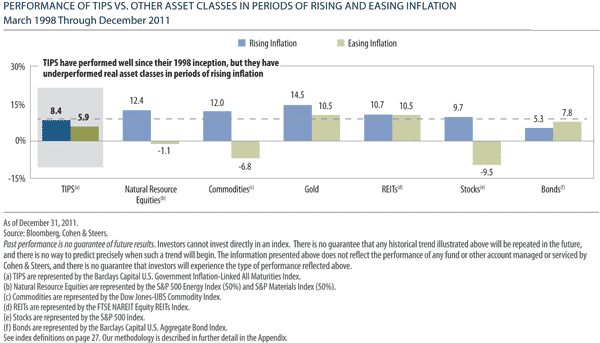
Unlike some other real asset managers, Cohen & Steers does not view Treasury Inflation Protected Securities (TIPS) as a core component of a real assets investment framework, although they may serve opportunistically as a diversifier. While TIPS have performed relatively well since their 1997 introduction, there is something they haven’t done: outperform real asset classes in periods of rising inflation. To illustrate, the chart below compares the returns of TIPS with various asset classes over periods of rising and easing inflation(2) from the inception of the Barclays Capital U.S. Government Inflation-Linked All Maturities Index through December 2011. Note that TIPS far underperformed securities backed by tangible real asset categories, like REITs, commodities and natural resource equities.
While a gold allocation can be effective for commodity value, this precious metal can play a far broader role as part of a diversified real assets framework. It has always been a recognized store of value relative to fiat currency, based on its liquidity, acceptability as a medium of exchange, and portability. Gold can be especially lucrative in times of expansive monetary policy, economic dislocation and geopolitical instability. Through these characteristics, gold can offer complementary diversification potential relative to other real asset categories and hedge a declining dollar.
Real Return Potential with Real Assets:
Measuring the Benefits of the Blend
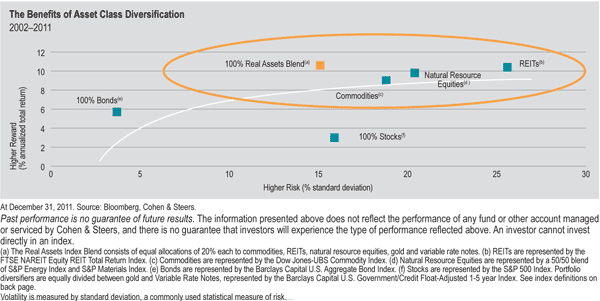
Most would agree that a real assets allocation has merit, from a diversification perspective. But using the “DIY” approach can have its challenges. Cohen & Steers advocates a risk-sensitive, systematic allocation to real asset classes (commodities, natural resource equities and REITs) mixed with portfolio diversifiers (gold and variable rate fixed income securities) for added stability. While single-sector niche investments can capture short-term swings, diversification at a broad level can provide a more stable long-term allocation.
The next snapshot looks again at investment returns over the past decade. Using available index data, the exhibit below shows the risk-adjusted returns of these core real asset classes, commodities, natural resource equities and REITs. When these groups are combined in equal amounts with two portfolio diversifiers (gold and variable rate fixed income securities), the return was higher and the volatility, as measured by standard deviation was lower.
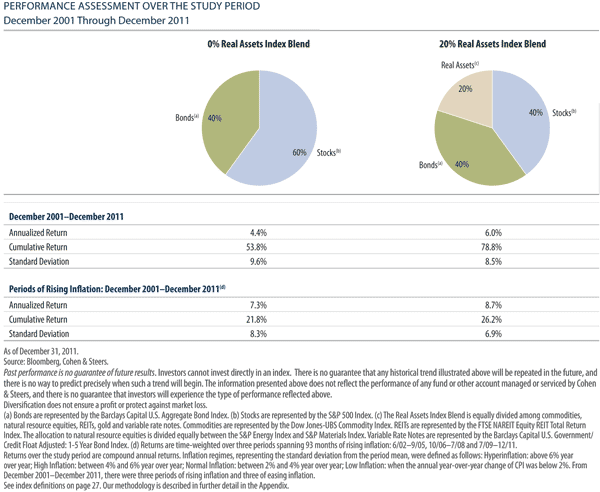
It would not be prudent to place 100% of an investment portfolio in real assets, for the same reason diversification makes sense in a real assets investment framework. However, an allocation to real assets could help investors maintain the long-term purchasing power of their portfolios. To illustrate, the exhibit below shows how a 20% allocation to diversified real assets would have served to enhance the returns of a traditional stock and bond portfolio over the past decade.
- The chart to the left shows the returns and volatility of a traditional asset allocation model, with 60% stocks and 40% bonds.
- The chart to the right shows equal allocations to stocks and bonds, with 20% allocated to a diversified real assets framework (allocated 20% each to commodities, natural resource equities, REITs, gold and variable rate notes). Returns from this portfolio were higher and volatility was lower.
Of course, in an actual diversified real assets framework, weightings would depend on factors like the macro environment, industry fundamentals within each asset class and a portfolio’s overall characteristics at any given point in time. Generally speaking, the Cohen & Steers model suggests that approximately 80% of an inflation-protection portfolio comprise securities backed by tangible real assets like commodities, natural resource equities and REITs. The remainder would be allocated to portfolio diversifiers like gold and variable rate notes for added stability. Higher weights are prescribed to commodities and REITs based on their relatively low correlations with one another and attractive return potential across different types of inflation regimes; weightings of more volatile sectors like gold and natural resource equities would generally be lower. Based on this rationale, sample allocations for each category would fall into the ranges shown below.

In closing, it may be difficult to see inflation as a near-term threat, with today’s low interest rates and accommodative global monetary policy. But this same monetary accommodation and resulting fiscal deficits could be the catalysts that ultimately drive inflation higher. Heightened emerging markets demand and potential barriers to the production of key natural and agricultural resources are also within the realm of probability. Based on the research of Cohen & Steers, it’s not too soon to prepare for these outcomes with a diversified and risk-sensitive approach to investing in real assets. For more in-depth perspective, download Cohen & Steers whitepaper, The Elements of Investing in Real Assets, from www.cohenandsteers.com.
The views and opinions in the preceding commentary are as of the date of this article and are subject to change. This material represents an assessment of the market environment as of March 31, 2012, should not be relied upon as investment advice, is not intended to predict or depict performance of any investment and does not constitute a recommendation or an offer for a particular security. Cohen & Steers considers the information in this document to be accurate, but we do not represent that it is complete or should be relied upon as the sole source of suitability for investment.