Advisor Perspectives welcomes guest contributions. The views presented here do not necessarily represent those of Advisor Perspectives.

This essay is excerpted from a recent version of The Credit Strategist (formerly the HCM Market Letter). To obtain the complete issue, you must subscribe directly to this publication; Please go here. The Credit Strategist is on Twitter - @credstrategist
“If men were angels, no government would be necessary. If angels were to govern men, neither external nor internal controls on government would be necessary. In framing a government which is to be administered by men over men, the great difficulty lies in this: you must first enable the government to control the governed; and in the next place oblige it to control itself. A dependence on the people is, no doubt, the primary control on the government; but experience has taught mankind the necessity of auxiliary precautions.”
James Madison, Federalist #51
Whether or not Congress manages to raise the debt ceiling before the U.S. Treasury runs out of money is almost beside the point. It would be incredibly reckless and foolish to default on our debt, but our country is run by reckless and foolish men and women. But a debt-ceiling deal won’t change the fact that the United States is on an unsustainable financial course. As Peter Coy wrote in Bloomberg Businessweek, “An honest assessment of the country’s projected revenue and expenses over the next generation would show a reality different from the apocalyptic visions conjured by both Democrats and Republicans during the debt-ceiling debate. I would be much worse.”1 The inexorable laws of compound interest alone will render it increasingly difficult if not impossible to rein in our debt. According to Mr. Coy, the Congressional Budget Office computed that it would require $15 trillion of cuts over the next decade just to keep the debt/GDP ratio where it is today in the year 2085 (a meaningless time frame but indicative of the scale of the problem). And even that ratio is artificially low because it excludes many off- balance sheet obligations such as Fannie Mae and Freddie Mac.
Many people argue that it is absurd to even discuss the possibility of downgrading the credit quality of a country with the resources and wealth of the United States. David Rosenberg points out, for example, that “[t]his is a country with a $15 trillion national income stream, a $50 trillion capital stock and $80 trillion of net worth in its household and business sector. The ability is there [to pay our debts], including all of the off-balance sheet liabilities. This is not some banana republic; it is not Greece, Argentina or Mexico.”2 He goes on, however, to point to the heart of the problem, a “political deficit right now that is blowing the fiscal issue out of proportion.”3 TCS agrees that there is a profound political deficit, but we do not believe that it is being blown out of proportion. In fact, we think the severity of the economic challenges facing the U.S. is being underestimated, at least by the financial markets.
The U.S. most likely will not default this week, but there will come a time when it does default by repaying its debt with a shrunken currency. Under the current financial regime, inflation and currency devaluation are the only means by which the U.S. can meet its obligations under even a best case scenario.4 Inflation and devaluation mean that lenders will receive less than they invested in real terms. A default by any other name is still a default.
Congress can pass and repeal all the laws it wants, but it cannot alter the laws of mathematics. Current debates over the best way to address the budget crisis are based on the assumption that the problem can be solved through a fairly conventional combination of expense cuts and revenue increases. That is simply not the case anymore. These are linear solutions applied to a problem that is exponential in nature: the federal deficit and the cost of servicing it. The United States will have to adopt radical and creative solutions in order to avoid suffering the fate of other countries that have permitted their economic policies to be hijacked by selfish financial and political elites.
1.Peter Coy, “It Gets Worse,” Bloomberg Businessweek, August 1, 2011, p. 6.
2. Breakfast with Dave, July 28, 2011, p. 4.
3. Ibid.
4. Perhaps in the future there will be a different way of looking at finance that will allow the U.S. to fully exploit its wealth, but that is a discussion for another day (and a topic TCS has just started to think about).
The debt ceiling negotiations are not about whether the United States can pay its bills. The U.S. will pay its bills, although, as noted above, only with diminished dollars. Rather, the debt ceiling circus concerns whether the United States can govern itself effectively and lead the world. This is why S&P is almost certain to downgrade America’s debt rating in the very near future. U.S. business and political leaders have failed abysmally to demonstrate their ability to make responsible decisions on economic matters (and not just our current legislators but those who preceded them as well). They are fully capable of doing so: any politician willing to place the public good above his reelection prospects could develop a meaningful budget reduction plan on the back of an envelope. Such a plan would include the following:
- Raising the eligibility age for Medicare and Social Security.
- Means testing all entitlements.
- Withdrawing from Afghanistan and Iraq and cutting defense spending commensurately.
- Raising taxes on the truly wealthy (income over $500,000/year).5
- Plugging egregious tax loopholes like the carried interest tax on private equity.
- Broadening the tax base to include the half of the population not paying taxes.
- Making significant cuts in domestic spending and eliminating pork barrel spending.
Such a plan would still fall short of solving the problem, but at least it would indicate that our leaders are approaching it seriously.
The fact that investors are still willing to buy 3 percent 10-year Treasuries bonds should not fool anybody. They are not acting irrationally. The Federal Reserve has repeatedly demonstrated that it will print enough money to repay them (even if that money will be worth substantially less in ten years than today). Moreover, the obvious weakness of the U.S. economy strongly suggests that interest rates will move lower in the near-term. But it is a certainty that buyers of Treasury bonds will eventually start demanding higher rates. That said, TCS believes that Treasuries are more likely to rally (lowering their interest rates) than fall in the wake of a downgrade. Treasuries remain a safe haven for investors in part because of the Federal Reserve’s implicit guarantee of repayment, but the real reason to buy them is that the U.S. economy is stuck in the mud.
TCS holds no truck for the rating agencies that are seemingly holding a Sword of Damocles over America’s head, but in this case they are correct. A nation that continues to spend money it doesn’t have and gives little indication that it is capable of managing its own affairs does not deserve the highest credit rating. What it deserves is new leaders who understand whom they serve and why they serve.
The global economy
However uncomfortable it is to hear it, investors need to consider the possibility that the economies of the United States and Europe have entered an extended period of slow growth due to the inexorable structural headwinds caused by excessive debt. There aren’t enough Steve Jobs and Mark Zuckerbergs to innovate our way out of the Everest of debt we have built for ourselves (and will continue to build for the foreseeable future). The good news (a purely relative evaluation) is that astute investors will find enormous opportunities in today’s markets as they increasingly reflect unsustainable fiscal and monetary imbalances. I have been discussing some of these opportunities in recent issues of this publication and return to them again at the end of this letter. Every time we tell ourselves we are being too pessimistic we are led back to the data, which makes us even more pessimistic. Here is what we see:
5. A much more productive and effective plan would adopt a lower flat tax rate for all Americans and eliminate most deductions, but that is a longer term project.
The United States
- The United States currently has more than $20 trillion of debt including the debt of the GSEs that are held in conservancy.
- The United States will have between $25 and $30 trillion of debt in 2020 (including the GSEs or their successors) even if a $4-5 trillion budget cutting package is passed. The more likely number is closer to $30 trillion, but I don’t want to upset anybody.
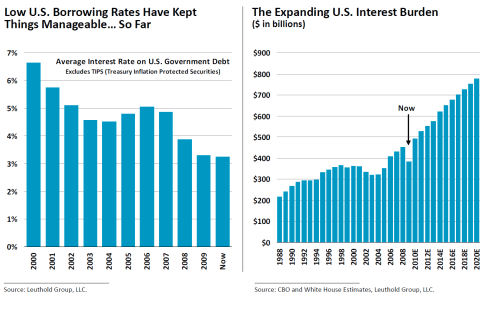
Figure 1
Into the Muck
- The United States economy cannot grow at a sufficiently rapid rate to sustain these levels of debt, in large part because this debt itself suppresses growth.
- The projected cost of servicing the federal debt is grossly understated because it is based on current interest rates, which are unsustainably low. Higher interest rates are inevitable barring an economic collapse and will add trillions of dollars of additional payment obligations that will consume much of the projected savings from any debt reduction measures. Reality dictates that the increase in the cost of servicing the debt will be exponential, not linear. President Obama’s 2010 budget (most of which nobody took seriously, with good reason) projected that interest payments on the national debt will be $900 billion in 2020, but that was based on a debt burden of $20 trillion in that year and doesn’t include the GSE’s (although it did assume higher interest rates). A sustained period of higher interest rates could render the U.S. fiscal position completely untenable.
- The United States will likely reach its “Keynesian end-point” no later than 2020. That is the point at which total revenues are equal to the combined cost of entitlements and debt service. Japan is just now reaching that point, with repercussions yet to be felt by the global economy (more on that below).
- The tried and true method of solving this type of problem is a combination of inflation and currency devaluation. But matters are not that simple. As noted above, both of these phenomena will lead to higher interest rates that will further increase the cost of servicing a still-rising debt burden. Anything less than a comprehensive economic plan that addresses not only the budget deficit but the underlying industrial, education, energy, tax and regulatory policies that have contributed to this crisis will leave us chasing our tails.
Europe
The economic situation in Europe is so bleak that it almost makes the U.S. look good in comparison. Sometimes it seems like the leaders of the two regions are competing to do the most damage to their own and the global economies.
- The European Union is unsustainable in its present form. A significant portion of the union is functionally insolvent.
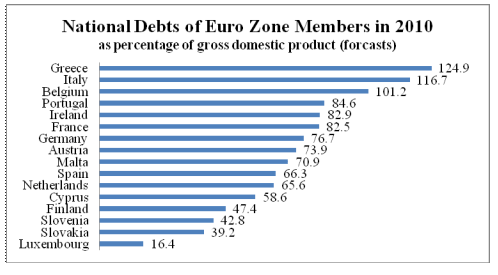
- The Greek bailout will fail and the country’s default will unfold in stages that hand debt holders significant losses. The plan’s assumption that holders will only lose 21 percent of the value of their holdings is laughable (losses will be closer to 80 percent). Refusing to take the pain now will only make the subsequent pain worse.
Figure 2
Bankrupt Europe
- Ireland and Portugal are in the same boat as Greece and will also default and hand debt holders significant losses. On July 29, Moody’s placed Spain on review for possible downgrade (currently Aa2) and six regions were simply downgraded immediately. The country’s five biggest banks were also placed on review for downgrade. This would be the second downgrade of Spain this year. Spanish 10-year yields broke through 6 percent after this news (hitting 6.14 percent), with Italy not far behind at 5.87 percent. These borrowing levels make it impossible for either country to finance itself in the public markets.
- Europe overall and especially Europe’s southern flank is incapable of generating sufficient economic growth to sustain the debt levels of the European Central Bank or the individual countries (with the exception of Germany). This is not only due to excessive levels of debt in the system as in the United States, but compounded by inflexible labor laws and flawed tax regimes.
- Europe’s banking system is in many respects a ward of the state. Many banks, especially those in the South and the U.K., are functionally insolvent. Europe’s banks are grossly undercapitalized and buried in bad assets. Not only is this impeding lending and economic growth, but it leaves the system vulnerable to complete collapse in the event of a financial accident.
- The European Central Bank only holds 3 percent equity against its massive holdings of sovereign debt. And with each successive “bailout” it increases its leverage.
- The European Union is being held together by spit and rubber bands. Countries like Greece that cannot compete globally under the European currency regime must be released to reinstate their own currencies, devalue those currencies, and rebuild their economies. This is the path Iceland took and thus far it looks like it is working. Otherwise Greece, Portugal and Ireland will be joined by Spain, Italy and Belgium and drag the entire union into insolvency.6 Sooner or later the union will have to amputate its diseased limbs in order to survive.
Asia
- China will continue to be the major engine of global economic growth. But it is in a tightening cycle and is unlikely to increase its growth to compensate for slowing growth in other regions. As such, investors will study every piece of Chinese data like Talmudic scholars. There are serious questions about the accuracy of this data although much of it can be confirmed by other sources. Nonetheless, China’s economy remains troublingly opaque and the West is taking a lot of data on faith. (As for those investors willing to fool around with Chinese IPOs, we’re glad to hear that someone has extra money lying around to throw out the window.)
- China will continue to use its massive surplus to purchase key strategic assets around the globe, increasing its power and influence at the expense of American hegemony. This is an enormous geopolitical occurrence, rivaled in importance only by the spread of Radical Islam in places like Turkey, that is extremely damaging to U.S. interests.
- China, like Europe and the United States, is overindebted; much of the debt is hidden on the balance sheets of its banks. By June 2011, China had a total of $8 trillion of debt according to Bloomberg (although net debt is lowered significantly by its massive cash reserves). In 2009, China embarked on a $2.7 trillion lending program in answer to the financial crisis. At year-end 2010, it had $1.7 trillion of loans to local governments for infrastructure projects. Much of this money was wasted (as TCS pointed out at the time). Standard Chartered Plc predicts that 40 percent of that debt will not be repaid from cash flow generated by the projects they are financing. We can only hope that matters don’t turn out worse than that.
- Chinese economic growth appears to be robust enough to sustain this debt burden longer than the U.S. and Europe can sustain theirs. China also suffers from a significant amount of social unrest that the government tries (with diminishing success) to hide from Western eyes. China’s fate will ultimately be determined by the ability of the government to manage the greatest economic shift in the history of mankind without a blow-up. From that perspective, skepticism is warranted.
- Japan, as noted above, is reaching its “Keynesian end-point.” It remains to be seen whether the country will be able to finance its national debt and deficits through domestic sources or whether it will have to borrow from external sources, which would likely increase interest rates. Japan is also facing the world’s most dramatic example of an aging population and all of the attendant social and economic problems. Japan will not be in a position to contribute to global economic growth for a long time. Moreover, Japan will do everything in its power to cheapen its currency against the dollar and Euro in order to support its export-driven economy.
- Credit-to-GDP ratios in Asia ex-Japan and China are approaching their 1997 peak of almost 100 percent, when Asia experienced its financial crisis. Of course, those economies are much larger and healthier than they were 14 years ago. Their growth, however, is much more dependent on China today than it was then. Moreover, a 100 percent credit-to-GDP ratio is nothing to write home about and is another reflection of the global economy’s love affair with debt. These economies can handle this much debt due to their high rates of growth, but they will not be immune from a U.S. and European slowdown. The real problem will occur, of course, if the Chinese growth miracle turns out to be something else.
To read the complete essay, you must subscribe to The Credit Strategist.
6. Our friend Christopher Wood’s view is that “when the market pressures put Frau Merkel on the spot, she will move in the direction of fiscal integration.” (GREED & fear, July 28, 2011) That may well be the case in the short-term, but if the call on Germany’s capital proves to be a black hole (as TCS suspects), neither Frau Merkel nor any other German leader will be able to sustain arguments for fiscal union. The black hole will only disappear if genuine haircuts are forced on holders of defaulting countries’ sovereign debt. Based on the Greek example, Europe has not yet demonstrated it is willing to take this course (and deal with the intense pain it will cause).
Read more articles by Michael Lewitt