Advisor Perspectives welcomes guest contributions. The views presented here do not necessarily represent those of Advisor Perspectives.
“While there's life, there's hope.” – Cicero
Introduction
We live in an alpha-centric world. Active investment managers – “alpha hunters” – seek to generate superior risk-adjusted returns, which many investors accept as synonymous with “alpha.”
It is not my intent to pile onto the extensive empirical literature about actual success or failure in the quest for alpha, but I will explain why alpha does not automatically result in superior risk-adjusted returns and is not a suitable performance metric, except for investors with an unlimited appetite for leverage.
While beta has been declared dead several times in the past, alpha is a survivor. My diagnosis is that alpha, however, is in very critical condition itself, even under the most optimistic interpretation. A more realistic assessment is that alpha is dead.
Defining alpha
The “alpha” measure of performance has been part of the established body of knowledge for several decades. It was developed and discussed in the 1960s as a means of assessing mutual fund performance with the tools of the then-newly-developed Modern Portfolio Theory.
Typically, alpha is calculated as the intercept in a linear regression of portfolio returns on an index. This regression is commonly known as the single-index-model:

rp stands for the excess portfolio return over the returns of a risk-free asset; rb is the index’s excess return; and ep is a noise term that is assumed to be normally distributed with an expected return of zero and a positive volatility. As in the standard linear regression model, the noise term is assumed to be uncorrelated with rb. βp is commonly referred to as a portfolio’s beta, which captures the sensitivity of portfolio returns relative to the index returns and determines the proportions of the portfolio’s systematic and unsystematic risk, relative to the index chosen.
Conceptually, alpha can be interpreted as a residual return: On average, it is the portfolio return component that is not explained by the exposure to the index.
The CAPM predicts that in financial market equilibrium, all asset alphas must be zero; equilibrium returns are fully determined by the economically relevant risk component, which is systematic risk. (The diversification of unsystematic risk is a free lunch.) In light of this, significant positive alpha values on portfolio level can be interpreted as excess returns over an efficient passive market arising from superior skill.
Alpha is not modeled directly, but derived from a “budget constraint” that requires all return components to sum up to the portfolio return. This has important implications; later on, I will discuss an extreme case in which alpha consists of model misspecifications only.
Alpha is not sufficient
In the latest edition of Essentials of Investments by Zvi Bodie, Alex Kane and Alan J. Marcus, an interesting addition has been made to the chapter on “Portfolio Performance Evaluation.” In the section “the Relation of Alpha to Performance Measures,” the authors explain why they do not present alpha as a performance measure, despite the fact that it is widely used by practitioners in performance evaluation.
The starting point of their argument is the single-index-model as presented above. Several algebraic manipulations result in the following expression:
This result is interesting for several reasons:
While we usually work with risk-adjusted performance measures as ordinal measures establishing a ranking order between different portfolios, the above expression explains the cardinal difference between two Sharpe ratios. It can be interpreted as a Sharpe ratio attribution, breaking down the difference between two Sharpe ratios into two effects:
- An active return component consisting of the portfolio’s risk-adjusted alpha, in the sense of alpha divided by total portfolio risk.
- An active risk component determined by the correlation of the portfolio with its benchmark. It can be shown that this correlation is a close relative of “tracking error,” which is probably the most commonly used risk measure in active investment management.
This Sharpe ratio attribution addresses a common problem in the analysis of risk-adjusted portfolio returns: not just to provide a yardstick for comparison purposes, but to explain differences in returns and therefore point to possible actions to improve performance.
Alpha alone does not determine which portfolio has a larger Sharpe ratio; the portfolio volatility and correlation also play a role. A positive alpha is not a sufficient condition for a managed portfolio to offer a higher Sharpe ratio than its benchmark. Therefore, a positive alpha is not a sufficient condition for superior risk-adjusted returns. In order for risk-adjusted returns to be “superior,” the following inequality needs to be fulfilled:
This inequality defines a lower bound for alpha. For example, given a benchmark Sharpe ratio of 0.5, correlation coefficient of 95% and portfolio volatility of 25%, we need an alpha larger than 0.25 * (1-0.95) * 0.5 = 0.5% in order for the portfolio to deliver superior risk-adjusted returns.
From the above inequality, we can also see that a positive alpha is a necessary condition for superior risk-adjusted returns. Since portfolio volatility and benchmark Sharpe ratios must be positive and correlation coefficients cannot exceed 1, alpha must be positive in order for the inequality to be satisfied.
Alpha is a misleading performance measure for investors who consider the total returns as well as total risks of their portfolios. Alpha is one particular return component; the value of alpha for an investor is portfolio-specific and cannot be assessed without the portfolio context. Further, the value of alpha is not absolute; it can only be assessed relative to a benchmark (for example, its Sharpe ratio). This echoes certain arguments brought forward by M. Barton Waring and Laurence B, Siegel in their attempt to demystify “absolute returns”.1
1. Warring/Siegel: “The Myth of the Absolute Return Investor”, Financial Analysts Journal, 2006
Leverage dependence
Leverage is a complex matter. In order to analyze the impact of leverage on performance measures, we can model leverage as a “return multiplier” which increases returns without increasing the amount of capital invested. Ignoring financing costs, we can state that leveraged returns rL are the product of unleveraged excess returns multiplied by a constant L, which is larger than one in the case of leveraged portfolios:
From the calculation rules for variances, it follows that the volatility of the leveraged portfolio must be:
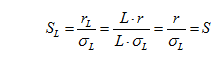
We see that leverage increases risk as well as return in a linear fashion. What is the Sharpe ratio of a leveraged portfolio?
The Sharpe ratio of the leveraged portfolio is equal to the Sharpe ratio of the unlevered portfolio, meaning Sharpe ratios are insensitive to leverage. What about alphas?
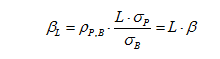
The beta of the leveraged portfolio is:
Therefore, the leveraged portfolio’s alpha must be:
While the leverage factor L cancels out in the case of the Sharpe ratio, leveraged alphas are directly proportional to L. Therefore, alpha is leverage-dependent.
The result that alphas scale with leverage is not really new. In fact, this property lies at the very heart of portfolio-construction techniques (portable alpha, alpha transfer) in the so-called absolute return industry.
But the leverage dependence of alpha creates a problem for ex-post performance analysis: When observing two funds with positive but different alphas, we cannot infer skill levels any more. The higher alpha might simply be the result of a financing decision (i.e. leverage) rather than superior skills.
If we postulate that “the higher a portfolio’s alpha, the more attractive the portfolio,” we assume that investors have a preference for leverage. In fact, a preference for positive alphas assumes that investors have an unlimited preference for leverage.
As higher leverage not only increases returns but also risk, this assumption contradicts the standard assumption about investor risk preferences, that the typical investor likes return and dislikes risk. More alpha due to more leverage is only preferable if we assume that investors have no objection to risk.
Alpha cannot distinguish skill from leverage. Therefore, alpha on a standalone basis is a misleading performance measure for risk-averse investors.
The residual return issue
As discussed above, alpha is a residual by construction. This is true for single-index models as well as their extensions to several indices or risk factors, the co-called multi-index models. If we introduce the possibility of specification errors, alpha will not only represent a return due to superior skills, but spurious returns due to specification errors. Possible specification errors are:
- Using the wrong factors.
- Violations of the assumptions underlying linear regression.
I will illustrate the first class of specification errors with an example. The second class is covered in detail in the statistical literature.
It has been shown in numerous studies that the explanatory power of multi-index models clearly exceeds that of single-index models. The most famous example is the Fama/French three-factor model compared to a CAPM-style single-factor model with a broad equity benchmark only.
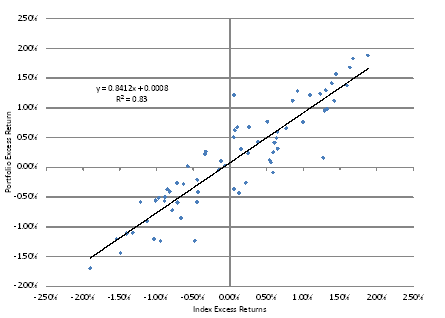
In the scatter plot below, I regressed a certain monthly portfolio excess return time series with a corresponding index excess return time series, assuming that the single-index model specification applies.
A casual performance analysis would probably draw a very positive conclusion: the fund delivers a monthly alpha of 0.08, which is an annualized alpha value of 0.94%. Both the portfolio and index figures are taken from typical fixed-income return time series, and most people would agree that an annualized alpha of almost 1% in a fixed-income portfolio is an excellent result. The result looks even better when considering the portfolio’s low systematic-risk exposure, i.e. its beta of 0.8412. The overall verdict would be that this is a “defensive portfolio delivering superior risk-adjusted returns,” truly a dream product for most investors.
Unfortunately, the rosy verdict breaks down when we add some information about the underlying return generation process of this portfolio: what we have done is mix a passive 90% fixed-income exposure with 10% equities. The entire reported alpha in the estimated single-index model is the result of a “hidden” equity beta. We see this immediately if we use the correct two-index model featuring the fixed-income benchmark and the equity benchmark used in the construction of the portfolio.
Multi-index models can be estimated easily in Microsoft Excel with the help of the built-in function LINEST(). The two Betas and Alpha are:
Fixed Income Beta Equity Beta Alpha
0.9 0.1 0.0000
Of course, the beta values are nothing other than the fixed income and equity weights in our constructed portfolio. The reported alpha value is zero. We see that the relevant model correctly identifies the beta exposures and the spurious alpha values caused by the specification error vanish.2
Unfortunately, it is current best practice in performance analysis to use single-index models in measuring alpha. It can be expected that a lot of alpha values measured are spurious results caused by hidden betas, not “superior skills in producing risk-adjusted returns.”
The process of identifying hidden betas and converting them into properly specified risk exposures is the most important task of an investment performance analyst. From this perspective, large alphas are indicators of ignorance that require further investigation. An alpha value of zero, on the other hand, means that returns can be fully explained in terms of risk exposures: Zero alphas are not superior risk-adjusted returns, but rather they are indicators of qualitatively superior returns that cannot be explained solely by risk exposure.
Conclusions
Essentials of Investments is not an academic publication produced for a highly specialized niche audience; it is the market-leading undergraduate investments textbook used to train the next generation of investment professionals all over the world. The message of the authors in the latest edition is clear: Alpha should not be used for performance evaluation purposes, because it does not necessarily result in superior risk-adjusted returns.
Additionally, alpha is leverage-dependent and therefore cannot distinguish between superior skills and return due to leverage. Rather, unrealistic investor risk preferences are required for alpha to be a relevant performance criterion in the light of this argument.
The current practice of using single-index models will produce spurious results because of specification errors. Better specifications will necessarily decrease reported alpha figures, but they will also increase investors’ qualitative understanding of the risk factors driving the returns their portfolios.
© 2011, Andreas Steiner Consulting GmbH. All rights reserved
Andreas Steiner offers independent consulting services related to investment performance and risk analysis (see here) and free educational materials related to investment performance and risk analysis (see here).
2. An Excel spreadsheet illustrating the use of LINEST() to estimate multi-factor models is available on request. Please contact us on [email protected]
Read more articles by Andreas Steiner