Advisor Perspectives welcomes guest contributions. The views presented here do not necessarily represent those of Advisor Perspectives.
The active-passive debate typically centers on the nature of the investment product – whether it is an actively managed fund or a passive index fund. This, however, is only one aspect of that debate, and to consider it alone represents too simplistic a view.
A broader issue, namely how a portfolio of actively or passively managed funds is managed over time, has a more profound impact on whether one is truly an active or passive investor.
For example, a high-turnover portfolio of index funds is more appropriately characterized as an actively managed portfolio of passive index funds. Very simply, it is an “active/passive” portfolio. By contrast, an investor or advisor who purchases index funds using a buy-and-hold approach has a “passive/passive” portfolio.
One can be an active manager of passive funds, or a passive manager of actively managed funds.
A die-hard index fund advocate may be “passive” at the instrument level and “active” at the portfolio management level. Conversely, an investor who invests in actively managed funds may be passive in their ongoing management. Viewed this way, it’s difficult to determine which investor is passive and which is active.
In fact, there are four primary combinations of active and passive, as shown in Figure 1.
Figure 1. The Active/Passive Grid
|
Passive Index
Funds |
Actively Managed
Funds |
Passive Portfolio Management |
Passive / Passive
Buy-and-hold using Index funds |
Passive / Active
Buy-and-hold using actively managed funds |
Active Portfolio Management |
Active / Passive
Active management of Index funds |
Active / Active
Active management of actively managed funds |
Note that the word “financial advisor” could be substituted in place of the word “investor” in each of the four active/passive scenarios – the framework applies just as well.
The distinction between the use of “active” portfolio ingredients and the “active” management of the portfolio ingredients is key. The value of “active” management at either level can only be determined by establishing a properly “passive” baseline portfolio for comparison.
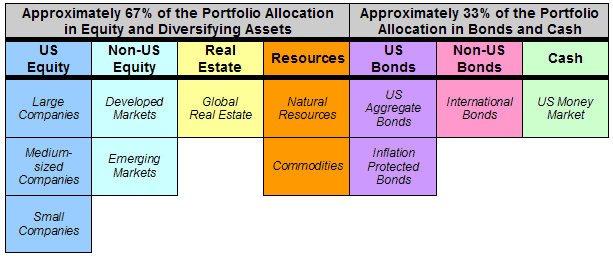
The baseline passive portfolio in this analysis is a multi-asset portfolio (as shown in Figure 2). This portfolio has approximately a 67%/33% ratio of equity and diversifying assets to bonds and cash. This is a classic ratio, but it is vastly more diversified than the typical 60/40 balanced fund.
The seven core asset classes in the baseline portfolio are US equity, non-US equity, real estate, resources, US bonds, non-US bonds, and cash. There are 12 underlying specific sub-assets. Each sub-asset is equally weighted, meaning that each mutual fund (or ETF) represents 1/12th of the portfolio, or an 8.33% allocation. This allocation is maintained by rebalancing the portfolio back to equal portions at the beginning of each year (representing passive portfolio management) or at the beginning of each month (representing active portfolio management). The sub-asset classes in the multi-asset portfolio can either employ actively managed funds or passively managed ETFs.
The 12 asset sub-categories were chosen because they represent a foundational level of diversification that includes traditional US and non-US equities across various market capitalizations, traditional and inflation-protected fixed income assets, and diversifying assets such as real estate, commodities, and natural resources. The overall correlation among these 12 asset classes is approximately 0.35, indicating a rich array of lightly correlated assets. For instance, the correlation between natural resources and commodities is 0.63. By comparison, the correlation between large-cap and mid-cap US equity is 0.90.
Diversifying assets (such as natural resources and commodities) often have low correlation between themselves as well as low correlations with the other “core” assets in the portfolio. The specific funds and ETFs used to model the 12 sub-asset classes are part of my proprietary 7Twelve methodology. (You can contact me for more information.)
If the multi-asset portfolio is built with actively managed funds and rebalanced monthly, it is an active/active portfolio. If built with passively managed index funds (or ETFs) and rebalanced monthly it represents an active/passive portfolio.
If the multi-asset portfolio is built with actively managed funds and rebalanced annually, it is a passive/active portfolio. If built with passively managed index funds (or ETFs) and rebalanced annually it represents a passive/passive portfolio.
Figure 2. Multi-Asset Portfolio

The 10-year performance as of December 31, 2009 for each of the four active-passive combinations is presented in Figure 3. A passive/active approach produced the best 10-year outcomes. In this approach, each of the 12 sub-asset classes in the multi-asset portfolio were actively managed mutual funds (chosen by this author). The funds were rebalanced back to 8.33% at the end of each year. The funds were not changed over the 10-year period. In other words, no “cherry picking” took place (a practice of inserting the best funds from the prior year into the portfolio). This passively managed portfolio of 12 active mutual funds generated an annualized return of 9.99%. By comparison, over this same 10-year period from, January 1, 2000 to December 31, 2009, the S&P 500 Index returned an annualized -1.03% (if using VFINX as an investable proxy for the S&P 500 Index).
An active/active portfolio was created by using the same 12 actively managed funds. This portfolio was rebalanced back to an 8.33% allocation per fund on a monthly basis. An active/active portfolio generated a 10-year annualized return of 9.51%. Active portfolio management (represented by rebalancing more frequently) did not add value. In fact, it hurt the 10-year performance by just under 50 bps. Understandably, active managers tend to have less style-box purity compared to index or exchange traded funds. As a result, the diversification purity achieved by using ETFs might be reduced when employing actively managed funds with a portfolio. But the same 12 actively managed funds were used in this analysis, which negates any style-drift bias in this particular study.
The active/passive portfolio, which consisted of 12 exchange-traded funds (which, almost by definition, are passive instruments) that were rebalanced back to 8.33% per ETF on a monthly basis, returned 7.52% over the 10-year period, considerably lower than the returns generated by a portfolio populated with actively managed funds.
Finally, a passive/passive portfolio that included the same 12 ETFs but rebalanced annually rather than monthly was put to the test. This approach generated a higher return than the active/passive approach by about 30 bps, but it still paled in comparison to a portfolio that was built with actively managed funds.
Figure 3. 10-Year Annualized Performance (2000-2009)
|
|
Passive Index Funds |
Actively Managed Funds |
Passive Portfolio Management
(Annual Portfolio Rebalancing) |
Passive / Passive
7.81 |
Passive / Active
9.99 |
Active Portfolio Management
(Monthly Portfolio Rebalancing) |
Active / Passive
7.52 |
Active / Active
9.51 |
When holding the portfolio management constant (that is, comparing from left to right), it is clear that during this particular 10-year period (notably, one of the worst in modern history as measured by the S&P 500 Index) it was advantageous to use actively managed funds rather than passive ETFs in this particular multi-asset portfolio. Both the passive/active portfolio and the active/active portfolio outperformed their passive-asset counterparts.
When holding portfolio ingredients constant (that is, comparing from top to bottom), it becomes clear that passive portfolio management produces slightly better performance than active portfolio management, in the range of 30-50 bps over this particular 10-year period. Of course, active portfolio management in this analysis is represented by frequency of rebalancing, which is more strategic than tactical. Measuring tactical active portfolio management (which involves at-the-moment decisions) is far more difficult, inasmuch as historical judgment and choices would have to be modeled.
The performance comparison, as well as standard deviation of return, among the four active/passive portfolio over three different time frames (3-year, 5-year, 10-year) appear in Table 1.
Table 1. Return and Risk
|
Passive/Passive |
Passive/Active |
Active/Passive |
Active/Active |
|
Buy-and-hold using Index funds
(Annual rebalancing)
|
Buy-and-hold using actively managed funds
(Annual rebalancing)
|
Active management of Index funds
(Monthly rebalancing)
|
Active management of actively managed funds
(Monthly rebalancing)
|
Annualized Return (%) |
3-Year
(2007-2009) |
1.58 |
2.66 |
1.02 |
1.66 |
5-Year
(2005-2009) |
6.31 |
7.33 |
5.93 |
6.66 |
10-Year
(2000-2009) |
7.81 |
9.99 |
7.52 |
9.51 |
Standard Deviation of Annual Returns (%) |
3-Year |
25.6 |
31.1 |
26.3 |
31.8 |
5-Year |
18.9 |
22.5 |
19.4 |
23.1 |
10-Year |
15.1 |
16.9 |
15.4 |
17.2 |
Conclusion
This is not a theoretical study. Rather, it represents the pragmatic decisions that investors and financial advisors must make. Do they fill their portfolio with actively or passively managed funds? And how should they manage the portfolio over time – actively or passively?
These results indicate that actively managed funds have the potential to outperform passively managed funds. Having said that, assembling a multi-asset portfolio of passively managed funds or exchange traded funds still represents an excellent starting point for an investment portfolio. However, actively managing the portfolio tends to detract from performance, no matter the portfolio’s contents
Passive management of a portfolio of actively managed mutual funds produced the best performance over the specific 10-year period of this study (2000-2009). Clearly, the results of this study are affected by the 12 actively managed funds that were used. Therein lies the challenge of comparing active funds to passive funds – doing so requires decisions about which active funds to select. This is precisely why analyses of “active vs. passive” funds are imperfect from the start.
This study is not exempt from that imperfection, but it illustrates clearly the impact of active vs. passive portfolio management. Its results suggest that a more passive approach (that is, rebalancing a multi-asset portfolio less often) can yield better results.
Craig L. Israelsen, Ph.D., is an associate professor at Brigham Young University. He is the designer of the 7Twelve Portfolio (www.7TwelvePortfolio.com) and author of the forthcoming book “7Twelve: A Diversified Investment Portfolio with a Plan” by John Wiley & Sons. His is the co-author of “Your Nest Egg Game Plan” with Phil Fragasso.
Read more articles by Craig L. Israelsen, Ph.D.