Advisor Perspectives welcomes guest contributions. The views presented here do not necessarily represent those of Advisor Perspectives.
In absolute terms, the past decade was the worst in modern stock market history, with two substantial bear markets (2000-2002, and 2007-2009) and the S&P 500 Index returning a cumulative -9.1%. No wonder the Wall Street Journal’s David Weidner called it the “Lost Decade of Stock Investing.”
Pundits have taken advantage of these dismal returns to challenge long-held investing principles. In February, Bank Investment Consultant writer Joan Warner declared that the “classical approach to asset management has let an entire generation down.” And she’s not alone. In a Barron’s article written a year ago, author Mike Hogan asserted that “markets are likely to be too erratic in the future to rely only on nicely structured portfolios and economic growth.”
Did the last ten years really demolish the foundations of Modern Portfolio Theory and classic investing principles? How did portfolios that stuck to the principles of effective diversification and buy-and-hold investing actually perform during the so-called “Lost Decade?”
A negative return for U.S. equities is a historically rare event. Between January 1926 and December 2009, fully 95 percent of the possible rolling ten-year investment windows delivered positive returns. Only five percent of the time would money invested for a ten-year period fail to produce gains.
In addition, once you look beyond U.S. large-cap equities and the recent gloom and doom on Wall Street, conditions really weren’t too bad for stock investing. As the chart below shows, most equity asset classes generated positive returns over the course of the decade, despite lost ground in the S&P 500 Index and a cumulative decline of 33.4 percent among U.S. large growth stocks (as measured by the Russell 1000 Growth Index).
U.S. Value, U.S. Small, International Value, and International Small equity asset classes all delivered a positive return for the decade. And REITs and Emerging Markets generated quite appealing returns. 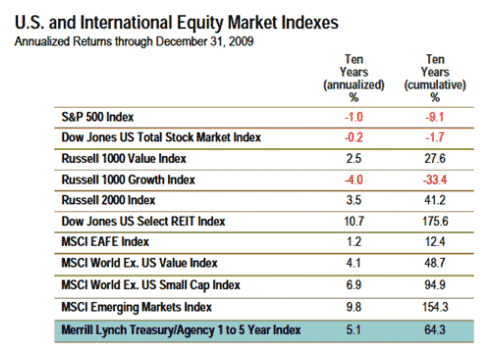
Data Sources: S&P 500 Index data are provided by Standard & Poor’s Index Services Group, Russell Index data provided by The Russell Company, www.russell.com; MSCI Index data provided by Morgan Stanley Capital International Group Inc. www.mscibarra.com (January 2010). Indexes are unmanaged baskets of securities in which investors cannot directly invest. Actual investment results may vary. All investments involve risk, including loss of principal. Past performance is not indicative of future results. Foreign securities involve additional risks, including foreign currency changes, political risks, foreign taxes, and different methods of accounting and financial reporting.