Asset Allocation Summary
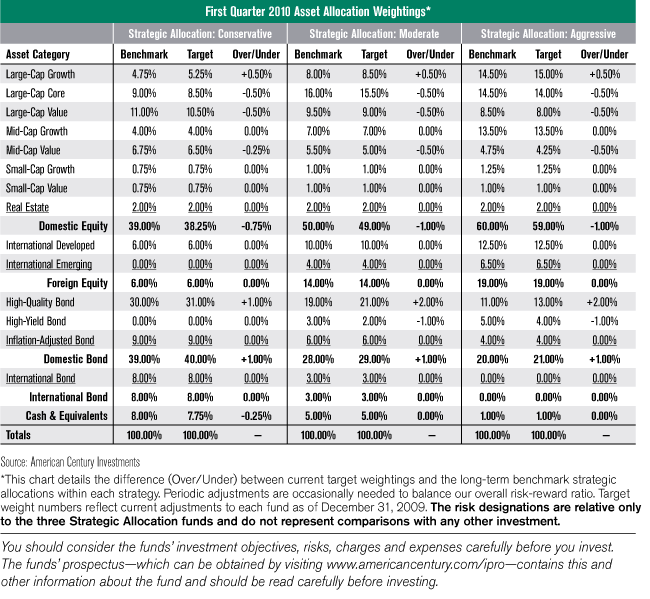
We have made several changes to our asset allocation weights since the last quarter (fourth quarter 2009). The most important of these is the inclusion of three new domestic equity positions in small-cap growth, small-cap value and real estate (such as real estate investment trusts or REITs). Strategic Allocation: Aggressive received the highest collective weightings to these positions (4.25%) while Strategic Allocation: Moderate received a collective weight of 4% and Strategic Allocation: Conservative received a 3.5% weight. In all cases, the current target
Weekly Market Update
From our Investment Managers
Click Here
weights are neutral, meaning they match the long-term benchmark.
The addition of the two small cap strategies and real estate opens up new sources of return while helping to broaden our asset
coverage and diversification (i.e. helping to reduce total portfolio volatility) at a time when we believe that the economic outlook is uncertain in terms of which sectors will fare better or worse.
 Click here or call 800-345-6488 for more information on products and services available to you The split of the small-cap strategies between growth and value was made to provide flexibility to tactically weight between these two styles at the small cap level.
In order to accommodate the allocation to these new domestic equity positions, we trimmed our target exposure and long-term benchmark weights for both mid-cap growth and mid-cap value. However, our overall target weightings to domestic equity for all three Strategic Allocation portfolios have increased slightly since the last quarter, consistent with expectations of a continued economic recovery going into the New Year. In addition, our overall target weightings to all equity (domestic, international developed, and international emerging) increased by 1% for Strategic Allocation: Moderate and Aggressive while remaining unchanged since last quarter for Strategic Allocation: Conservative. Tactical overweights to large-cap growth stocks and high-quality bonds (domestic and international) have also remained in place or increased slightly since the last quarter.
The other important change we’ve made since the last quarter is to convert what had been a tactical (e.g. shorter-term) weighting and position in international bonds for both the Strategic Allocation: Conservative and Moderate portfolios into a longer-term (strategic) position with higher weights. Our exposure to international bonds in the Strategic Allocation: Conservative portfolio increased from a 3% tactical weight (0% benchmark) to an 8% weight and benchmark. For Strategic Allocation: Moderate, a tactical weight of 2% was increased to 3% (strategic weight in the portfolio and benchmark). Strategic Allocation: Aggressive continues to have no exposure to international bonds. We continue to believe that international bonds can be an important hedge on further weakening in the U.S. dollar due to the massive government deficits and debt forecast for the U.S.
Strong Medicine for a Sick Economy
In retrospect, the U.S. and global economy suffered a fairly major “heart attack” with the last year’s financial crisis and meltdown. And to continue this analogy, it took two massive doses of adrenalin to resuscitate the economy. The first dose consisted of monetary policy in the forms of both drastic cuts in short-term interest rates along with quantitative easing—a complex phrase for saying that the Federal Reserve (the Fed) got into the business of buying debt securities like mortgage-backed assets and Treasuries to inject liquidity into the system. The second dose consisted of fiscal policy in the form of unprecedented government deficits. For the government fiscal year ending Sept. 30, 2009, the federal deficit was approximately $1.2 trillion, nearly five times higher than it had ever been before.
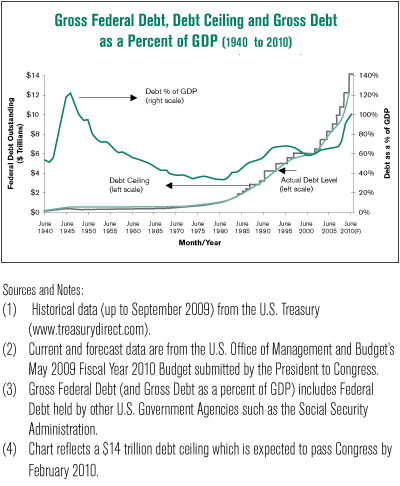
And initial projections for the first three months of the 2010 federal budget indicate we are on track to exceed that record in the coming year. Current projections call for the gross federal debt to approach $14 trillion by the late next year. As the chart on the following page illustrates, we are seeing a major increase in the absolute amount of gross debt outstanding (as illustrated by the level of debt and the debt ceiling) and also on a relative basis where gross federal debt outstanding as a percent of gross domestic product (GDP1) is approaching levels not seen since World War II.
While the economy had responded to these shots of adrenalin, the longer-term concern is that this level of government stimulus can’t continue indefinitely. Some programs have been temporarily extended, especially with regard to unemployment benefits. Congress is currently debating whether to pass a second stimulus program aimed at bringing down the current high unemployment. But the key question is, “What kind of economic recovery will we have once many of these temporary stimulus programs end?” It is somewhat enlightening to see how the third quarter 2009 GDP growth was revised downward over the course of last autumn. What began as a 3.5% growth rate (initial estimate) was later adjusted to 2.8% and finally revised to a 2.2% figure in part because of overestimations of how quickly companies were rebuilding inventories.
Debt and Danger
To go back to the heart attack analogy, what led to this occurring was a global economy choked on debt. In fact, you might think of this excessive debt as cholesterol. Continued high levels of debt are a major headwind the global economy continues to face as it works to recover. The problem with our current situation is that most of this debt is still outstanding—in households, in governments, and even in some businesses.
The minor crisis caused in December by the inability of Dubai World to service its massive debts, especially when regional governments refused to back their creditor claims, is one example of how leverage remains exceptionally high in some parts of the global economy. Dubai was a very small event in terms of the amount of debt involved relative to the size of the global capital markets. However, the response of these markets reveals that concerns about credit quality remain a primary focus. And as the chart below illustrates, since 1945, we have not seen such a degree of change in U.S. consumer debt outstanding as we have since the start of this decade.
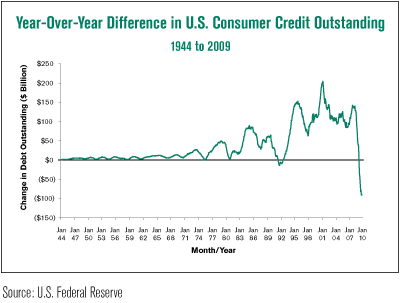
These profound changes in consumer debt, especially the huge decline since the beginnings of the current recession and credit crisis, reflect financial institutions’ continued credit tightening and hesitancy to extend new loans. This is not a good sign for consumer spending or investment by small businesses and reflects the continued fragility of the U.S. banking system.
Legislative Initiatives and Job Creation
The current legislative policies by the Obama administration in this economic environment are akin to placing one foot on the accelerator of the economy and the other on the brake. There has been and continues to be massive economic stimulus—both monetary and fiscal. Some of that monetary stimulus—in the form of TARP (Troubled Asset Relief Program) funding—is now being targeted for a major jobs creation program. And as noted earlier, a second economic stimulus bill is currently being debated by Congress.
But on the other side of the coin, many of the tax and policy initiatives being pursued by the Obama administration represent large potential burdens on investors, businesses, and consumers. Such initiatives include programs to reduce carbon dioxide emissions, national health care, the Department of Labor proposals to changes in rules to facilitate union organizing, and even the Environmental Protection Agency (EPA) announcing that carbon dioxide will be dealt with as a pollutant.
The result of these policy initiatives, even in light of massive economic stimulus, creates a great deal of uncertainty regarding future business expenses and labor costs. The greatest uncertainty is borne by small business owners where the hiring of even a small number of new workers is a major investment and change in their cost structure. Small businesses have proven to be a primary generator of new jobs over the past several decades. And while some of the TARP funds are now being proposed to stimulate hiring workers—using mechanisms such as temporary tax incentives—these are also temporary in nature.
Any jobs program will have a temporary benefit of getting people back to work. The question is (as we saw with Cash for Clunkers earlier this year) whether this can be maintained and supported once the stimulus program ends.
Inflation or Deflation?
There currently appears to be both the risk of inflation and deflation on the horizon. Much of this has to do with concerns regarding continued high levels of indebtedness among consumer and households. The problem is even worse in Japan or Russia where you see high levels of debt combined with shrinking populations. One of the effects of the huge injections of liquidity by central banks worldwide into the financial markets is that there is a lot of money looking for a home. We see the effects of this in some commodity prices. The price of lumber futures has risen substantially for much of 2009 while housing starts (a key use of lumber) are near an all-time low.
Additionally, emerging markets are up dramatically this year. Some of this reflects their basis as primary suppliers of resources and commodities. There is also the impact of a weakening U.S. dollar, causing investors to seek returns in markets poised to strengthen relative to the dollar. And finally, these markets have much higher long-term growth potential than the U.S, Japan, or Europe.
Outlook
I expect the U.S. Fed to maintain a low interest rate policy for the short and medium term. Inflation is not an immediate risk. The economy is still weak and even the consumer sector remains anemic. Results from the Black Friday weekend holiday sales this year were at best flat relative to 2008, which was a very weak year. And unemployment remains very high by historical standards. With the U.S. government running massive budget deficits, it appears the only practical and politically palatable way our growing national debt will be reduced is by running and accepting higher than desired levels of inflation for an extended period.
1: Gross Domestic Product or GDP is a measure of the aggregate output of goods and services by our national economy.
A WORD ABOUT RISK
The funds’ performance depends on the investment managers’ skill in determining the strategic asset class allocations, the mix of underlying American Century Investments funds, as well as the performance of those underlying funds. The underlying performance may be lower than the performance of the asset class they were selected to represent. Stocks and bonds can decline due to adverse issuer, market, regulatory, or economic developments. International markets may be less liquid and can be more volatile than U.S. markets. These risk factors, including those associated with currency exchange rates, also apply to investments in international markets, all of which make international markets more volatile and less liquid than investments in domestic markets. Some of the underlying funds can invest in either high-yield securities or small/emerging growth companies. Investments in these types of securities generally are subject to greater volatility than either higher grade securities or more established companies, respectively. Before making an investment in any fund, you should consider all the risks associated with it.
Scott Wittman, CFA, Senior Vice President and Senior Portfolio Manager, is the senior investment officer assigned to American Century Investments Strategic Allocation Funds (Conservative, Moderate, and Aggressive). The risk designations are relative only to the three Strategic Allocation Funds and do not represent comparisons with any other investment. The three diversified portfolios invest in varying levels of stocks, bonds, and cash and account for over $2.9 billion (as of December 31, 2009) in assets.
The opinions expressed are those of the contributors from the portfolio investment team. The opinions are no guarantee of the future performance of any American Century Investments portfolio. Material presented has been derived from industry sources considered to be reliable, but their accuracy and completeness cannot be guaranteed.
You should consider the funds’ investment objectives, risks, charges and expenses carefully before you invest. The funds’ prospectus, which can be obtained by calling 1-800-345-6488 or by visiting www.americancentury.com/ipro, contains this and other information about the fund and should be read carefully before investing.
P.O. Box 419385
Kansas City, MO 64141-6385
1-800-345-6488
www.americancentury.com/ipro
American Century Investment Services, Inc., Distributor
©2010 American Century Proprietary Holdings Inc. All rights reserved.
IN-FLY-67511 1001
Non-FDIC Insured • May Lose Value • No Bank Guarantee