Advisors understand their competitive position in their own market, but many have a hard time translating this knowledge into crisp marketing that differentiates them. While business development is a big challenge for many firms, the old adage “failing to plan is planning to fail” is reality for wealth managers. Those who do focus on sales planning and execution are much more successful at growing their businesses than those who do not. Referral-based selling is still the #1 way to build an advisory business, while advisors all but ignore the use of social networking and media for marketing and selling – a field of rapid growth in other industries.
Many investment advisory and wealth management firms have struggled to increase assets in the recent difficult markets. In order to understand how advisors feel they are faring – and the keys, and obstacles, to success – we partnered with Advisor Perspectives to survey advisors on the state of their business-building efforts. After working directly with advisors to help them grow their businesses for over the last 15 years, we’ve identified seven factors crucial to consistent and ongoing growth. The 7 Steps to Business Building, as we call them, are:
- Defining your firm’s goals and what you consider success (written business plans)
- Marketing that differentiates the firm in a crowded wealth management market
- Defining and executing a new business development plan (and having the right people to do this)
- Having and implementing a centers-of-influence (COI) strategy
- Ensuring that client referrals are coming from every possible channel
- Effectively using public relations – becoming the obvious expert the press turns to for comments or explanations
- Communicating with individual clients as frequently as each requires (and in the proper medium)
Our survey consisted of questions focused on advisor firm “health” in these seven areas. Responses came from 354 advisors representing approximately 335 firms (several responses came from different offices of large wirehouses). The breakdown was as follows:
| Firm-type |
|
Fee-only firm description |
|
|
Fee-only advisory |
39% |
Wealth management |
37% |
| Independent rep |
29% |
Investment advisory |
30% |
| Other |
14% |
Financial planning |
19% |
| Wirehouse/brokerage |
13% |
Other |
14% |
| Bank brokerage/trust |
6% |
|
|
The responding firms have assets managed, number of clients and full-time personnel as follows:
|
Assets Managed
($ millions) |
Clients |
Personnel |
| Median |
$ 60 |
154 |
5 |
| Average |
$ 228 |
501 |
56 |
Wirehouses and firms with AUM greater than $2.5 billion excluded
Using the seven factors or “steps” as a guide, how do advisors feel they are doing? Some of the highlights follow:
1. Defining success and goals
Over 71% of respondents have defined their firm’s mission and values in writing. When asked how well they knew their firm’s strengths, opportunities, weaknesses and threats (SWOT) for their marketplace, 73% said “excellently” or “very well” while 27% said “somewhat” or “not at all.”
2. Marketing – standing out in a crowded market
While most advisors (68%) believe they have a clear and easily articulated story (benefits of working with you, differentiators, etc.), the survey indicates they are not expressing it clearly in their marketing. When asked “To what degree does your marketing material tell your story and help you in selling?” only 36% said “excellently” or “very well” while 64% said “somewhat” or “not at all”.
When asked about “obstacles to obtaining new business,” 20% of the 85 respondents who commented cited marketing-related issues. Many respondents indicated that they were “working on” having a clear and easily articulated story, but this seems to be problematic for many firms. Equally interesting were comments that do not specifically mention marketing but cite obstacles that, from our experience, could be mitigated by marketing communication or tactics. These include:
- “Increased competition”
- “Lack of consistent prospect-generating strategy”
- “While we often discuss how to penetrate our target markets, we struggle with the execution of our ideas.”
- “Current economic environment has made it more difficult to attract new investors”
- “Perceptions of structured products given impact of CDO and sub-prime market collapse”
- “Issues of ‘new’ advisor and principal protected product”
- “Fear, causing paralysis [by prospects/clients]”
- “Few people outside the industry know what a multi-family office is or does”
- “Lack of knowledge by the public regarding what different types of financial practitioners actually provide”
One respondent’s comment is a truism that seemed to sum up all the comments: “Marketing is difficult and expensive.”
The role of Social Media
There’s a lot of buzz about online networking and communication tools’ (blogging, LinkedIn, Facebook, Twitter, etc.) ability to help advisory businesses enhance brand awareness and sales, but most wealth managers still are not buying it: 58% don’t use social media at all in marketing or client communication. Among those who do, 18% use LinkedIn and just 5% use Facebook. Most comments centered on compliance concerns or the lack of value relative to face-to-face and other communication means.
3. New business development
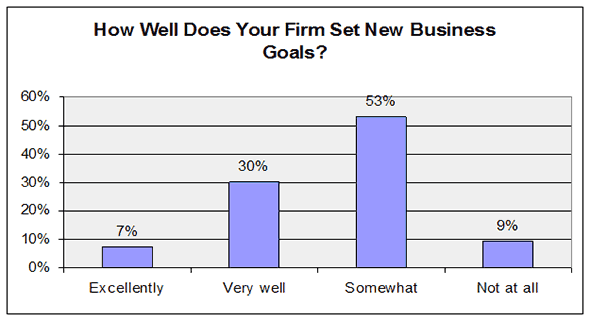
When it comes to generating new business – specifically sales planning and execution – respondents rated their firms much lower than the quality of their marketing. Only 37% feel their firm sets and executes new business goals excellently or very well while 62% feel they do an average or poor job at this. The most-often cited obstacle to new business was “poor marketing,” followed by “lack of sales process and tools” and “no clear plan.” We solicited comments, and many of them cited problems with a lack of firm or sales leadership, a lack of time and resources to focus on sales, and poor sales skills.
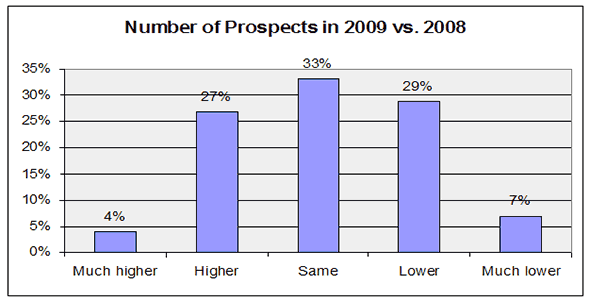
We asked “How many new prospects have you had in 2009?” The average was 34 and the median was 11. Comparing this year to last, 31% of respondents are seeing higher or much higher numbers, while 36% are seeing lower or much lower.

While this “normal” distribution could be expected, the results are more interesting when we delve deeper. Our experience shows that the most successful advisors write and stick to a business development plan, have processes and systems to fully track efforts, and are more assertive sellers.
How important is it to set business development goals and have written plans? Seemingly, very. In addition to asking about new business development goals we asked how the number of good prospects compared between 2009 and 2008. Only 37% satisfactorily set new business goals, and just 35% have written business development plans. On every measure, those answering “excellently” or “very well” to the setting of goals, “yes” to written plans and “much higher” or “higher” in new prospects reported more satisfaction with business growth. This higher satisfaction includes confidence that their marketing communications were performing well, they are happier with client and COI referrals and rate the overall business-building culture of their firm much higher than those respondents who rated themselves much lower on these questions.
Who is doing the business development?
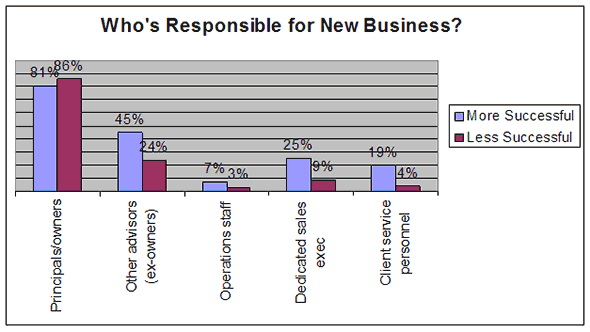
Principals or owners were the primary salespeople for 56% of respondent firms, with other advisors (non-owners) the second-most common (21%). Many fewer firms employed dedicated sales staffs – just 10%. This mirrors our experience in working with advisors – many depend heavily on firm founders/owners to capture new business. But this often comes at the expense of stronger business growth – these principals simply lack enough hours in the day to “do it all.” We have found that the most successful advisors do not wholly depend on firm owners/founders to do the selling. The survey data support our experience, as the most successful firms (based on metrics such as the number of new prospects in the past year) are using principals/owners almost as much as less successful firms, but they are making higher use of a broad array of personnel to win new business – especially other advisors (non-owners/principals) and dedicated sales people.
4. COI Strategy and Implementation
While only 19% say that COI referrals are the best way their firm has found to bring in new business (a distant second to “clients” at 68%), virtually all respondents have either formal or informal relationships with COIs for this purpose. CPAs nose out lawyers 40% to 38% as the #1 COI source. The best way advisors have found to get new business from COIs is simply to ask them. We then asked “Do you generate the expected referrals from COIs or strategic alliances?” a whopping 65% said “no.” This is not surprising, as the top chosen answer to “What is the biggest obstacle to bringing in new business through COI relationships?” was “Haven't determined a way to work with them!”
5. Gaining client referrals
No surprise here – most new business comes from client referrals (68%), followed by trusted advisors/COIs (19%). We asked what were the biggest obstacles to gaining prospect referrals (from any source). At 40%, “not asking for them – lack of tools or process” was first, followed by “Not asking for them – think it's ‘unseemly.’” Third was “Clients simply don't refer.”
6. Effective – and assertive – public relations
We were somewhat surprised to see how few firms use PR as a primary means of business building. Only 33% said they used PR for that purpose. When asked “How would you rate your relationships with the media in your area or in your targeted market?” only 26% said “excellent” or “good” while 47% said “satisfactory” and 28% said “bad.” Advisors who said they received positive PR were most likely to cite “Quoted in the news” (27%), “Sponsoring events” (16%) and “Writing articles in local/regional newspapers” (15%) as examples of their successes.
Does PR work as a business-building tool? The most successful advisors, as defined above, believe so – 54% use PR for this purpose while only 22% of the least successful group do. The successful group gave a 35% excellent/good rating to their relations with the media while just 19% of the least successful group did. Conversely, 12% of the successful group rated media relations “bad” while 35% of the least successful group did.
7. Client communication
Asked to comment on their clients preferred mode of communication, phone calls and in-person meetings were cited by the largest number of advisors. The next three most-cited methods cited were newsletters, email blasts and seminars/workshops.
People have different communication, and therefore learning, styles, which is why we counsel advisors to offer multiple forms of communication and not assume that “one size fits all.” Unfortunately, many comments indicated that advisors don’t know what clients prefer and haven’t asked.
Our experience shows that one of the most effective ways to communicate with clients is to survey them – and the more interactive, the better. Over 64% of advisors survey their clients, with 23% of all respondents using mailed surveys and 18% asking for feedback in meetings. We have found that clients are more open with an objective third-party, but only 4% of all advisors are using outside resources (via focus groups and phone) to interview them.
Conclusion
We were heartened to see that most firms are setting firm-wide goals and defining their missions, and that they believe they know their strengths, weaknesses, opportunities and threats (Step 1). Advisors are doing reasonably well in client communication (Step 7). Unfortunately, the results in Steps 2 through 6 mirror what we encounter with most advisors and wealth managers – that business development and marketing acumen are usually the worst-performing aspects of a firm’s operation. The data clearly show that the firms that develop their business most successfully are those that rigorously plan their sales and marketing efforts, set goals, diversify their “selling attack” by not depending on firm owners/founders, use technology to monitor efforts and stay visible in the marketplace.
A more detailed version of this report, including interpretation and recommendations for addressing the issues raised by survey respondents, will be available soon. Please go here for information on the research report and Advisors Trusted Advisor’s 7 Steps to Effective Business Building for Financial Advisors Program.
Read more articles by Michael Slemmer, CFA