Diversification Really Does Pay Off
Membership required
Membership is now required to use this feature. To learn more:
View Membership BenefitsThe last decade severely tested investors’ belief in the value of diversification and strategic asset allocation, leading some in the financial media to assert that diversification and asset allocation failed and were worthless during the crash of 2007-2008 (see, for example, here). Now is an ideal moment to look back and assess the carnage.
I use a test case to examine whether diversification and strategic asset allocation failed. By comparing the performance of diversified portfolios that I proposed well before the crisis to that of the S&P 500, I quantify the value of true diversification.
Diversification worked, even under the stressful conditions of the last two years. A diversified portfolio still lost money, but a retrospective analysis shows diversification had its expected impact on portfolio performance.
It has been four years since I wrote the article Tuning an ETF Portfolio Using Monte Carlo Simulation. I published a summary of this article on Seeking Alpha at that time. I took a well-diversified portfolio of ETFs and showed what a Monte Carlo model would suggest in the way of improvements. The starting portfolio of ETFs had been proposed by David Jackson, founder of Seeking Alpha, in an earlier analysis. The original ETF portfolio is shown below:

This portfolio has a lot to recommend it, with broad exposure across large, medium, and small market capitalization and substantial allocations to international developed and emerging markets. The portfolio spreads its 20% allocation to bonds across short-, medium-, and long-term maturities. There is also a 5% allocation to REITs. The expenses on this portfolio are quite low, too, thanks to the use of ETFs. Overall, most individual investors would be better off with this portfolio than whatever they have now (see here).
How could you do better than this portfolio? In December 2005, I analyzed this portfolio using Monte Carlo simulation (via Quantext Portfolio Planner, QPP) to see if I could alter the allocation to yield a portfolio that would have more expected return with less risk than this one.
To begin, it is useful to think about why such an idea might even make sense. The return and risk of a portfolio is largely determined by the expected return and risk of each component, and the correlations between them. A Monte Carlo simulation takes all of these factors as inputs and calculates a portfolio’s expected rate of return and risk level. By adjusting the components of the portfolio, we seek to exploit low correlations between asset classes in order to get the most return for the risks that we take.
A better ETF portfolio
When I modified the original portfolio using QPP, the model suggested that the following portfolio would be likely to generate more return, with less risk, than the original portfolio:
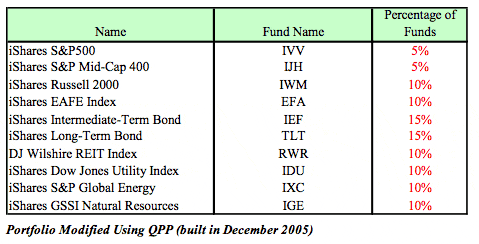
This portfolio is a fairly radical departure from the original asset allocation. The allocation to the S&P500 is dramatically smaller — down from 35% to 5%. Secondly, there are now substantial allocations to energy and utilities, as well as higher exposure to real estate (10% vs. 5% in the original portfolio). When this portfolio was designed, in December 2005, oil was trading at around $60 per barrel; this was well before the enormous run-up that took oil to $140 per barrel in July 2008. The new portfolio had far greater exposure to real assets than the original. In the spring of 2006, Ibbotson published an influential study – radical at the time – that supported the idea that a substantial allocation to commodities would increase the expected risk-adjusted return of standard asset allocations.
In my original article, I compared projected return and risk (as measured by standard deviation in return) for the original portfolio, the S&P500, and for my modified portfolio. The results from the original analysis are shown below:
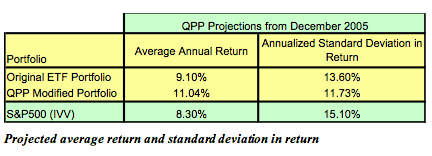
My Monte Carlo simulation projected an average annual return of 8.3% per year for the S&P500 – a long-term expectation, based on the equity risk premium. The original ETF portfolio was projected to have an expected return of 9.1% per year (0.8% more than the S&P500) as well as lower risk than the S&P500, although not radically lower. The baseline projected risk level from QPP for the S&P500 is 15.1% per year vs. 13.6% for the original ETF portfolio. The modified ETF portfolio was projected to have an average annual return of 11.04% per year (1.94% more in annual return than the original ETF portfolio) while also being less risky than its predecessor.
The modified portfolio allocated 30% to bonds vs. 20% in the original, but that higher exposure is entirely in medium- and long-term bonds which are considerably more risky than short-term bonds which make up the majority of the allocation to bonds in the original portfolio. The risk reduction due to a higher allocation to bonds is partly offset by the substantial allocation to energy, a volatile asset class.
In the four years since my original analysis was published, the modified ETF portfolio has indeed out-performed the original ETF portfolio and the S&P500:
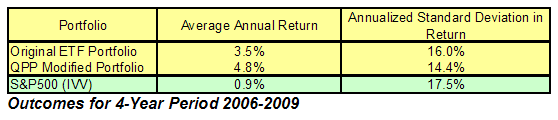
Both the original ETF portfolio and the modified ETF portfolio have soundly beaten the S&P500 in terms of increasing the average return and reducing the volatility of the portfolio relative to the S&P500. This should not be surprising. Unlike the S&P 500, both the original ETF portfolio and the modified ETF portfolio have allocations to bonds, and bonds out-performed stocks over this period.
Surprisingly, the modified portfolio generated both higher return and lower volatility than the original ETF portfolio, given that the new portfolio is very concentrated in energy and utilities and has twice the original’s allocation to REITs. Moreover, the modified portfolio has no allocation to emerging markets, which have been one of the few bright spots in terms of performance over the past four years.
For many investors, the improvement of 1.3% per year in average annual return and reduction of 1.6% per year in annualized volatility may not seem all that substantial, especially in the context of recent years’ huge market swings. When I run a basic Monte Carlo simulation for wealth accumulation over a 30-year period, however, missing out on 1.3% in return leads to a 35% reduction in wealth at the end of the period. This is generally consistent with analysis from the Department of Labor, which suggests that a 1% reduction in return per year leads to a 28% reduction in wealth accumulation over a working lifetime. The additional effect of lower volatility (which increases compounded return) reinforces the benefits of the more diversified portfolio.
Monte Carlo simulations can differ substantially between implementations, as discussed here. The adjustments to the portfolio from QPP may or may not agree with other models. A crucial element of effective Monte Carlo tools is parameters for expected risks and returns of various asset classes that are not simply equal to historical performance. It is well known that tuning portfolios with historical returns and risks invariably leads to bad outcomes, because you end up being massively overweight whatever asset class has out-performed in your historical sample.
The Intelligent Asset Allocator by Bill Bernstein provides a very nice study of this problem. QPP derives its parameters by combining recent history (three years is the standard) with long-term data on the relationship between risk and return in capital markets. An overview of the model is available here.
Reexamining the value of diversification
Let’s now circle back and examine the premise that asset allocation and diversification failed in the crash of 2007-2008. The first problem with this notion is that many investors simply do not understand the level of benefit that effective diversification is supposed to provide. In late 2005, I estimated that the original ETF portfolio (which many investors would have considered well diversified) was somewhat less risky than the S&P500, but not dramatically so. Even my tuned portfolio was hardly “low” risk. Diversification was expected to add on the order of 1-2% per year of return between the original ETF portfolio and the modified ETF portfolio, and it has done so over the past four years. In addition, the modified ETF portfolio has been somewhat less volatile than the original ETF portfolio. A key point, however, is that diversification was not expected to protect the portfolio from massive losses.
Portfolio theory suggests that effective diversification is perhaps the only ‘free lunch’ in investing. By combining asset classes effectively, you can add return and lower risk. Even over the past four years, during which the correlations between asset classes rose (thereby reducing the potential benefits), diversification has provided benefits that are remarkably close to what my Monte Carlo simulations projected four years ago.
Why does this point seem to be lost on the vast majority of investors? Would any investor reject a strategy that is likely to net them an additional 30% in wealth accumulation over their working lifetimes? Further, it is worth noting that the incremental 1.3% per year over the last four years is relative to the original ETF portfolio, which was quite well diversified already.
When I wrote an article last year that examined whether diversification had failed in 2008, I got a nice note from William Bernstein, the author of the classic text The Intelligent Asset Allocator (among others), on the analysis. Dr. Bernstein reviewed the analysis I presented here, and he was kind enough to offer the following thoughts:
Any portfolio that is light on the S&P500 and heavier on more exotic, less orthodox investments is fine by me!
The only problem I have with these portfolios is that they use bond ETFs. In a particularly bad state of the world, when you are going to be expending a large part of your "safe" assets for living expenditures and rebalancing, their liquidity, because of the problems that the Authorized Participant (AP) process has with bonds, is poor. (Take a look, for example, at how bond ETFs performed in late 2008 on a day-to-day basis compared to their underlying indexes). Far better to buy Treasury bonds, and then use a corporate bond ETF, rebalancing in more placid times.
Did Modern Portfolio Theory fail to anticipate the 2008 fat tail?
One additional theme comes up in critiques of portfolio theory that have emerged in the wake of the crisis. Did portfolio simulation models underestimate the probability of losses on the order of what we experienced in recent years?
Certainly the models put a very low probability on losses on the scale of what we saw in 2008, but this question is ill-posed. The correct question is simply whether the models captured the possibility of the events that occurred – we have no way of assessing whether the probability assigned to such an event was correct. In the 12-month period through the end of February 2009, the modified ETF portfolio lost 29% (its worst rolling 12-month return over the four years). The Monte Carlo projections from my original article suggest that a loss at or below -24% should will occur with a probability of 0.15% in a single year (a three standard deviation event). At what probability would we say that the model was ‘correct’? If the model had suggested that there was a 2% chance of this level of loss, would it have been correct?
Furthermore, the probability assigned to any given outcome from a model is determined by both the model (whether it is Gaussian or not, for example) and the input parameters. Perhaps the ‘ideal’ model would simply have a time-varying volatility as input, and the underlying probability of returns at any point in time is, in fact, Gaussian. Market declines on the scale of what we experienced are very rare – so rare, in fact, that it is difficult to even assess a meaningful historical probability. Even if, by some chance, someone came upon the ‘perfect’ model of extreme events, it would be impossible to demonstrate that they had done so.
We can certainly create new models with ‘fat tails’ that will put higher probabilities on extreme events, but how could we have any confidence that these are better representations of reality? The best approach to dealing with the risks associated with major market dislocations is to stress-test models to ensure that the truly worst cases are survivable (see here).
I am not suggesting that the modified ETF portfolio is an optimal portfolio going forward, or even that it was optimal back in late 2005. The goal of my original analysis was to tune an existing ETF portfolio, without venturing too far afield in terms of asset classes. Furthermore, a number of factors have changed over the past four years with implications for the range of core asset allocations. When I run the two ETF portfolios through QPP as of the end of December 2009, the model expects the modified ETF portfolio to provide about 0.7% per year more return than the original. There are many portfolios that are more attractive on a going-forward basis at a range of risk levels.
Quantext Portfolio Planner is a portfolio management tool. Extensive case studies, as well as access to a free extended trial, are available at http://www.quantext.com
Quantext is a strategic adviser to FOLIOfn, Inc. (www.foliofn.com), an innovative brokerage firm specializing in offering and trading portfolios for advisors and individual investors.
Membership required
Membership is now required to use this feature. To learn more:
View Membership BenefitsSponsored Content
Upcoming Virtual Events View All