A foundational principle of modern economics is that the creation of credit leads to economic growth. That precept underlies need for quantitative easing, and it is central to the question of what role monetary policy can and should play in stimulating a faster recovery from the Great Recession. It is also the subject of a debate between one of the world’s most prominent economic scholars, Paul Krugman, and a feisty Australian economist, Steve Keen.
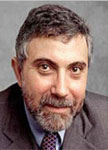
Krugman is an unusually public figure for an academic. The Nobel Prize-winner and Princeton professor is also a widely-read New York Times columnist and prolific blogger, with the gift – unusual for someone in so wonky a profession – of clear and persuasive prose. He has earned a large and passionate audience, among them both ardent acolytes and rabid detractors. Krugman represents the mainstream of neoclassical economics, which believes that a combination of central bank monetary policy and government fiscal policy can moderate the business cycle.
Among the dissidents is Keen, the author of a provocative book, Debunking Economics. By his own admission, Keen is proudly out of the mainstream, but also able (“because of impediments like academic tenure,” he says in his book) to challenge it without fatal retribution. Keen thinks central bank controls are not as effective as Krugman believes, because private banks can create money in the form of debt through a process that is beyond the central bank’s control. Because of that, the economy will regularly experience “financial instability,” as advocated by Keynes’s disciple Hyman Minsky.
The debate in the blogosphere between those in the Krugman camp and those in the Keen camp has generated more heat than light; but the core of the debate is whether or not private banks can create money “out of thin air” to their heart’s content, by extending credit – leaving the central bank with no choice but to sanction this money creation.
Keen has taken aim at Krugman, and about a month ago Krugman, welcoming the challenge (at least initially), responded to Keen several times on his blog, setting off a furor in the economics blogosphere that has reverberated well beyond it.
I reviewed the exchange between Keen and Krugman, as well as much of the voluminous blog traffic of commenters weighing in, often to support one side or the other. I also conducted a personal phone interview with Keen. (I contacted Krugman through The New York Times to ask for an interview but did not receive a response.) These efforts shed new light for me on this debate, which I share below.
The crisis in economics
Economics is in a state of ferment; I would like to be able to say it is like physics before Einstein, but economics is not remotely comparable to Newtonian physics, and no Einstein-esque economist is going to perfect it.
The critical state of economic theory has been exacerbated by the financial crisis, and numerous heterodoxies today bedevil the neoclassical mainstream – Post-Keynesianism, followers of Hyman Minsky, Modern Monetary Theory, Austrian economics, even Marxist economics. These alternative ideasets have been chronicled in The Economist, and a partial cast of characters has been mapped in The Washington Post. Most of the debate goes on in the blogosphere, which is particularly prolix on this subject. I have noticed that virtually all of the bloggers are economists – they may or may not be academics, but they generally have economics degrees.
The volume of internet chatter among professional economists is staggering. A friend of mine was once chairman of the Federal Reserve Bank of Kansas City. He is not an economist but a businessman. (No, my friend is not Herman Cain.) He told me that when he arrived in the position, he found that there were 170 economists who reported to him – and he didn’t have the foggiest idea what they were all doing with their time. Now that I’ve read so much of the blogging on this subject, I think I could tell him. They are all kibitzing about Fed policy, reading charts and data and constructing models.
The bloggers are trying to determine what central bank policy should be. Some of the new schools of economics believe central banks like the Federal Reserve can create all the money they want without negative consequences. Others believe central banks shouldn’t exist at all. Some schools believe that, instead of trying to fine-tune a balance between inflation and GDP growth, the Fed should just target a constant rate of nominal GDP growth, to effect a balance of inflation and GDP growth all in one bang. And others still, believe the central bank has little to say about it because booms and busts will occur whatever it does (this is closest to the locus of the Keen-Krugman debate.)
The core of the dispute
The central question in the Keen-Krugman interchange is whether banks can create money with complete freedom, or whether they are effectively constrained by the actions of the central bank. The question at issue is whether banks can “create credit out of thin air,” a notion that seems to have been first advocated by the economist Joseph Schumpeter. Keen and others of his faction say they can; Krugman says they can’t.
But there are really two aspects to the debate. The first is the general charge that all of neoclassical economic theory is bankrupt because it is enthralled with equilibrium, and therefore it cannot model or understand the dynamic evolutionary economic process. That is to say, the essential nature of the economy is to be in disequilibrium, so theories obsessed with equilibrium cannot model it.
This charge seems wholly valid to me. In answer to the mainstream’s deficiencies, Keen said in my interview with him, “I want to eliminate the neoclassical mainstream and replace it with a Schumpeterian dynamic growth evolutionary mainstream.”
Schumpeter, you’ll recall, was the economist who coined the term “creative destruction” to characterize the capitalist economic process – a term beloved by nearly all economists, but of which it is difficult to find any trace in mainstream economic models. Says Keen, “Creative destruction doesn’t involve equilibrium, so they leave it out completely. It’s about how investment comes in pulses and waves … so you get an inherent explanation for the cyclicality of capitalism out of Schumpeter.”
The second aspect is a chicken-and-egg problem: Do banks take in deposits and then lend, or do they loan first, then use the proceeds of the loan to create deposits? It is not merely a chicken-and-egg question – those, like Keen, who say banks can create money out of thin air also say that the central bank must condone, willy-nilly, this so-called “endogenous” money creation. Krugman, on the other hand, says the central bank can control the process. That is, he believes money is created only “exogenously” by the central bank. Keen is a disciple of Hyman Minsky, who was a disciple of John Maynard Keynes but also of Schumpeter. Minsky believed that this process of banks creating money, in the form of debt, would inevitably lead to frequent financial bubbles and crises.
Judging from how much feverish blogging there has been surrounding the Keen-Krugman battle alone, this is a thorny question to resolve one way or the other. The amazing thing is that, in this debate, one side or the other will present what appears to be a very simple proof that they are right – and yet the other side is not persuaded in the least.
What really bothers me about the debate
It is difficult for a non-economist to decipher the debates, which revolve around esoteric terminology known only to the disputants – like “aggregate demand” and even “money.” Most people certainly don’t know what economists mean by “money.” A friend of mine told me he was at a meeting recently with a number of people, most of whom thought that when the central bank increased the money supply it actually physically printed currency – and all the people at the meeting were financial advisors.
As I said, almost all of the debates are among economists, bandying about terms that are, in principle, quantified aggregates of manifestly intangible, imprecisely defined theoretical objects like “aggregate demand,” “economic growth,” and “money” (not just currency), none of which can be measured very accurately, even if they are defined. Then they make stepwise arguments involving causality from one aggregate to another, like “an increase in money increases aggregate demand.” These feel to me like either verbally constructed tautologies, or oversimplifications of a more complex process.
For example in one of the most enlightening blog entries that I found discussing the Krugman-Keen debate, written by a University of Massachusetts graduate student named Josh Mason, Mason actually tries – I say “tries;” I do not think he succeeded – to clarify what “aggregate demand” really means. Is the orthodox view that aggregate demand is the same thing as aggregate income? Not quite, Mason says: “The question, as always, is which way causality runs. The term ‘aggregate demand’ is shorthand for the argument that causality runs from aggregate expenditure to aggregate income, whereas pre-Keynesian orthodoxy held that causality ran strictly from income to expenditure.”
But surely causality doesn’t only run one way. This was George Soros’s insight in the concept he calls “reflexivity;” in Soros’s application, this means that the price implied by projected future earnings for an investment can also be a cause of those earnings. Causality runs both ways, complicating the relationship.
I am particularly baffled by these debates, because my background is in pure mathematics. Economics pretends to be mathematics, but it is not mathematics. There is a major difference. No mathematician uses a term in a formula, or a statement of a theorem, unless that term has first been defined with excruciating precision. Hence, there is no question of what the term means, let alone any debate that is carried on only because two disputants have different concepts of the meaning of their terms. As a result, a very simple proof of something will invariably persuade the other side. The cost of this, however, is that mathematics is strictly limited in what it can define and prove.
In economics, it is completely different. Terms are used in formulas without ever having been precisely defined. Economists may think they’ve defined them, but they should try reading some real mathematics to see what a precise definition truly is. The economists, I think, leave the work of definition to be inferred from the way the terms are used in the formulas. This, to me, is weird – but I suppose it could work, and it does work sometimes, but more often it leads to ridiculous debates that leave matters of real importance unexamined.
That seems to be the case in the Keen-Krugman faceoff. The most central terms – inflation and GDP – are so riddled with measurement problems that they are almost arbitrary fictions, a reality with which no one ever grapples. There is never so much as a nod to the fact that a large body of intelligent people believe that economic growth, by mathematical necessity, cannot continue forever, or even for long – yet efforts to define clearly enough what “economic growth” means in order to close the gap with this external (and sometimes internal) body of thought are rarely seen in debates among economists.
Understanding Minsky in common-sense terms
I think economics often becomes clearer if you disdain the abstractions and think in more ordinary terms.
The economist Randall Wray, a disciple of Minsky, makes things a little clearer by pointing out that Minsky said that anybody can create money out of thin air, by loaning to someone else. That at least gets us to stop thinking that we can only discuss aggregates of ill-defined monetary units mediated by institutions.
As an experiment, I tried thinking about it this way. Suppose there is a community in which some particularly well-respected person – let’s call her Ms. X – is not only held to have high credibility, but is also assumed to have a significant wealth, or access thereto.
Ms. X lends her credibility – not to say, sometimes, explicitly her credit – to numerous people in the community in whom she believes. Her honor and sense of responsibility are of such a high order that she tends to command these same qualities in others. Hence, her credibility and/or credit tend to rub off on, and to be extended to, anyone for whom she vouches – and she vouches for many people.
Hence, for example, an innovative writer of children’s books wishes to try creating a line of books using specialized expertise that can be provided by an arts and crafts supplier in the community. Ms. X recommends the book writer to the arts and crafts supplier, vouching that the book writer is someone whom Ms. X esteems and stands behind. The book writer asks the supplier to provide certain materials and expertise to facilitate her innovation.
These agreements or collaborations can be cemented through loan agreements, with Ms. X as countersigner or extender of credit, or merely through a tacit underlying presumption of Ms. X as guarantor, in cash or in kind. After all, aren’t all exchanges and collaborations some combination of extensions both of credit in strict monetary terms, as well as in the broader sense – the sense meaning trust or expectations of eventual compensatory treatment?
The point is that, with the general level of credit extended by Ms. X to many people, economic activity will no doubt increase. “Aggregate demand” will increase. “Money” will increase. These statements are true not because they are true in some quantitative sense, but because they are true qualitatively – the degree to which the economic activity, the aggregate demand, and even the “money” all increase could probably be measured, after a fashion, but it would be very approximate.
The source of all the confusion, in my view, is the idea that if you can’t measure something and model it mathematically, it has no meaning. There is too much mathematics used and expected in economics, and too much of it is of poor quality and distorts the ideas it is meant to undergird. Keen agrees. “If you’re actually aware of the limitations of mathematics, you say, ‘Well, this is a guide, but I could have missed something,’” he told me. “So there’s more modesty in a proper non-equilibrium dynamic modeling approach than you’ll ever get out of neoclassical equilibrium modeling.”
To go on with the Ms. X analogy, the economic growth that her spreading trust engenders is delicate. If she overextends – if she stands behind more people than she can actually back up, or if she has miscalculated the trustworthiness or credibility of some of her mentees – her own credibility – and through her, theirs – may suffer erosion. You can see how things could collapse quickly. This is, I believe, a simple version of the Minsky financial instability hypothesis.
This simple narrative confirms that creating “credit” in the broad sense – trust and confidence in your trading partners and collaborators – can help spawn economic activity, though it can also create a credit bubble that can break. But if the sole and entire purpose of this exercise were to get it put into formulas, you can see how you might lose a lot of the texture. Perhaps it’s possible, but if you do it too soon, and too imprecisely, you’ll create a Babel in which people fight over the formulas, instead of over what’s actually going on.
Michael Edesess is an accomplished mathematician and economist with experience in the investment, energy, environment and sustainable development fields. He is a Visiting Fellow at the Hong Kong Advanced Institute for Cross-Disciplinary Studies, as well as a partner and chief investment officer of Denver-based Fair Advisors. In 2007, he authored a book about the investment services industry titled The Big Investment Lie, published by Berrett-Koehler.
Read more articles by Michael Edesess