Advisor Perspectives welcomes guest contributions. The views presented here do not necessarily represent those of Advisor Perspectives.
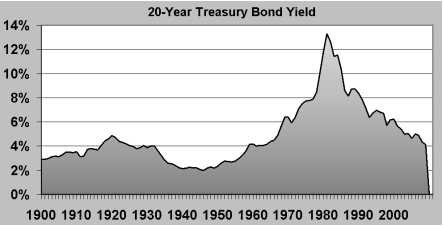
Thirty-one years ago, in 1981, the one-year Treasury reached its all time high of 14%. Today it hovers around 0.10%. Never before have interest rates fallen so far. Many economists and investment advisors, seeing nowhere to go but up, expect interest rates to climb from these historic lows. But that would not be the catastrophe that many bond investors fear.
The conventional belief is that an interest rate increase would harm bond investors. That fear is understandable. When interest rates go up, bond prices go down, and bond investors lose. From most investment industry professionals, the talk is not if but when. To pick one particularly egregious example, consider the alarm sounded recently by Investment News, under the ominous heading: “Disastrous Bond Rout Just Up the Road, Experts Warn” The article cautioned that “even a puny rise in interest rates will slam current holders of US debt” and said there was a ”high probability” of an “inflationary shock.”
In contrast to these shrill warnings, my research tells a different story.
Setting aside the conventional wisdom about bond prices and yields and stepping into the real world, with history as a guide, I find that diversified bond fund investors may profit long term, even in the face of rising interest rates.
Looking to history
To evaluate the outlook for bonds, I measured how bond mutual funds and indices performed when interest rates rose. This is not easy to do because few of us have experienced any prolonged rise of interest rates.

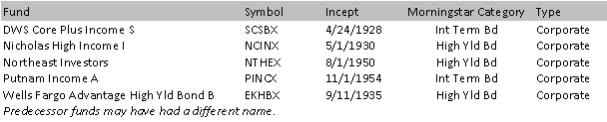
How did investors do during rising interest rates? There is little data. Of the 4,227 taxable bond funds today, only five had an inception date before 1960 (the relevant rising interest rate period). How did these five perform? This may surprise you. The five funds’ average annual return from 1963-1981, a 19-year period when interest rates rose more than threefold, was 4.15%.1. An equal-weighting of the only five taxable-bond funds available then and now, during those 19 years – the worst run-up in interest rate history – would have doubled.
One of the five funds lost money for the 19-year period; another made less than a 1% annual return. Nevertheless, these were all of the funds that were available that are live today.
What about survivorship bias? Since our investment assumption period reaches back almost 50 years, can we assume that there were other bond funds in which one could have invested that might have skewed these results? According to Blake, Elton, and Gruber there were as many as 46 taxable bond funds in 1979.2 (There were likely fewer than 46 that existed for the entire 1963-1981 period I tested.)
The number of bond funds grew dramatically during the 1980s, from 84 in 1978 to 914 in 1990.3 This should not be a surprise, given that interest rates peaked in 1981. By then, bonds became a very attractive investment option and fund managers seized the opportunity with the launch of more upon more bond funds.
So it is true that many bond funds have come and gone since the time period I studied, and many that existed in that era have since shuttered. Edwin Elton and Martin Gruber, however, have argued that “survivorship bias is less important for bond funds than it is for stock funds since bond fund performance is less variable…” A major bond fund study conducted by Elton, Gruber, and Christopher Blake in 1995 concluded that a reasonable survivorship factor for bond fund returns was 27 basis points per year.4 If our bond funds returns are discounted by the normative bond survivorship bias factor (or even by significantly more), the results do not change: Long-term aggregate bond fund returns were positive during steeply rising rates, even after adjusting for potential survivorship bias.
1.
Fund source: Morningstar Advisor Workstation. May 14, 2011 and corrected August 2, 2011Performance data source: Yahoo! Finance and Morningstar, Inc. (We could not find performance data for all five funds pre 1963.)
2. The Performance of Bond Mutual Funds, Christopher R. Blake, Edwin J. Elton and Martin J. Gruber, The Journal of Business, Vol. 66, No. 3, The University of Chicago Press, Jul., 1993 (http://www.jstor.org/stable/2353206), p. 373
3. Fundamental Economic Variables, Expected Returns, and Bond Fund Performance, Edwin J. Elton; Martin J. Gruber; Christopher R. Blake, The Journal of Finance, Vol. 50, No.4. (Sep., 1995), p. 1237
4. Fundamental Economic Variables, Expected Returns, and Bond Fund Performance, Edwin J. Elton; Martin J. Gruber; Christopher R. Blake, The Journal of Finance, Vol. 50, No.4. (Sep., 1995), pp. 1247-48.
Broader conclusions
These five funds were actively managed. What about indices? Can we build a generic case and filter out the benefits of active management from this analysis? After all, active management can outperform in difficult markets and underperform in good markets, as we saw most recently in 2011. According to SmartMoney on November 2, 2011, roughly 98% of intermediate government bond funds, intermediate-term bond funds, and multi-sector funds were lagging behind their benchmark indices to date. What’s more, unlike individual bonds, the durations of bond indices remain fairly constant over time.
There are very few fixed-income indices with a long-term track record. Elton and Gruber observed that they knew of only four fixed-income indices that existed from 1980-1992. The oldest of Barclay’s indices is the Capital US Aggregate Bonds Index. How did it fare? From its inception January 1, 1976, and for the following 10 years, when interest rates climbed by 300 basis points, this index did not have a single down year and produced an average annualized return of 10.49%, according to Morningstar. This statistic alone should bring comfort to diversified bond investors.
Further, in the 1963-1981 period discussed above, when interest rates tripled, 20-Year Treasury bonds offered a 1.28% annual return5 and 10-Year Treasury bonds returned 3.37% annually over the same period.6 The higher return for the shorter duration 10-Year Treasury bond is what we expect in a rising interest rate environment.
Reaching back earlier than 1963, between 1950 and 1980, a period when 10-Year Treasury bonds rose from 2.32% to 10.80% – a near-fivefold increase – the 10-year compounded returns on 10-Year Treasury bonds were 7.7%, 13.9%, and 40.75% respectively for the decades of the 1950s, 1960s, and 1970s. (Note the escalating net compounded returns as rates increased over the 30 years.) This is a striking indictment against the fear mongering of the “bond bubble” alarmists.
What about the looming “inflationary shock?” Is it the menace that the media and the investment industry often portray? How did bonds perform against inflation during this rising rate period? From 1963 through 1981, Treasury bills earned an average annual rate-of-return of 6.29%, while the US experienced a historically high 6.12% average inflation rate.7 Treasury bills beat near-hyperinflation. For the bear market period from 1950-1980, the real return for US Intermediate Government bonds was -0.1% – not much of a shock. Longer term, Treasury bills and Treasury bonds out-earned inflation almost twofold and sevenfold, respectively, from 1925-2009.
The data clearly show that gloomy predictions about bond bubbles and bond routs do not have a historical basis.
Supply, demand, and income
Many will find this counterintuitive. Why might bond fund and bond index returns go up, even in a rising rate environment? Could it be that supply and demand pricing law is as relevant for bonds as it is for stocks? Like stocks, bonds are worth whatever buyers agree they are in the market. Even in a rising rate environment, if the alternative investment choices are deemed less appealing, investors can bid up prices. Is it surprising that investors could grow more interested in bonds as interest rates go up?
When compounded interest is factored in, it further builds the case. Chris Phillips, CFA, Senior Investment Analyst at the Vanguard Investment Strategy Group, recently wrote about rising interest rates and their implications for fixed income total return, explaining that “over the long term, interest income – and reinvesting of that income – accounts for the largest portion of total returns for many bond funds. The impact of price fluctuations can be more than offset by staying invested and reinvesting income.” 8 An instructive parallel can be found in the stock market, where dividends can fuel surprising returns. After the Dow peaked at 381.17 on September 3, 1929, for example, it took 25 years, 2 months, and 20 days for the Dow to close above 381 again. Even though the stock market went nowhere in 25 years, however, the average annual nominal return for the Dow as a whole was 5.2%, thanks to dividends.
5. Source returns data: James Keys, Ibbotson
6. Source returns data: Federal Reserve Bank, Aswath Damodaran, PhD
7. American Funds Hypothetical Illustration, T-bills vs. CPI, 12/31/1962-12/31/1981
8. Investments & Wealth Monitor, March/April 2011, p. 48
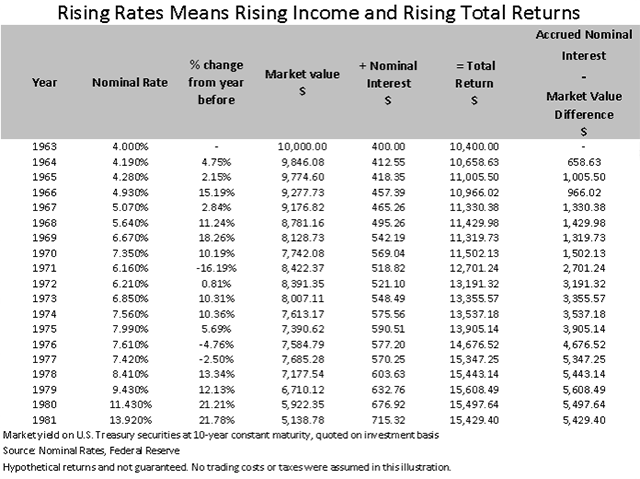
To further explore the interest income contribution to total return, I modeled rising interest rates with two sets of hypotheticals, a theoretical and a portfolio model. The theoretical model is an NPV discounting calculation, plus accumulated interest. The portfolio model assumes annual purchases and an aggregate maturity value that combines the reduced value of each bond with accumulated interest as rates go up. Though the results differed slightly in the two model types for all of the scenarios I ran, in no case did the theoretical and portfolio models contradict one another.
The following theoretical model illustrates the year-over-year nominal rate increases from 1963 to 1981 for 10-Year Treasury bonds.
From the model above, we see that interest rates climb steadily; as a result, the market values of bonds drop. Since investors lose market value on their bonds as rates rise, they have less to invest, so they buy higher coupons with smaller investable amounts. Even so, net total returns are rising because the interest income more than offsets the market loss. In this gradually rising rate period, then, the excess return from higher interest rates outpaces the market value loss long-term by 2.28% annually. The portfolio model returned 1.81% annually – less than the theoretical model, but still a positive total return. 9
The results were never negative, nor could I create a negative total return even by assuming historically steep interest rate increases. The only way the catastrophic losses that many in the industry are predicting could occur is if interest rates rose faster and more dramatically than history has ever witnessed, or if an investor’s time horizon is extremely short-term.
Cause for pause
I have been accused (fairly) of not believing too strongly in my own data. That is okay with me. I would rather be uncertain than boast a false certainty and overstate my case. As Scott Adams, the creator of Dilbert, has said, “I’m suspicious of anyone who has a strong opinion on a complicated issue.”
In that spirit, let me be clear: It would be a big mistake to go all-in with non-diversified long-term bonds. The worst thing that a money manager can do is to insist that the markets cannot disprove his or her argument; there is never a greater risk than having no doubts. And one of the worst pitfalls facing a researcher is to allow his or her theories to devolve into dogma.
There is a better chance that my research suffers from style bias than survivorship bias. Each of the five mutual funds I observed was a corporate bond fund. Rising interest rates often reflect greater economic activity and marginally higher GDP growth. Indeed, GDP gains were above-average in the 1950s, 60s, and 70s.10 Corporate bonds may enjoy a performance boost when interest rates and GDP are both rising, a correlation Elton and Gruber have postulated11 and I have observed. A money manager, then, might focus more assets in corporate rather than government or mortgage bonds if he or she felt we were in a sustained period of rising economic activity. On the other side, the only positive influence of rising GDP on government bonds is a possible ratings upgrade – and we have seen with Japanese and US government bonds that the difference between AA+ and AAA can be very little when it comes to pricing. This minimal positive effect is far outstripped by the benefits to corporate lenders, who are much more likely to avoid default, can afford to pay higher interest, and enjoy increased asset values when rising GDP boosts their profitability.
My research may also suffer from term bias. My conclusions are based on a long-term diversified portfolio of bond funds with dividends reinvested. As you extend time frames with any investment, the short-term peaks and valleys tend to smooth. Short-term returns are much more sensitive to the interest rate/bond price fulcrum than long-term returns, and short-term volatility is a concern, even for an asset like fixed-income, whose returns show relatively little variability over longer time horizons.
9. Neither trading costs nor taxes were taken into account. Had they been, lower returns would have resulted. Nor did I compound interest earned, which would have produced higher returns.
10. http://www.data360.org/dataset.aspx?Data_Set_Id=508
11. Fundamental Economic Variables, Expected Returns, and Bond Fund Performance, Edwin J. Elton; Martin J. Gruber; Christopher R. Blake, The Journal of Finance, Vol. 50, No.4. (Sep., 1995), pp. 1248
There is also one caveat to my finding that total return grows over time even amid rising rates: The return recovery after a rate shock depends on a long compounding period. Since interest rates have historically taken a long time to rise, however, I believe I am being realistic.
Finally, it is imperative to distinguish between short- and long-maturity bonds. Nothing I have said about 10-Year Treasurys would apply to 30-Year Treasurys. The 10-Year Treasury held up well in the worst bear market for bonds in history, but 30-Year Treasurys were a poor investment. I tested rising interest rates against bond funds, not coupon bonds. I have also assumed a widely diversified, equally weighted, portfolio of bond funds. One fund type is not enough.
Those are all reasons to take my findings in proper context, something that is sorely lacking from many of the warnings on the other side of the argument. Remember the article I cited earlier that argued that “even a puny rise in interest rates will slam current holders of US debt”? That article asserted that, if yields on Treasury Bonds rise just 3%, 10-Year Treasurys will decline 23.5% and 30-Year Treasurys will drop 40.7%. The problem with this is rates would have to rise 3% in one year. Rates have never come anywhere close to rising 3% in one year – 3% is not “puny.” It is absurd to make such a historically improbable estimate – much like saying that all the polar ice fields will melt if temperatures rose 3 degrees overnight. This may be true, but the fact that temperatures have only increased one-half degree Celsius in the last 100 years should restrain such wild predictions.
In each instance of rising interest rates that I studied or modeled, except for those from what some would call a tail event, the total return of a bond portfolio was positive in a rising rate environment. A tail event, something outside of expected range, would be the doubling of 10-Year Treasury bond rates within a period of 10 years, which has only happened twice in history (1972-1981 and 1973-1982). Over a five-year period, 10-year Treasury rates have never doubled. But even if that were to happen, a doubling of 10-Year Treasurys was positive in our models. The quickest that 10-Year Treasury rates have ever tripled was in 16 years, from 1967-1982. If rates tripled over the next 16 years, our models still predict a positive total return.
Art or science?
After what equity investors have suffered through in the last 10 years, we might excuse the industry for issuing dire warnings, even if a few prove to be false alarms. But it is dangerous for these warnings to be so unrealistic that the investor reacts in a self-destructive manner. These warnings teach a yield-to-crisis mentality to investors, who may overreact and avoid bonds completely or make risky bets on speculative leveraged and derivative bond products that are untested in rising rate environments. Is it a coincidence that the dire warnings often come from the same people who are developing these speculative investment products?
Moreover, these warnings gloss over the basic fact that the returns for bonds and stocks behave differently in essential ways. Long-term the average returns and standard deviation for intermediate Treasury Bonds and Treasury Bills are roughly equal, whereas, the standard deviation for stocks is roughly twice their average return. Perhaps only with bonds can you accurately state that risk equals reward. That is good news for bond buyers; it says that overall there are few surprises in either a bull or bear market.
A final word on investment models: Some analysts suggest colorfully that stocks are an art, and bonds are a science. Neither is quite true. Investment analysis will always be best-informed when it comes from historians, not artists or scientists. We are most reliable when we identify recurring or reversing trends, which is precisely what I have attempted here.
In conclusion
Rising interest rates are not what bond investors would, in an ideal world, prefer. During the 29-year declining rate environment from 1982-2010, the five bond funds whose example I looked to produced predictably better annual performance than they had in the rising rate environment – 7.85% annually versus 4.15% annually – and the real returns for bonds were significantly higher from 1980-2010 than from 1950-1980.
What lessons should you take away from my research?
- History is on the side of bond investors, even in a rising rate environment;
- The low historical variability of returns for bonds means past bear markets were much easier on bond buyers than is commonly thought;
- Interest rate increases have unfolded gradually;
- Since interest rate increases have been slow, rising interest income will outweigh the loss in principal value;
- Maturities should be shortened in a rising rate environment;
- Bond funds may perform better than individual bonds during rising rates, because of the ability to reinvest funds at progressively higher interest rates;
- Diversification across bond issuers, sectors and maturities is vital during a period of rising rates; and
- Avoid experimenting with untested products or strategies during rising rates.
For the diversified bond fund, bond index or balanced fund investor, rising interest rates are simply not the looming catastrophe they have been made out to be.
Andrew D. Martin is president of 7Twelve Advisors, LLC, an SEC registered investment adviser, and a registered principal for Girard Securities, Inc., a San Diego based broker/dealer. He holds the series 7, 24, 53, 63 and 66 licenses.
Read more articles by Andy Martin