Vitaliy Katsenelson, CFA, is chief investment officer at Investment Management Associates, Inc., a Denver-based money management firm. Vitaliy is also the author of the highly acclaimed books The Little Book of Sideways Markets (Wiley, 2010) and Active Value Investing: Making Money in Range Bound Markets(Wiley, 2007). His web site is Contrarian Edge.
We spoke with Vitaliy on December 20, 2011.
Paul Krugman wrote about China in his New York Times column last Monday. That’s a topic that you have researched closely. He said that "China’s story just sounds too much like the crack-ups we’ve already seen elsewhere," referring to the financial crisis in the US and the Japanese lost decade. Do you agree with his assessment?
Yes. You can draw a lot of parallels between the Japanese and US real estate bubbles. But China’s bubble is much larger; it spreads beyond residential real estate to commercial real estate, the industrial sector, and infrastructure. Also, though there were government fingerprints on the US and Japanese real estate bubbles, the Chinese real estate bubble was directly and entirely caused by the Chinese government.
The Chinese bubble has been inflating for years. It should have popped during 2008 recession. But China fire-hosed a stimulus equal to 12% of its GDP into its economy and was able to keep the bubble growing.
When is it going to pop? It has already begun. You see sales volumes and prices plummeting at double-digit rates in second-tier cities.
I agree with Krugman’s assessment. What perplexes me is why the Nobel Prize-winning economist wrote this column now, when the problems he describes are plain for all to see, and not a few years ago. You’d think he would have been alarmed over the consequences of monstrous government intervention in an economy the size of China’s. But perhaps Krugman, who describes himself as a liberal economist, secretly hoped that the Chinese government would be able to manage the economy better than the free market.
But even over the last few years China’s growth has remained relatively strong – certainly as compared to the rest of the world – just not as strong as it was in the years prior to that.
It was completely driven by fixed-asset investment and the bad loans that came with that – not a sustainable type of growth.
One of the things Krugman pointed to was the lack of reliable data from the Chinese government. To what extent does that cloud your analysis, and how certain can you be in your forecast and your analysis, given the uncertainty, or unreliability, of Chinese government data?
He is right. When you look at Chinese government data, it has a couple of biases. Number one is in the way they collect data: it comes from municipalities and local governments that are given growth targets. The federal government says, “You need to grow, let's say 10% of GDP per capita, for your municipality.” The local bureaucrat has to get that growth. The easiest way to do it is to build, and that is why they have had a real estate bubble.
But the problem is, if the local bureaucrats fail to deliver the growth they know they'll lose their jobs. So they start cooking the numbers, and they start sending numbers to the top that are falsified. That is the number one bias.
The second bias is that this is a government that is very concerned about its image. It is very good at propaganda. The government puts people in jail for writing anti-government articles. The economic statistics are the output of a propaganda machine. You truly can't trust the data coming from the government.
But that is why you look at anecdotal evidence, and the data points they can't or just don't bother to cook. During the 2008-2009 recession, the global economy was contracting and the Chinese government was showing that GDP was growing at a fairly healthy pace. However, other data points, like the tonnage of goods shipped through railroads, were down by double digits. Electricity consumption declined too.
Eventually, we started seeing empty cities popping up here and there.
What made it easy for me to understand China is that I was raised in Soviet Russia for the first half of my life. This experience helped me to understand how inefficient, dysfunctional, and corrupt an economy that is run by the government can be. You start seeing and piecing together the small bits of anecdotal evidence. You build a framework that helps you to understand their economy.
Are there any policy options that are still available to the Chinese government, for example, stimulus measures that it could take to avert the kind of crisis that Krugman predicts and that you say is already occurring?
I am fairly certain that, once the pain of economic slowdown is felt, the government will do what it did in 2008: It will try to re-inflate the bubble. But that will add another layer of future problems on top of the existing ones. For instance, according to Pivot Capital, toxic shadow banking, which was almost nonexistent in 2008, is estimated to be $250 billion in 2011. The Chinese government may manage to keep the bubble from bursting for a little longer, but at some point the basic laws of economics will assert themselves, and there is absolutely nothing the Chinese will be able to do.
What will be the spillover effect in the United States?
This is very interesting. Look at what is going on in Europe today. Let's say the euro will not blow up. In other words, Europe is still going to have a monetary union consisting of the same 17 members going forward, but a byproduct of that will be austerity, and they will consume less. We are going to sell fewer goods to Europe. Europe will be consuming fewer goods from Japan and from China. So what happens in Europe could accelerate what is already happening in China, and that may hasten the bursting of its bubble.
Japan’s largest trading partner is not the United States, but China. (China accounts for of 19.4% of Japanese exports; the US is only 15.7%.) We are all concerned about Europe, but Japan is in much worse shape than Europe. Italy has debt-to-GDP of 120% and it is paying 7% for its 10-year bonds, while Japan’s debt-to-GDP is over 200% and its 10-year bonds yield less than 1%. Japan has even worse demographics than Europe, which is hard to imagine. The Japanese government was able to amass an enormous pile of debt because it borrowed internally from its citizens, who had a very high savings rate. The savings rate, however, has declined over the last decade as Japanese society ages. The economic crisis in China will likely cause much higher unemployment in Japan and thus a further decline in the savings rate.
Suddenly, the Japanese government will have to borrow money externally, and US and European investors will not be buying Japanese 10-year bonds for 1%, I assure you. Even bigger budget deficits will result – and Japan is already running 8% shortfalls – or the Japanese will print money, which will cause huge inflation. Most likely, both will be the case.
China may accelerate the bursting of the Japanese debt bubble. The Japanese bubble has been developing for a long time. We may see contagion in ways we haven’t seen before. Of course, the obvious consequences are in the area of industrial commodities. Because China builds so much, it consumes a lot of them, and their prices will plummet. Also, commodity-exporting countries (Australia, Brazil, and others) that appear immune to the tornadoes sweeping through the global economy will suffer. It is very likely that we’ll see much higher global interest rates.
The collapse of Chinese residential real estate will make a lot of Chinese angry. The Chinese government set bank interest rates at below-inflation levels, thus pushing its citizens into becoming real estate speculators. A collapse in real estate prices will wipe out a huge chunk of generational wealth and may cause political unrest. We are seeing a lot of stories already of people who bought homes and condos, lost 30% in just a few months, and are now storming offices of real estate developers to demand refunds.
Let's turn to Europe. Do you see an inevitable outcome for that region in terms of how it will resolve the crisis over the euro and its member nations’ sovereign debt?
There is a very high probability that the European Union will become more fiscally integrated. This crisis will bring them closer, not pull them apart.
It is like getting married and having 20 children – it is very difficult to get divorced. If the monetary union falls apart, the weak countries – Spain, Greece, etc. – will suffer tremendously, because if they have to convert back to their own currencies their banking systems will collapse almost overnight. Everybody will rush to the banks to get their money out, which is already happening in Greece to some degree. Their debts will be in euros, and their local currencies will depreciate.
The strong countries will suffer as well, especially Germany, since it is a very large exporter to the rest of Europe. If Germany leaves the European Union, then the deutschemark will appreciate, and it will hurt their economy.
German banks have huge exposure to the rest of Europe. By bailing out Europe, Germany is basically bailing out its own banks. Germany cannot bail out all the weak countries. Germany, because of what happened during the Weimar Republic, does not want to do that, because they fear inflation. They saw what inflation did. But they’ll have little choice.
I never thought I’d say this, but printing money is a lot more democratic than bailing out other countries. I believe Europe will print.
There is a 70% probability that the European countries will become much more fiscally integrated than they were before. However that will be accompanied by austerity. Austerity means government deleveraging, which will bring higher unemployment. At some point you may have people rioting in the streets, as has happened in Greece. I can see people saying, “If being in the monetary union means we don’t have jobs, then we want no part of it.”
Just to be clear, for Europe to remain integrated, does it require what you describe as “printing more money”? Is that essentially having that ECB buy the bad sovereign debt that is on the books of the banks?
What we keep learning is that financial geeks are very creative, even more creative than the geeks in the Silicon Valley, and they find vehicles that we didn't even know existed. I never thought the IMF would be able to put in place a bailout mechanism for Europe. But Italy will contribute $23.5 billion to the IMF to bail out itself! I've learned never to underestimate the creativity of financial geeks, and they have a lot of them in Europe.
I have no idea exactly how they are going to print money, but they will figure out a way to do it. It's going to be through the ECB, and through euro-bonds or through some other vehicle that we don't know about yet. We are going to have a much greater money supply in Europe.
Will they avoid inflation, because at the same time they will be undergoing a deep recession?
To some degree they will, because the prices of necessities will go up, and at the same time wages will stagnate or decline (as unemployment rises). So it is very difficult to say right now. You are going to have a much greater money supply, but you don't know what's going to happen to the velocity of money and thus inflation.
Let's turn to the United States. You've written about the fact that the US is in a sideways market. What do you mean by that? More importantly, where are we are now in that cycle and what is the timing, in terms of when we will emerge from the sideways market into either a bull or a bear market?
Think about market cycles in this way. In the long run, stock-price returns come from earnings growth and from change in price-to-earnings ratios. In the very long term, changes in price-to-earnings tend to cancel each other out, so therefore in the very long run stock prices really go up with earnings growth, which equals GDP growth. In the shorter term, a combination of earnings growth and change in the P/E gives you the return for the stock market. You add dividends on top of that, and now you have total stock market returns.
Whenever you have a secular bull market, which lasts about 15 years (plus or minus a few), you have two elements. You have earnings growth and price-to-earnings ratios that are expanding. At the beginning of the bull market, price-to-earnings ratios are very low, let's say seven to 10. By the end of the bull market, the ratio has run through the average to an above-average level, let's say to the 20s.
A sideways market happens at the end of a bull market. Earnings are still growing during a sideways market. P/Es, though, are declining, going from above-average to below-average. Earnings growth and P/E contraction cancel each other out, and this is why the market goes sideways.
When I say sideways, don’t confuse it with a kind and placid market – there can be a lot of volatility and a lot of cyclical bear and bull markets embedded in a sideways market. In fact, the last sideways market, from 1966-1982, included five little bear markets and five little bull markets – so a lot of volatility.
Finally, you have a third type of secular market. It is the bear market, which happens a lot less often than you would think. Bear markets start with high valuations, which we had in the late 1990s, and prolonged contacting earnings. So you have two negatives, declining earnings and declining P/Es. Together you have very poor returns, because you add two negatives.
Over the last 10 or 11 years earnings have grown and P/Es have contracted, so we've been in a sideways market.
Going forward, are we going to be in a sideways market or a bull market?
This is where I just gave you a framework, and you can use your own assumptions. If we're still going to have positive growth in the long run, then we are still going to be in a sideways market. If we are going to have a contracting economy for a long period of time, however, then all the bets are off and we are in a bear market, as today’s valuations are still high. I am not saying this because I am hedging my bets. This is a very simple framework, and all you have to do is figure out one thing: Are we going to have economic growth, or not?
What is your answer to that question?
In the context of what is going on Europe, China, Japan, and the US, the next decade will be payback time for all the partying the global economy did previously. Our economy will still grow, but at a slower rate.
Actually, let me clarify this: It is the nominal earnings growth rate that really matters. So even if real earnings growth is low, there is a good chance that inflation will pick up and the nominal growth rate will be higher than we are used to. So you have to make an assumption about what will happen to inflation and deflation in the future as well.
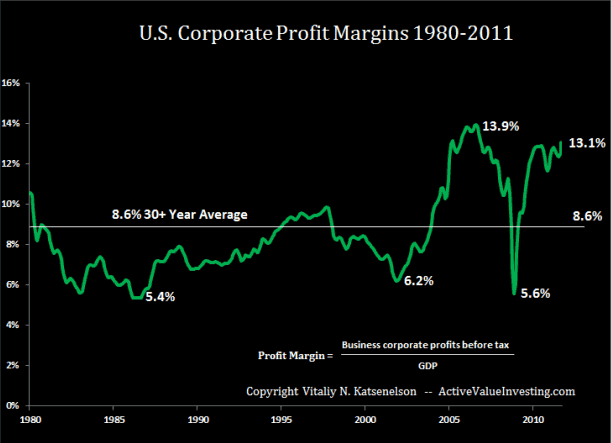
The second part is this: How long until the end of the sideways market? This is where it gets tricky. The market is only cheap today because profit margins are still high. Corporate profit margins are about 50% above their average [see the chart below]. Once margins start normalizing (or, in this instance, decline), profits will either stagnate or fall. So the market is not cheap.
Sideways markets end with lower P/Es, with one important point caveat: P/Es can stay at below-average levels for a while. Right now, we are at average to slightly above-average P/E ratios, if you normalize earnings for current profit margins. If you assume that we need to spend some time at below-average P/E levels, then we still have some pain ahead. We still have at least five or 10 years of sideways market left before we get to the below-average P/Es, and we could stay there for a while. So we are not there yet.
But the good news is that once sideways markets end, it is usually bull market time.
You are saying that unusually high profit margins are holding up valuations right now, and that eventually there will be a reversion to the mean. But can't profit margins stay at a high level for a long period of time, just as you said that P/E multiples can remain in a low range for a long period of time? Can't this reversion to the mean occur over a protracted period?
Profit margins usually can’t hang in there as long as P/Es – just a few years. Because when one company starts making abnormal profits, competition comes in and erodes those profits.
Let me give you this example. Apple made terrific iPhone and iPads. Several years later, there is now a lot of new competition that has introduced products that are almost as good, or products that are not as good but are much lower-priced (such as Kindle Fire). And guess what? At some point, Apple, to be competitive, is going to have to lower its prices; and therefore its profit margins, which are at their highest level ever, will have to decline.
The same thing applies for the economy as a whole, with some exceptions. There are some industries that can maintain high margins for a long period of time. But for the economy overall, competition either forces lower prices or offers products or services that have more features for the same price, and in the end profit margins decline.
Why don't we turn to one of your stock selections. I saw you wrote recently that Microsoft is a company you like. It is also one of Seth Klarman’s holdings. How can it be that a stock as prominent as that, which is followed by as many analysts as it is, can offer the margin of safety that a value investor like you would require?
That’s what is interesting. If I gave you Microsoft’s financial statements and I didn't tell you what company it was, you would say it was an incredible business. The company has more than doubled its earnings over the last five years and has a huge, cash-rich balance sheet, an enormous return-on-capital of nearly 40%, enormous cash-flow generation, and a near-monopoly in a lot of businesses where it operates.
Then you look at the stock price and you say, “Huh, this company hasn't gone anywhere for the last 12 years.” Microsoft, to some degree, is a very typical sideways-market stock. Its P/E was extremely high and its earnings were very high at the end of the last bull market, and its P/E collapsed. Its P/E was 50; and now, if you take out cash, it is at about 6.5 to 7 times earnings. There is a psychological element, where people look at the stock price and are fatigued by the nonperformance of the stock.
But there is another element that is very specific to Microsoft. Even if you take the sideways market psychology into consideration, this company should not be trading at this valuation. Wall Street lost confidence in the company's management. Microsoft’s business was so good that it was able to grow earnings on autopilot.
There is a lot more competition now, like Google and Apple. They are very strong financially. They're dominating their main markets.
The market is saying Microsoft is going to become a dinosaur. It's going to decline into obsolescence. This is where Klarman and I disagree with the consensus.
Look at Windows Vista; it was a horrible product. But it was still a financial success, because Microsoft had a monopoly. Then Windows 7 took over from Windows Vista and fixed it. Windows 7 was not an innovative product, but it was a good solid product.
Then, a few months ago, Microsoft showed Windows 8, which is going to come out next year. This was the first time I looked at a Microsoft product and said “Wow!” It was created by a company that is paranoid about competition, not something that Microsoft ever was before. It is a very good product that is going to work not only on PCs and laptops but also on tablets, which is very important, because tablets are the piece that Microsoft was missing.
Apple and Google were attacking Microsoft on the tablet front, and Microsoft did not have a product. Microsoft used to sell Windows for Netbooks, which were underpowered laptops. That category of products is gone. Microsoft is going to have a very solid product with which to compete against Apple and Google next year.
What are your thoughts on the new partnership between Microsoft and Nokia?
What I really like is that Microsoft did something uncharacteristic of itself. It did not go out and buy a company, but created an alliance with a company that was extremely desperate for an alliance – Nokia. Nokia was always great at making cell phones and hardware. But when the smart phones came around, Nokia could not come up with good operating-system software.
Then Nokia’s new CEO, who came from Microsoft, struck a deal by which Nokia is going to bet its future on Microsoft software. All the smart phones that Nokia is going to make in the future will be based on Microsoft Windows. Nokia came out with its first smart phone a few months ago in Europe, and it has received great reviews.
What is important about Nokia and Microsoft together is that to be successful in this market you have to have the marriage of hardware and software. That's why the companies are working together on developing software.
Microsoft says its Nokia alliance is going to be an accelerator. It is going to allow them to bring cellphones to the market very quickly. Nokia still has a very good brand name in Europe, and it has a tremendous distribution network.
Finally, you have a new trend that the media will be making a huge deal over the next three to six month: ultrabooks. They are thin, beautiful, powerful laptops. Basically, Intel did something brilliant; it trademarked the term ultrabook. They are going to spend a couple hundred million dollars promoting the brand. If you are a PC-maker, and you want to make an ultrabook, it will have to meet very specific criteria that Intel has spelled out: It has to be light, have a solid-state drive, a fast boot time, and a long battery life.
You are already seeing these ultrabooks hitting the stores, and we are going to see a lot more of them. Right now they are expensive, but the price will come down soon. They are going to make Windows products sexy again.
Now you have a company – Microsoft – that's actually doing smart things, and its stock price is incredibly cheap. It has a terrific balance sheet that is still based on a monopoly, for the most part. And you can buy it at one-third the multiple of the market. It’s a no-brainer.
That's why Seth Klarman owns it, and we own it, too.
Read more articles by Robert Huebscher