One of the most popular variable annuity riders is the guaranteed lifetime withdrawal benefit (GLWB), which offers downside protection through lifetime income, upside potential with step-ups based on market performance, and minimal surrender penalties. But, examining historical data, I have found that those riders carry a cost that will not be readily apparent to retirees: their cash flows rapidly decrease on an inflation-adjusted basis.
Moreover, GLWB riders, which are also known as guaranteed minimum withdrawal benefits (GMWBs), compare unfavorably to the cash flows a retiree would obtain using a systematic withdrawal plan.
Vanguard made headlines recently with its offering of a GLWB rider that costs less than nearly all of its competitors. This product is attracting lots of attention as retirees seek guaranteed income sources in the face of market turbulence. Vanguard is marketing it on behalf of two insurers, and the retiree is still exposed to the credit risk of those insurers. The rider for its variable annuities guarantees an income for life at a fixed withdrawal percentage of the initial contracted assets. As long as one does not exceed the allowed withdrawal amounts, guaranteed withdrawals never decrease (in nominal terms) even if the account balance falls to zero. In this regard, GLWBs share similarities with immediate annuities, though a GLWB contract can be terminated and remaining assets can be returned. Additionally, if the contract value of the underlying account increases enough in value after accounting for any withdrawals and fees, a step-up feature may kick in to provide permanently higher withdrawal amounts.
For Vanguard’s recent offering, the GLWB rider has an annual fee of 0.95% of the total withdrawal base (this is the amount used to calculate the guaranteed withdrawals and may often be more than the contract value of remaining assets) on top of the 0.59% fees on the underlying assets held in a Vanguard variable annuity.
But do these products provide guarantees of any real value to their users? I won’t attempt to evaluate the actuarially fair cost for the GLWB guarantee to determine if they are over- or underpriced. Others have done important work in that area, such as Advisor Perspectives’ analysis and a rather heated discussion with Morningstar that ensued. I acknowledge such disagreements about the actuarial value of the guarantees, and that such products’ values are difficult to objectively quantify.
Those issues aside, I remain concerned that prospective retirees may be overvaluing the guarantees in their mind because they are not properly considering how inflation will erode their real value over time. In behavioral economics, this bias is known as money illusion. People can logically understand the effects of inflation, but their emotional responses and decisions remain attached to nominal values.
The guarantees are not inflation-adjusted and would have been worth little in rolling periods of U.S. historical data. Moreover, it would have been rather easy to replicate the GLWB guaranteed withdrawal amounts using a systematic withdrawal plan that is not guaranteed and does not require a rider. Benefiting from GLWB guarantees would require worse circumstances than any historical stretch so far. It’s important to note, however, that U.S. financial market history has been very kind to retirees. A new worst-case scenario could await those of us for whom retirement lies in the uncertain future. But these guarantees depend on the insurance company’s ability to pay, which could be at risk if the overall financial landscape gets bleaker.
Data and modeling approach
I used Ibbotson Associates' Stocks, Bonds, Bills, and Inflation (SBBI) data on total returns for U.S. financial markets since 1926. For the purposes of my inquiry, I used the U.S. S&P 500 index to represent the stock market and the intermediate-term U.S. government bond index to represent the bond market. In all cases, returns are calculated on an annual basis with withdrawals taken at the beginning of each year, fees taken at the end of each year and annual rebalancing. I investigated performance over rolling 30-year periods taken from the historical data. This covers 56 rolling periods between 1926 and 1981.
For the GLWB, I used Vanguard’s offering as the basis for many assumptions, though I did not model it exactly. For instance, I used annual instead of quarterly data, and I used index returns rather than the returns from Vanguard’s specific underlying variable annuity. My GLWB has a 0.59% annual fee on the contract value of the remaining assets in the variable annuity, and it has an annual rider of 0.95% of the total withdrawal base. That base is always at least as large as the remaining contract value, which is used to calculate the annual withdrawal amount. When GWLB assets reach zero, fees stop, but the guaranteed withdrawals continue. To simplify the scenario, I assumed the GLWB was purchased for a single male on his 65th birthday. It provides a 5% withdrawal amount of the initial assets and steps up if and when the total withdrawal base increases. The GLWB owner withdraws precisely the maximum allowable amount each year within the terms of the contract to maintain the guarantee. The GLWB asset allocation is 65/35 for stocks/bonds, as using the highest possible stock allocation gives the best chance for step-ups, and Vanguard’s Balanced Portfolio variable annuity is the most aggressive option, with approximately this allocation.
Guarantees and money illusion
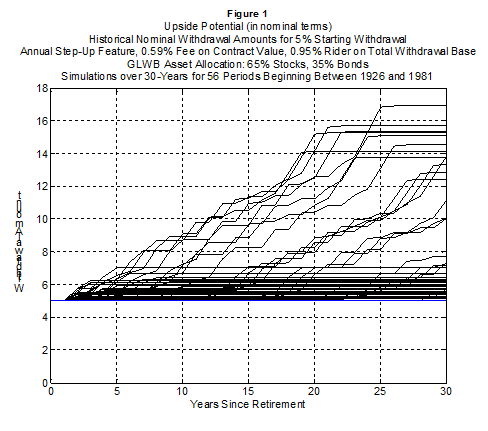
First, consider the potential upside of a GLWB with the relatively low Vanguard-style expenses and the annual step-up feature. Figure 1 shows the path of withdrawal amounts for each of the 56 rolling 30 year periods starting between 1926 and 1981. This is provided for reference, but figure 1 only shows nominal withdrawals. Anyone considering a GLWB should instead focus on real withdrawal amounts.

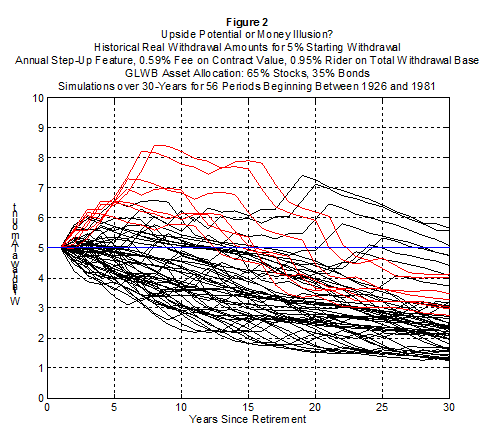
Figure 2 shows the real withdrawal amounts, adjusted for the historical consumer price inflation data. After 30 years, GLWB withdrawal amounts met or exceeded their initial levels in real terms in only three of the 56 periods (5.4%). Incidentally, these three years were 1979, 1980, and 1981, when maximum sustainable withdrawal rates (MWRs) were quite high anyway – equity markets were just beginning the long boom period of the early 1980s. An MWR for a retirement year is the highest initial withdrawal amount, as a percentage of retirement date assets, that can be adjusted for inflation in subsequent years without depleting the account balance before the end of 30 years. In a number of cases, the guaranteed spending amounts after 30 years may be only 20-30% of the initial level in real terms.
One other consideration in assessing these results relates to the seven deflationary scenarios, which are colored red for convenience. These are the paths for retirements beginning between 1926 and 1932, when retirees would have experienced the Great Depression and deflation in their early retirement years. From the start of 1926 to the start of 1933, the price level dropped 27%. This provides a rare case when a nominal withdrawal amount actually provided 27% more in real than nominal terms. I assume that GLWB users withdraw their full guaranteed amount, but retirees during deflationary periods might reasonably be expected to reduce their nominal spending, which also better preserves the contract value of their GLWB assets.
Replicating GLWB withdrawals with a systematic withdrawal plan
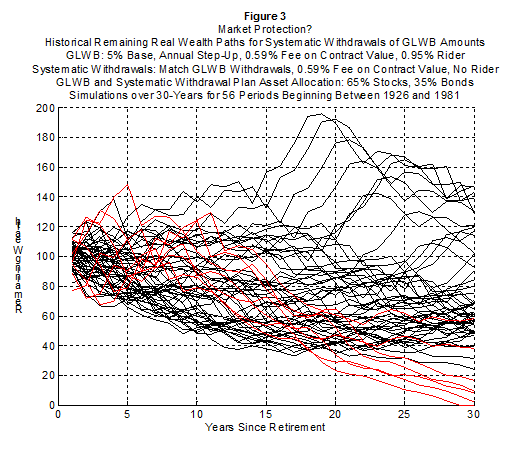
Would a systematic withdrawal plan, in which retirees make withdrawals without any guarantees from their accumulated wealth, have ever failed to match the GLWB withdrawals? Figure 3 explores this for a systematic withdrawal plan with a 0.59% annual fee. Retirees withdraw the specific guaranteed amounts for a GLWB with a 0.95% rider and a 0.59% fee on the contract value. If remaining wealth never falls to zero, then systematic withdrawals would have never failed to provide the withdrawal amounts guaranteed by the GLWB, based on historical data. Aside from deflation, which forced retirees to withdraw more than 5% in real terms and caused the 1929 retiree to run out in year 29, a systematic withdrawal plan would not have failed to provide the guaranteed withdrawals over any 30-year period. In a number of simulations, the additional cost of the rider would have sent the contract value of the GLWB to zero, but in no case did a systematic withdrawal plan fail to match the GLWB withdrawals.
A comparison for 1966 retirees
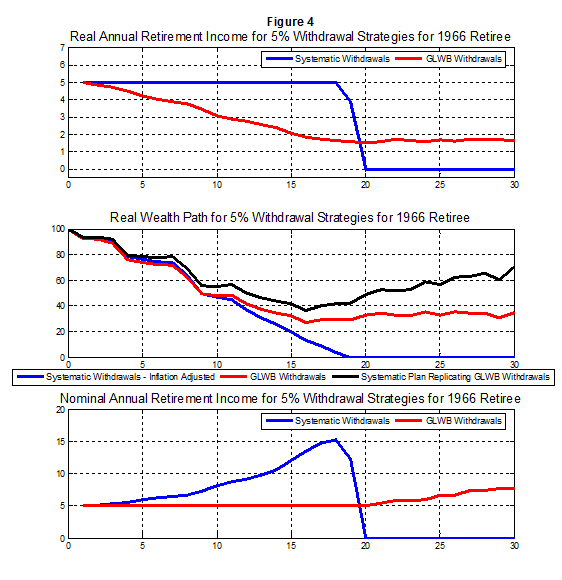
To fully understand the underlying cost of a GLWB rider, it is useful to examine what would have happened to someone who had the bad luck to retire in 1966. Because of the bear market in equities and high inflation that followed, individuals retiring that year would have had the lowest sustainable withdrawal rates of any among the 56 cohorts studied. Even for that unfortunate group, a systematic withdrawal plan would still have been superior to a GLWB rider.
Usually we think of systematic withdrawal plans as providing an inflation-adjusted withdrawal amount. The withdrawal rate is 5% in real terms. But the GLWB withdrawals are 5% in nominal terms, with the potential for upward adjustments. The GLWB user always withdraws the maximum amount allowed for keeping the guarantee in place, and the GLWB user chooses a 65/35 asset allocation to maximize the probability for step ups. As I assume a conservative retiree, the systematic withdrawal plan user chooses a 40/60 asset allocation and pays annual fees of 0.59%.
While the two retirees start with the same income, the income for the GLWB retiree declines rapidly in real terms. By year 15, the GLWB is providing a benefit amount that is approximately 40% of the initial 5% withdrawal in real terms. The systematic withdrawal plan continued providing inflation-adjusted withdrawals until year 19, when the last of the wealth was used. While the GLWB continues providing guaranteed income worth about 30% of the initial value in real terms, those who employed this strategy experienced dramatically lower income in the earlier years, when the retiree enjoyed a much higher probability of still being alive.
The second part of figure 4 shows how, in real terms, the contract value of the GLWB stabilizes at about 35% of the initial value after about year 15, but this is primarily because the value of the GLWB withdrawals are so low by this point. In fact, the black curve is the path of remaining wealth for a systematic withdrawal plan (with a 65/35 asset allocation as well), replicating these lower GLWB withdrawal amounts without paying a rider; 71% of initial assets remain after 30 years in real terms, and in nominal terms this is a factor of 3.33 times retirement date wealth.The difference between the black and red curves is explained solely by the compounding impact of the 0.95% GLWB rider on the total withdrawal base.
The last part of the figure shows that for the 1966 retiree, the first step up does not occur until the 20th year of retirement. These step ups are what help to keep the real withdrawal amount stabilized at about 30% of its initial value in subsequent years.
The bottom line
Retirees may find “peace of mind” from the guarantees a GLWB provides. Perhaps the guarantee would stop retirees from panicking and selling stocks after a market drop. Moreover, if retirees do have a tendency to reduce their spending as they age, it may not be necessary for them to maintain a fully inflation-adjusted income. GLWB guarantees may also come in handy if people live beyond a 30-year retirement horizon. Perhaps most importantly, I have conducted research that suggests that withdrawal rates may fall dramatically below 4% for recent retirees. Should that prove to be the case, retirees could possibly benefit from the guarantees.
Nevertheless, there are several important points that advisors and their clients should consider when evaluating GLWBs. For one thing, the nominal withdrawal amount guaranteed by a GLWB can become quite small in real terms, and money illusion biases may prevent clients from properly appreciating this drawback. What’s more, GLWBs rarely provide inflation protection, and they are least likely to do so during inflationary periods or periods with poor equity returns. In the event that someone replicating GLWB withdrawals on his or her own runs out of wealth, an outcome that no investor has faced historically, then GLWB owners will surely worry about the risk of default for the insurer. And it’s important to note that the GLWB considered here is a best-case scenario for GLWBs with relatively low fees. Higher fees would erode the account balance more quickly, allowing for fewer step ups, more exposure to inflation, and making it even easier for systematic withdrawals to match GLWB withdrawal amounts.
It is possible that purchasing a fixed single-premium immediate annuity (SPIA) would generally enable retirees to obtain a guaranteed income source more cheaply. Financial planner Joe Tomlinson refers to GLWBs as “actuaries gone wild,” due to their complex combination of downside protection and upside potential. It may be more straightforward to treat these important needs separately, which is a proposition I plan to examine in a future article.
Wade Pfau, Ph.D., CFA, is an associate professor of economics at the National Graduate Institute for Policy Studies (GRIPS) in Tokyo, Japan. He maintains a blog about retirement planning research at wpfau.blogspot.com
Wade wishes to thank Peter Benedik, CFA, Jason Branning, CFP®, Robert P. Seawright, J.D., and Joseph Tomlinson, FSA, CFP®, for providing him with helpful feedback on an earlier draft of this article.
Read more articles by Wade Pfau